Thank you for visiting SNEWPapers!
Sign up free
The Daily Worker
Chicago, Cook County, Illinois
What is this article about?
U.S. Commerce report details exploitation of Austrian workers by international capital under League of Nations, with wages as low as 5.7c/hour in May 1925, failing to match 31% rise in living costs since 1914, lowering family standards.
Merged-components note: Austria wages table is embedded in the text discussing exploitation under the League of Nations.
Clipping
OCR Quality
Full Text
WORKERS OF SUBJECT COUNTRIES,
WAGES GO DOWN, LIVING COST RISES
By LELAND OLDS
(Federated Press Industrial Editor)
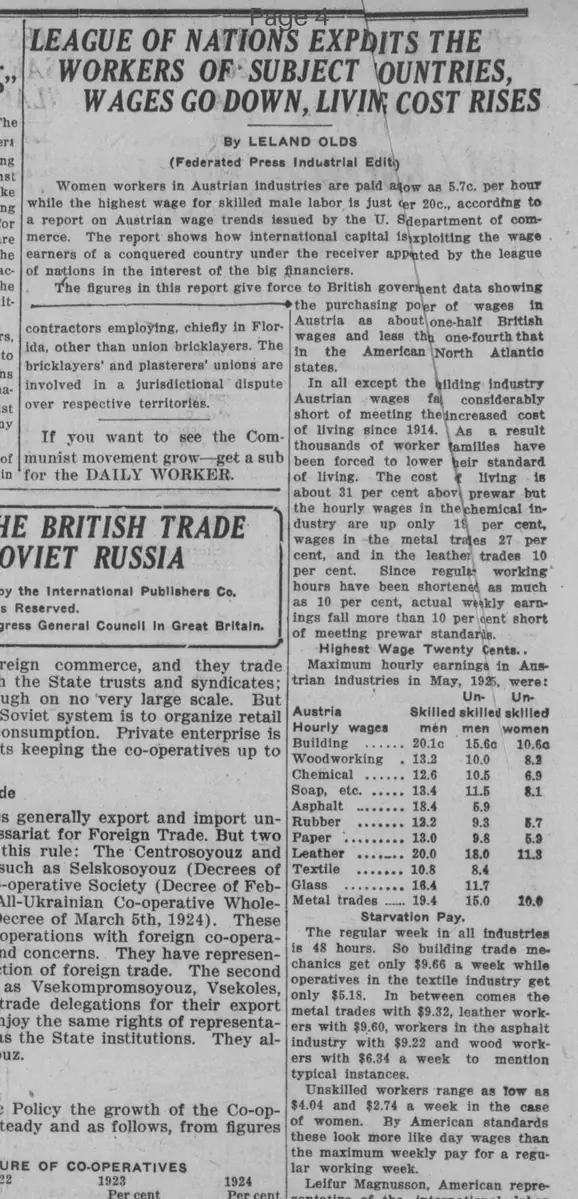
Women workers in Austrian industries are paid now as low as 5.7c. per hour while the highest wage for skilled male labor is just over 20c., according to a report on Austrian wage trends issued by the U. S. department of commerce. The report shows how international capital is exploiting the wage earners of a conquered country under the receiver appointed by the league of nations in the interest of the big financiers.
The purchasing power of wages in Austria is about one-half British wages and less than one-fourth that in the American North Atlantic states.
In all except the building industry Austrian wages fall considerably short of meeting the increased cost of living since 1914.
As a result thousands of worker families have been forced to lower their standard of living. The cost of living is about 31 per cent above prewar but the hourly wages in the chemical industry are up only 19 per cent, wages in the metal trades 27 per cent, and in the leather trades 10 per cent. Since regular working hours have been shortened as much as 10 per cent, actual weekly earnings fall more than 10 percent short of meeting prewar standards.
Highest Wage Twenty Cents.
Maximum hourly earnings in Austrian industries in May, 1925, were
Starvation Pay.
The regular week in all industries is 48 hours. So building trade mechanics get only $9.66 a week while operatives in the textile industry get only $5.18. In between comes the metal trades with $9.32, leather workers with $9.60, workers in the asphalt industry with $9.22 and wood workers with $6.34 a week to mention typical instances.
Unskilled workers range as low as $4.04 and $2.74 a week in the case of women. By American standards these look more like day wages than the maximum weekly pay for a regular working week.
| Austria | Skilled | skilled | skilled | Skilled |
| Hourly wages | men | men | women | women |
| Building | 20.1c | 15.6c | 10.6c | 10.6c |
| Woodworking | 13.2 | 10.0 | 8.2 | 10.0 |
| Chemical | 12.6 | 10.5 | 6.9 | 10.5 |
| Soap, etc. | 13.4 | 11.5 | 8.1 | 11.5 |
| Asphalt | 18.4 | 5.9 | 10.0 | 18.4 |
| Rubber | 12.2 | 9.3 | 5.7 | 12.2 |
| Paper | 13.0 | 9.8 | 5.9 | 13.0 |
| Leather | 20.0 | 18.0 | 11.3 | 20.0 |
| Textile | 10.8 | 8.4 | 10.8 | 10.8 |
| Glass | 16.4 | 11.7 | 10.8 | 16.4 |
| Metal trades | 19.4 | 15.0 | 10.0 | 19.4 |
What sub-type of article is it?
What keywords are associated?
Where did it happen?
Foreign News Details
Primary Location
Austria
Event Date
May, 1925
Outcome
wages fall short of increased cost of living since 1914, forcing thousands of worker families to lower standards; purchasing power about one-half british wages and less than one-fourth american north atlantic states wages.
Event Details
Women workers in Austrian industries paid as low as 5.7c. per hour, highest for skilled male labor just over 20c., per U.S. Department of Commerce report. International capital exploits wage earners of conquered country under League of Nations-appointed receiver for big financiers. In all except building, wages do not meet cost of living rise. Regular week 48 hours; examples include building mechanics $9.66/week, textile operatives $5.18/week.