Thank you for visiting SNEWPapers!
Sign up free
Story
March 19, 1849
Lynchburg Virginian
Lynchburg, Virginia
What is this article about?
Article criticizes U.S. Navy captains charging freight on specie aboard warships, an inconsistent practice copied from British Navy but unequally distributed; argues for abolition or fair sharing to end corruption and duty neglect, especially relevant to California trade. (248 characters)
Clipping
OCR Quality
95%
Excellent
Full Text
FREIGHT ON SPECIE.
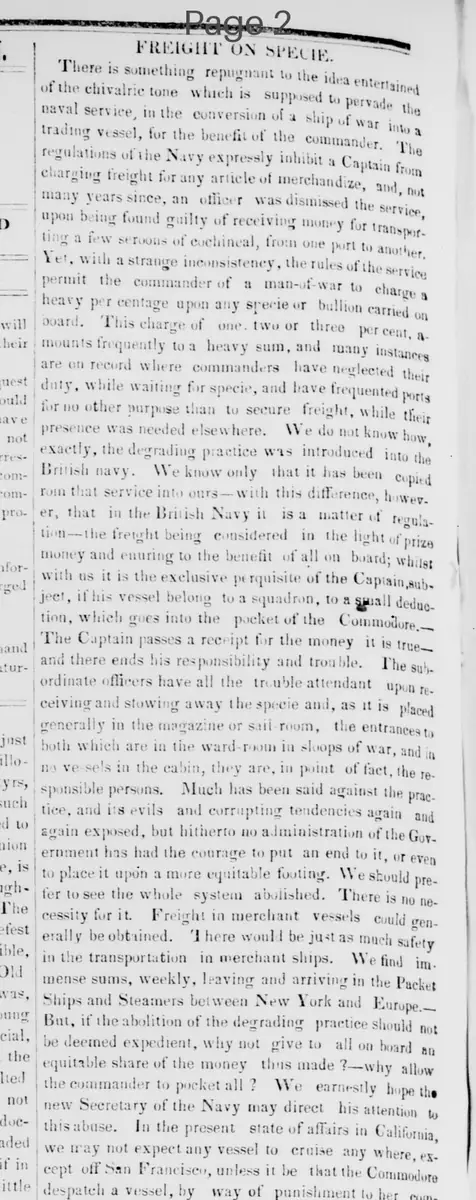
There is something repugnant to the idea entertained of the chivalric tone which is supposed to pervade the naval service, in the conversion of a ship of war into a trading vessel, for the benefit of the commander. The regulations of the Navy expressly inhibit a Captain from charging freight for any article of merchandize, and, not many years since, an officer was dismissed the service upon being found guilty of receiving money for transporting a few strokes of cochineal, from one port to another. Yet, with a strange inconsistency, the rules of the service permit the commander of a man-of-war to charge a heavy percentage upon any specie or bullion carried on board. This charge of one two or three per cent, amounts frequently to a heavy sum, and many instances are on record where commanders have neglected their duty, while waiting for specie, and have frequented ports for no other purpose than to secure freight, while their presence was needed elsewhere. We do not know how, exactly, the degrading practice was introduced into the British navy. We know only that it has been copied from that service into ours—with this difference, however, that in the British Navy it is a matter of regulation—the freight being considered in the light of prize money and enuring to the benefit of all on board; whilst with us it is the exclusive perquisite of the Captain, subject, if his vessel belong to a squadron, to a small deduction, which goes into the pocket of the Commodore.—The Captain passes a receipt for the money it is true—and there ends his responsibility and trouble. The subordinate officers have all the trouble attendant upon receiving and stowing away the specie and, as it is placed generally in the magazine or sail room, the entrances to both which are in the ward room in sloops of war, and an no vessels in the cabin, they are, in point of fact, the responsible persons. Much has been said against the practice, and its evils and corrupting tendencies again and again exposed, but hitherto no administration of the Government has had the courage to put an end to it, or even to place it upon a more equitable footing. We should prefer to see the whole system abolished. There is no necessity for it. Freight in merchant vessels could generally be obtained. There would be just as much safety in the transportation in merchant ships. We find immense sums, weekly, leaving and arriving in the Packet Ships and Steamers between New York and Europe.—But, if the abolition of the degrading practice should not be deemed expedient, why not give to all on board an equitable share of the money thus made ?—why allow the commander to pocket all ? We earnestly hope the new Secretary of the Navy may direct his attention to this abuse. In the present state of affairs in California, we may not expect any vessel to cruise anywhere, except off San Francisco, unless it be that the Commodore despatch a vessel, by way of punishment to her commander, to some point where he could render service to American commerce.
There is something repugnant to the idea entertained of the chivalric tone which is supposed to pervade the naval service, in the conversion of a ship of war into a trading vessel, for the benefit of the commander. The regulations of the Navy expressly inhibit a Captain from charging freight for any article of merchandize, and, not many years since, an officer was dismissed the service upon being found guilty of receiving money for transporting a few strokes of cochineal, from one port to another. Yet, with a strange inconsistency, the rules of the service permit the commander of a man-of-war to charge a heavy percentage upon any specie or bullion carried on board. This charge of one two or three per cent, amounts frequently to a heavy sum, and many instances are on record where commanders have neglected their duty, while waiting for specie, and have frequented ports for no other purpose than to secure freight, while their presence was needed elsewhere. We do not know how, exactly, the degrading practice was introduced into the British navy. We know only that it has been copied from that service into ours—with this difference, however, that in the British Navy it is a matter of regulation—the freight being considered in the light of prize money and enuring to the benefit of all on board; whilst with us it is the exclusive perquisite of the Captain, subject, if his vessel belong to a squadron, to a small deduction, which goes into the pocket of the Commodore.—The Captain passes a receipt for the money it is true—and there ends his responsibility and trouble. The subordinate officers have all the trouble attendant upon receiving and stowing away the specie and, as it is placed generally in the magazine or sail room, the entrances to both which are in the ward room in sloops of war, and an no vessels in the cabin, they are, in point of fact, the responsible persons. Much has been said against the practice, and its evils and corrupting tendencies again and again exposed, but hitherto no administration of the Government has had the courage to put an end to it, or even to place it upon a more equitable footing. We should prefer to see the whole system abolished. There is no necessity for it. Freight in merchant vessels could generally be obtained. There would be just as much safety in the transportation in merchant ships. We find immense sums, weekly, leaving and arriving in the Packet Ships and Steamers between New York and Europe.—But, if the abolition of the degrading practice should not be deemed expedient, why not give to all on board an equitable share of the money thus made ?—why allow the commander to pocket all ? We earnestly hope the new Secretary of the Navy may direct his attention to this abuse. In the present state of affairs in California, we may not expect any vessel to cruise anywhere, except off San Francisco, unless it be that the Commodore despatch a vessel, by way of punishment to her commander, to some point where he could render service to American commerce.
What sub-type of article is it?
Curiosity
Historical Event
What themes does it cover?
Justice
Moral Virtue
What keywords are associated?
Naval Freight
Specie Charge
Captain Perquisite
Navy Regulations
California Commerce
Where did it happen?
U.S. Navy, British Navy, San Francisco
Story Details
Location
U.S. Navy, British Navy, San Francisco
Story Details
Critique of U.S. Navy practice allowing captains to charge 1-3% on specie transported on warships, despite prohibitions on other freight; contrasts with British system; highlights neglect of duty, calls for abolition or equitable sharing, urges new Secretary to address amid California affairs.