Thank you for visiting SNEWPapers!
Sign up free
The Manitowoc Pilot
Manitowoc, Manitowoc County, Wisconsin
What is this article about?
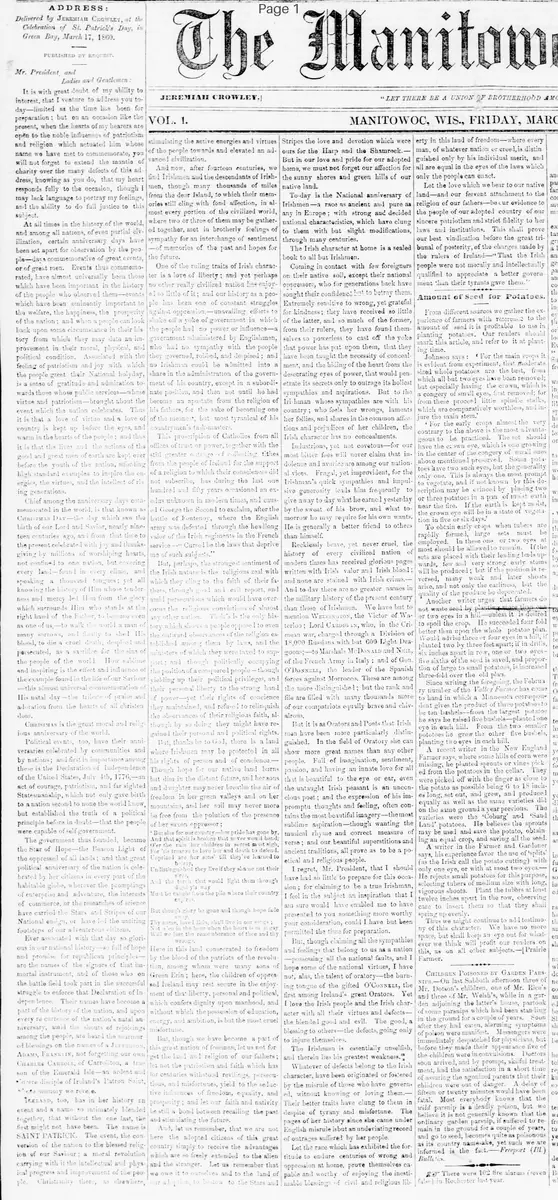
Jeremiah Crowley's speech at St. Patrick's Day celebration in Green Bay on March 17, 1860, honors Irish heritage, St. Patrick's conversion of Ireland to Christianity, centuries of oppression under English rule, Irish character traits like bravery and religious zeal, and gratitude for American liberty while urging fidelity to faith and native land.
Merged-components note: These three sequential components form a single continuous speech/article delivered by Jeremiah Crowley on St. Patrick's Day, published by request.
Clipping
OCR Quality
Full Text
Celebration of St. Patrick's Day, in
Green Bay, March 17, 1860.
PUBLISHED BY REQUEST.
Mr. President and
Ladies and Gentlemen:
It is with great doubt of my ability to
interest, that I venture to address you to-
day—limited as the time has been for
preparation; but on an occasion like the
present, when the hearts of my hearers are
open to the noble influences of patriotism
and religion which actuated him whose
name we have met to commemorate, you
will not forget to extend the mantle of
charity over the many defects of this ad-
dress, knowing as you do, that my heart
responds fully to the occasion, though I
may lack language to portray my feelings.
and the ability to do full justice to this
subject.
At all times in the history of the world.
and among all nations, of even partial civ-
ilization, certain anniversary days have
been set apart for observation by the peo-
ple—days commemorative of great events
or of great men. Events thus commemo-
rated, have almost universally been those
which have been important in the history
of the people who observe them—events
which have been eminently important to
the welfare, the happiness, the prosperity
of the nation; and when a people can look
back upon some circumstance in their his-
tory from which they may date an in-
provement in their moral, physical, and
political condition. Associated with the
feeling of patriotism and joy with which
the people greet their National holyday,
is a sense of gratitude and admiration to-
wards those whose public services—whose
virtue and patriotism—brought about the
event which the nation celebrates. Thus
it is that a love of virtue and a love of
country is kept up before the eyes, and
warm in the hearts of the people; and that,
it is that the lives and the actions of the
good and great men of earth are kept ever
before the youth of the nation, affording
high standard examples to inspire the en-
ergies, the virtues, and the intellect of ris-
ing generations.
Chief among the anniversary days com-
memorated in the world, is that known as
Christmas Day—the day which saw the
birth of our Lord and Savior, nearly nine-
teen centuries ago, and from that time to
the present celebrated with joy and thanks-
giving by millions of worshiping hearts,
not confined to one nation, but covering
every land—found in every clime, and
speaking a thousand tongues; yet all
knowing the history of Him whose tenderness and mercy led Him from the glory
which surrounds Him who stands at the
right hand of the Father, to become even
as one of us.—to walk the world a man of
many sorrows, and finally to shed His
blood, to die a cruel death, despised and
persecuted, as a sacrifice for the sins of
the people of the world. How sublime
and inspiring is the effect and influence of
the example found in the life of our Savior
—this almost universal commemoration of
His natal day—the tribute of praise and
adoration from the hearts of all Christendom.
Christmas is the great moral and religious anniversary of the world.
Political events, too, have their anni-
versaries celebrated by communities and
by nations; and first in importance among
these is the Declaration of Independence
of the United States, July 4th, 1776,—an
act of courage, patriotism, and far-sighted
Statesmanship, which not only gave birth
to a nation second to none the world knows
but established the truth of a political
principle before in doubt—that the people
were capable of self-government.
The government thus founded, became
the Star of Hope—the Beacon Light of
the oppressed of all lands; and that great
political anniversary of the nation is cele-
brated by her citizens in every part of the
habitable globe, wherever the promptings
of enterprise and adventure, the interests
of commerce, or the researches of science
have carried the Stars and Stripes of our
National ensign, of Love in the untiring
footsteps of our adventurous citizens.
Ever associated with that day so glori-
ous in our national history—so full of hope
and promise for republican principles—
are the names of the signors of that im-
mortal instrument, and of those who on
the battle field took part in the successful
struggle to enforce that Declaration of In-
dependence. Their names have become a
part of the history of the nation, and upon
every recurrence of the nation's natal day
anniversary, amid the shouts of rejoicings
among the people, are heard the murmured
blessings on the names of a Jefferson,
Adams, Franklin, not forgetting our own
Charles Carroll, of Carrollton, a true
son of the Emerald Isle—an ardent and
sincere disciple of Ireland's Patron Saint,
—memoria we revere.
Ireland, too, has in her history an
event and a name so intimately blended
together, that without the one last, the
first might not have been. The name is
Saint Patrick. The event, the con-
version of the nation to the blessed religion of our Saviour: a moral revolution
carrying with it the intellectual and physical progress and improvement of the peo-
ple. Christianity there, elsewhere.
stimulating the active energies and virtues
of the people towards and elevated an ad-
vanced civilization.
And now, after fourteen centuries, we
find Irishmen and the descendants of Irish.
men, though many thousands of miles
from the dear Island, to which their mem-
ories still cling with fond affection, in all.
most every portion of the civilized world,
where two or three of them may be gather-
ed together, met in brotherly feelings of
sympathy for an interchange of sentiment
—of memories of the past and hopes for
the future.
One of the ruling traits of Irish charac-
ter is a love of liberty: and yet perhaps
no other really civilized nation has enjoyed so little of it; and our history as a peo-
ple has been one of constant struggles
against oppression,—unavailing efforts to
shake off a yoke of government in which
the people had no power or influence—a
government administered by Englishmen.
who had no sympathy with the people
they governed, robbed, and despised: and
no Irishman could be admitted into a
share in the administration of the govern-
ment of his country, except in a subordi-
nate position, and then not until he had
become an apostate from the religion of
his fathers, for the sake of becoming one
of the meanest, but most tyrannical of his
countrymen's task-masters.
This proscription of Catholics from all
offices of trust or power, together with the
still greater outrage of collecting tithes
from the people of Ireland for the support
of a religion to which their consciences did
not subscribe, has during the last one
hundred and fifty years occasioned an ex-
cess unknown in modern times, and caus-
ed George the Second to exclaim, after the
battle of Fontenoy, where the English
army was defeated through the headlong
valor of the Irish regiments in the French
service—“Cursed be the laws that deprive
me of such subjects.”
But, perhaps, the strongest sentiment of
the Irish nature is the religious zeal with
which they cling to the faith of their fa-
th ers, through good and evil report, and
amid persecutions which would have over.
come the religious convictions of almost
any other nation. Their's is the only his-
tory which shows a people opposed to even
the outward observances of the religion es.
tablished among them by laws, and the
ministers of which they were taxed to sup.
port; and though politically occupying
the position of a conquered people—though
yielding up their political privileges, and
their personal liberty to the strong hand
of power—yet their rights of conscience
they maintained, and refused to relinquish
the observances of their religious faith, al-
though by so doing they might have re-
gained their personal and political rights.
But, thanks be to God, there is a land
where Irishmen may be protected in all
his rights of person and of conscience.—
Though hope for our native land burns
but dim in the distant future, and her sons
and daughters may never breathe the air of
freedom in her green valleys and on her
mountains, and her soil may never more
be free from the pollution of the presence
of her Saxon oppressor;
'Battles for our country—her pride has gone by
And that spirit is broken that never would bend;
O'er the ruin her children in secret must sigh,
For 'tis treason to love her and death to defend.
Unprized are her sons' till they've learned to
be ray,
Unflinchingly they live if they shame not their
sire,
At the torch that would light them through
darkly's way
Must be caught from the pile where their country
lies
But though glory be gone and though hope fade
Away,
Thy name, loved one, shall live in our songs;
Not come in the hour when the heart is most gay
Will we lose the remembrance of thee and thy
wrong.
Here in this land consecrated to freedom
by the blood of the patriots of the revolution, among whom were many sons of
Green Erin: here, the children of oppressed Ireland may rest secure in the enjoy.
ment of that liberty, personal and political
which confers dignity upon manhood, and
without which the possession of education
energy, and ambition, is but the most cruel
misfortune.
But, though we have become a part of
this great nation of freemen, let us not forget the land and religion of our fathers:
let not the patriotism and faith which has
for centuries withstood revilings, persecutions, and misfortunes, yield to the seductive influences of freedom, equality, and
prosperity; and let our faith and nativity
be still a bond between recalling the past
and stimulating the future.
And, let us remember, that we are not
here the adopted citizens of this great
country simply to receive the advantages
which are so freely extended to the alien
and the stranger. Let us remember that
we owe it to ourselves and to the land of
our adoption, to
lessen to the Stars and
Stripes the love and devotion which were
ours for the Harp and the Shamrock.—
But in our love and pride for our adopted
home, we must not forget our affection for
the sunny shores and green hills of our
native land.
To-day is the National anniversary of
Irishmen—a race as ancient and pure as
any in Europe; with strong and decided
national characteristics, which have clung
to them with but slight modifications,
through many centuries.
The Irish character at home is a sealed
book to all but Irishmen.
Coming in contact with few foreigners
on their native soil, except their national
oppressors, who for generations back have
sought their confidence but to betray them.
Extremely sensitive to wrong, yet grateful
for kindness; they have received so little
of the latter, and so much of the former,
from their rulers, they have found them-
selves so powerless to cast off the yoke
that power has put upon them, that they
have been taught the necessity of conceal-
ment, and the hiding of the heart from the
desecrating eyes of power, that would pen-
etrate its secrets only to outrage its holiest
sympathies and aspirations. But to the
Irishman whose sympathies are with his
country; who feels her wrongs, laments
her follies, and shares in the common affec-
tions and prejudices of her children, the
Irish character has no concealments.
Industrious, yet not covetous—for our
most bitter foes will never claim that in-
dolence and avarice are among our nation-
al vices. Frugal, yet improvident, for the
Irishman's quick sympathies and impul-
sive generosity leads him frequently to
give away to-day what he earned yesterday
by the sweat of his brow, and what to-
morrow he may require for his own wants.
He is generally a better friend to others
than himself.
Recklessly brave, yet never cruel, the
history of every civilized nation of
modern times has received glorious pages
written with Irish valor and Irish blood:
and none are stained with Irish crime.—
And to-day there are no greater names in
the military history of the present century
than those of Irishmen. We have but to
mention Wellington, the Victor of Wa-
terloo: Lord Cardigan, who, in the Cri-
mean war, charged through a Division of
18,000 Russians with but 600 Light Dra-
goons;—to Marshals McDonald and Ney,
of the French Army in Italy; and of Gen.
O'Donnell, the leader of the Spanish
forces against Morocco. These are among
the more distinguished; but the rank and
file are filled with many thousands more
of our compatriots equally brave and chiv-
alrous.
But it is as Orators and Poets that Irish
men have been more particularly distin-
guished. In the field of Oratory she can
show more great names than any other
people. Full of imagination, sentiment,
passion, and having an innate love for all
that is beautiful to the eye or ear, even
the untaught Irish peasant is an uncon-
scious poet; and the expression of his im-
promptu thoughts and feeling, often con-
tains the most beautiful imagery—the most
sublime aspiration—though wanting the
musical rhyme and correct measure of
verse; and our beautiful superstitions and
ancient traditions, all prove us to be a po-
etical and religious people.
I regret, Mr. President, that I should
have had so little to prepare for this occa-
sion; for claiming to be a true Irishman,
I feel in the subject an inspiration that I
am sure would have enabled me to have
presented to you something more worthy
your consideration, could I have but been
permitted the time for preparation.
But, though claiming all the sympathies
and feelings that belong to us as a nation
—possessing all the national faults, and I
hope some of the national virtues, I have
not, alas, the talent of oratory—the burn-
ing tongue of the gifted O'Connell, the
first among Ireland's great Orators. Yet
I love the Irish people and the Irish char-
acter with all their virtues and defects—
the blended good and evil. The good, a
blessing to others—the defects, going only
to injure themselves.
The Irishman is essentially unselfish.
and therein lies his greatest weakness.
Whatever of defects belong to the Irish
character, have been originated or fostered
by the misrule of those who have govern-
ed, without knowing or loving them.—
Their better traits have clung to them in
despite of tyranny and misfortune. The
pages of her history since she came under
English misrule is but an undeviating record of outrages suffered by her people.
Let the race which has exhibited the for-
titude to endure centuries of wrong and
oppression at home, prove themselves ca-
pable and worthy of enjoying the inesti-
mable blessings of civil and religious liberty in this land of freedom—where every
man, of whatever nation or creed, is distinguished only by his individual merit, and
all are equal in the eyes of the laws which
only the people can enact.
Let the love which we bear to our native
land—and our fervent attachment to the
religion of our fathers—be our evidence to
the people of our adopted country of our
sincere patriotism and strict fidelity to her
laws and institutions. This shall prove
our best vindication before the great tri-
bunal of posterity, of the charges made by
the rulers of Ireland—“That the Irish
people were not morally and intellectually
qualified to appreciate a better govern-
ment than their tyrants gave them."
What sub-type of article is it?
What themes does it cover?
What keywords are associated?
What entities or persons were involved?
Where did it happen?
Story Details
Key Persons
Location
Green Bay
Event Date
March 17, 1860
Story Details
Speech commemorating St. Patrick's Day, praising St. Patrick's conversion of Ireland to Christianity, detailing Irish history of oppression under English rule, highlighting Irish traits of bravery, religious zeal, and unselfishness, and expressing gratitude for American freedom while urging preservation of Irish faith and patriotism.