Thank you for visiting SNEWPapers!
Sign up free
Kentucky Gazette And General Advertiser
Lexington, Fayette County, Kentucky
What is this article about?
Historical account of the Kentucky Spanish Association's 1785-1790 conspiracy to detach Kentucky from the U.S. for Spain, involving Wilkinson and Brown, countered by British offers, amid settlers' hardships; links to Blount and Miranda plots.
Clipping
OCR Quality
Full Text
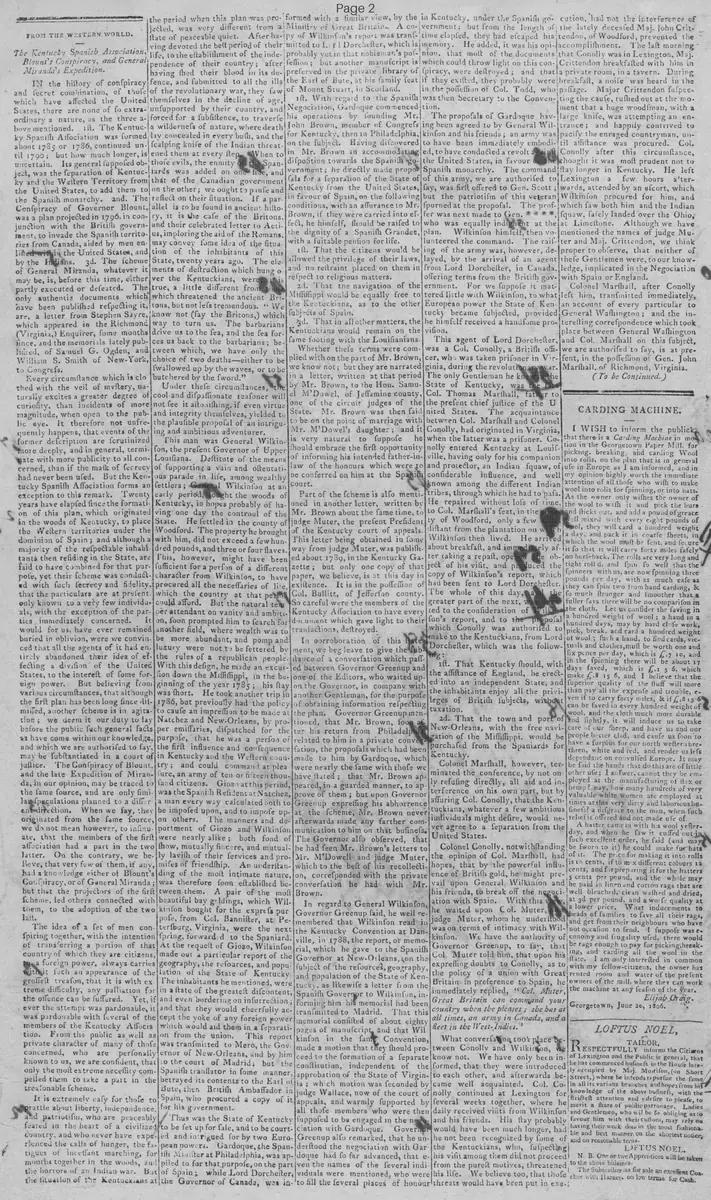
The Kentucky Spanish Association, Blount's Conspiracy, and General Miranda's Expedition.
IN the history of conspiracy and secret combination, of those which have affected the United States, there are none of so extraordinary a nature, as the three above mentioned. 1st. The Kentucky Spanish Association was formed about 1785 or 1786, continued until 1790; but how much longer, is uncertain. Its general supposed object, was the separation of Kentucky and the Western Territory from the United States, to add them to the Spanish monarchy. 2nd. The Conspiracy of Governor Blount, was a plan projected in 1796, in conjunction with the British government, to invade the Spanish territories from Canada, aided by men enlisted within the United States, and by the Indians. 3d. The scheme of General Miranda, whatever it may be, is, before this time, either partly executed or defeated. The only authentic documents which have been published respecting it, are, a letter from Stephen Sayre, which appeared in the Richmond (Virginia) Enquirer, some months since, and the memorials lately published, of Samuel G. Ogden, and William S. Smith of New-York, to Congress.
Every circumstance which is clothed with the veil of mystery, naturally excites a greater degree of curiosity, than incidents of more magnitude, when open to the public eye. It therefore not unfrequently happens, that events of the former description are scrutinized more deeply, and in general, terminate with more publicity to all concerned, than if the mask of secrecy had never been used. But the Kentucky Spanish Association forms an exception to this remark. Twenty years have elapsed since the formation of this plan, which originated in the woods of Kentucky, to place the Western territories under the dominion of Spain; and although a majority of the respectable inhabitants then residing in the State, are said to have combined for that purpose, yet their scheme was conducted with such secrecy and fidelity, that the particulars are at present only known to a very few individuals, with the exception of the parties immediately concerned. It would for us, have ever remained buried in oblivion, were we convinced that all the agents of it had entirely abandoned their idea of effecting a division of the United States, to the interest of some foreign power. But believing from various circumstances, that although the first plan has been long since dismissed, another scheme is in agitation; we deem it our duty to lay before the public such general facts as have come within our knowledge, and which we are authorised to say, may be substantiated in a court of justice. The Conspiracy of Blount, and the late Expedition of Miranda, in our opinion, may be traced to the same source, and are only similar speculations planned to a different direction. When we say, they originated from the same source, we do not mean however, to insinuate, that the members of the first association had a part in the two latter. On the contrary, we believe, that very few of them, if any, had a knowledge either of Blount's Conspiracy, or of General Miranda; but that the projectors of the first scheme, led others connected with them, to the adoption of the two last.
The idea of a set of men conspiring together, with the intention of transferring a portion of that country of which they are citizens, to a foreign power, always carries with it such an appearance of the grossest treason, that it is with extreme difficulty, any palliation for this offence can be suffered. Yet, if ever the attempt was pardonable, it was pardonable with several of the members of the Kentucky Association. From the public as well as private character of many of those concerned, who are personally known to us, we are confident, that only the most extreme necessity compelled them to take a part in the treasonable scheme.
It is extremely easy for those to prattle about liberty, independence, and patriotism, who are peaceably seated in the heart of a civilized country, and who never have experienced the calls of hunger, the fatigues of incessant marching, for months together in the woods, and the horrors of an Indian war. But the situation of the Kentuckians at the period when this plan was projected, was very different from a state of peaceable quiet. After having devoted the best period of their life, to the establishment of the independence of their country; after having shed their blood in its defence, and submitted to all the ills of the revolutionary war, they saw themselves in the decline of age, unsupported by their country, and forced for a subsistence, to traverse a wilderness of nature, where death lay concealed in every bush, and the scalping knife of the Indian threatened them at every step. When to those evils, the enmity of the Spaniards was added on one side, and that of the Canadian government on the other; we ought to pause and reflect on their situation. If a parallel is to be found in ancient history, it is the case of the Britons, and their celebrated letter to Aetius, imploring the aid of the Romans, may convey some idea of the situation of the inhabitants of this state, twenty years ago. The elements of destruction which hung over the Kentuckians, were, it is true, a little different from those which threatened the ancient Britons, but not less tremendous. "We know not (say the Britons,) which way to turn us. The barbarians drive us to the sea, and the sea forces us back to the barbarians; between which, we have only the choice of two deaths—either to be swallowed up by the waves, or to be butchered by the sword."
Under these circumstances, the cool and dispassionate reasoner will not see it astonishing, if even virtue and integrity themselves, yielded to the plausible proposal of an intriguing and ambitious adventurer.
This man was General Wilkinson, the present Governor of Upper Louisiana. Destitute of the means of supporting a vain and ostentatious parade in life, among wealthy settlers; General Wilkinson at an early period, sought the woods of Kentucky, in hopes probably of having one day the controul of the state. He settled in the county of Woodford. The property he brought with him, did not exceed a few hundred pounds, and three or four slaves. This, however, might have been sufficient for a person of a different character from Wilkinson, to have procured all the necessaries of life, which the country at that period could afford. But the natural temper attendant on vanity and ambition, soon prompted him to search for another field, where wealth was to be more abundant, and pomp and luxury were not to be fettered by the rules of a republican people. With this design, he made an excursion down the Mississippi, in the beginning of the year 1785; his stay was short. He took another trip in 1786, but previously had the policy to cause an impression to be made at Natchez and New-Orleans, by proper emissaries, dispatched for the purpose, that he was a person of the first influence and consequence in Kentucky and the Western country; and could command at pleasure, an army of ten or fifteen thousand citizens. Gayoso at this period, was the Spanish Resident at Natchez, a man every way calculated both to be imposed upon, and to impose upon others. The manners and deportment of Gayoso and Wilkinson were nearly alike; both fond of show, mutually insincere, and mutually lavish of their services and promises of friendship. An understanding of the most intimate nature, was therefore soon established between them. A pair of the most beautiful bay geldings, which Wilkinson bought for the express purpose, from Col. Bannister, at Petersburg, Virginia, were the next spring, forwarded to the Spaniard. At the request of Gayoso, Wilkinson made out a particular report of the geography, the resources, and population of the State of Kentucky. The inhabitants he mentioned, were in a state of the greatest discontent, and even bordering on insurrection; and that they would cheerfully accept the yoke of any foreign power which would aid them in a separation from the union. This report was transmitted to Miro, the Governor of New-Orleans, and by him to the court of Madrid; but the Spanish translator in some manner, betrayed its contents to the Earl of Bute, then British Ambassador in Spain, who procured a copy of it for his government.
Thus was the State of Kentucky to be set up for sale, and to be courted and intrigued for by two European powers. Gardoqui, the Spanish Minister at Philadelphia, was applied to for that purpose, on the part of Spain; while Lord Dorchester, the Governor of Canada, was informed with a similar view, by the Ministry of Great Britain. A copy of Wilkinson's report was transmitted to Lord Dorchester, which is probably yet in that nobleman's possession; but another manuscript is preserved in the private library of the Earl of Bute, at his family seat of Mount Stuart, in Scotland.
With regard to the Spanish Negociation, Gardoqui commenced his operations by sounding Mr. John Brown, member of Congress for Kentucky, then in Philadelphia, on the subject. Having discovered in Mr. Brown an accommodating disposition towards the Spanish government; he directly made proposals for a separation of the State of Kentucky from the United States, in favour of Spain, on the following conditions, with an assurance to Mr. Brown, if they were carried into effect, he himself, should be raised to the dignity of a Spanish Grandee, with a suitable pension for life. 1st. That the citizens would be allowed the privilege of their laws, and no restraint placed on them in respect to religious matters. 2d. That the navigation of the Mississippi would be equally free to the Kentuckians, as to the other subjects of Spain. 3d. That in all other matters, the Kentuckians would remain on the same footing with the Louisianians.
Whether these terms were complied with on the part of Mr. Brown, we know not; but they are narrated in a letter, written at that period by Mr. Brown, to the Hon. Samuel M'Dowell, of Jessamine county, one of the circuit judges of the state. Mr. Brown was then said to be on the point of marriage with Mr. M'Dowell's daughter; and it is very natural to suppose he should embrace the first opportunity of informing his intended father-in-law of the honours which were to be conferred on him at the Spanish court. Part of the scheme is also mentioned in another letter, written by Mr. Brown about the same time, to judge Muter, the present President of the Kentucky court of appeals. This letter being obtained in some way from judge Muter, was published about 1790, in the Kentucky Gazette; but only one copy of that paper, we believe, is at this day in existence. It is in the possession of Col. Bullitt, of Jefferson county. So careful were the members of the Kentucky Association to have every document which gave light to their transactions, destroyed.
In corroboration of this statement, we beg leave to give the substance of a conversation which passed between Governor Greenup and one of the Editors, who waited upon the Governor, in company with another Gentleman, for the purpose of obtaining information respecting the plan. Governor Greenup mentioned, that Mr. Brown, soon after his return from Philadelphia related to him in a private conversation, the proposals which had been made to him by Gardoqui, which were nearly the same with those we have stated; that Mr. Brown appeared, in a guarded manner, to approve of them; but upon Governor Greenup expressing his abhorrence at the scheme, Mr. Brown never afterwards made any farther communication to him on that business. The Governor also observed, that he had seen Mr. Brown's letters to Mr. M'Dowell and judge Muter, which to the best of his recollection, corresponded with the private conversation he had with Mr. Brown.
In regard to General Wilkinson, Governor Greenup said, he well remembered that Wilkinson read in the Kentucky Convention at Danville, in 1788, the report, or memorial, which he gave to the Spanish Governor at New-Orleans, on the subject of the resources, geography, and population of the State of Kentucky, as likewise a letter from the Spanish Governor to Wilkinson, informing him his memorial had been transmitted to Madrid. That this memorial consisted of about eighty pages of manuscript, and that Wilkinson in the same Convention, made a motion that they should proceed to the formation of a separate constitution, independent of the approbation of the State of Virginia; which motion was seconded by judge Wallace, now of the court of appeals, and warmly supported by all those members who were then supposed to be engaged in the negociation with Gardoqui. Governor Greenup also remarked, that he understood the negociation with Gardoqui had so far advanced, that even the names of the several individuals were mentioned, who were to fill the several places of honour in Kentucky, under the Spanish government; but from the length of time elapsed, they had escaped his memory. He added, it was his opinion, that most of the documents which could throw light on this conspiracy, were destroyed; and that if they existed, they probably were in the possession of Col. Todd, who was then Secretary to the Convention.
The proposals of Gardoqui having been agreed to by General Wilkinson and his friends; an army was to have been immediately embodied, to have conducted a revolt against the United States, in favour of the Spanish monarchy. The command of this army, we are authorised to say, was first offered to Gen. Scott; but the patriotism of this veteran spurned at the proposal. The proffer was next made to Gen. * * * *, who was equally indignant at the plan. Wilkinson himself, then volunteered the command. The raising of the army was, however, delayed, by the arrival of an agent from Lord Dorchester, in Canada, offering terms from the British government. For we suppose it mattered little with Wilkinson, to what European power the State of Kentucky became subjected, provided he himself received a handsome provision.
This agent of Lord Dorchester, was a Col. Connolly, a British officer, who was taken prisoner in Virginia, during the revolutionary war. The only Gentleman he knew in the State of Kentucky, was the late Col. Thomas Marshall, father to the present chief justice of the United States. The acquaintance between Col. Marshall and Colonel Connolly, had originated in Virginia, when the latter was a prisoner. Connolly entered Kentucky at Louisville, having only for his companion and protector, an Indian squaw, of considerable influence, and well known among the different Indian tribes, through which he had to pass. He repaired without loss of time, to Col. Marshall's seat, in the county of Woodford, only a few miles distant from the plantation on which Wilkinson then lived. He arrived about breakfast, and immediately after taking a repast, opened the object of his visit, and produced the copy of Wilkinson's report, which had been sent to Lord Dorchester. The whole of this day, and the greater part of the next, was devoted to the consideration of Wilkinson's report, and to the proposal which Connolly was authorised to make to the Kentuckians, from Lord Dorchester, which was the following:
1st. That Kentucky should, with the assistance of England, be erected into an independent State, and the inhabitants enjoy all the privileges of British subjects, without taxation. 2d. That the town and port of New-Orleans, with the free navigation of the Mississippi, would be purchased from the Spaniards for Kentucky.
Colonel Marshall, however, terminated the conference, by not only refusing directly, all aid and interference on his own part, but by assuring Col. Connolly, that the Kentuckians, whatever a few ambitious individuals might desire, would never agree to a separation from the United States.
Colonel Connolly, notwithstanding the opinion of Col. Marshall, had hopes, that by the powerful influence of British gold, he might prevail upon General Wilkinson and his friends, to break off the negociation with Spain. With this view, he waited upon Col. Muter, now judge Muter, whom he understood was on terms of intimacy with Wilkinson. We have the authority of Governor Greenup, to say, that Col. Muter told him, that upon his expressing doubts to Connolly, as to the policy of a union with Great Britain in preference to Spain, he immediately replied, "Col. Muter, Great Britain can command your country when she pleases; she has at all times, an army in Canada, and a fleet in the West-Indies."
What conversation took place between Connolly and Wilkinson, we know not. We have only been informed, that they were introduced to each other, and afterwards became well acquainted. Col. Connolly continued at Lexington for several weeks together, where he daily received visits from Wilkinson and his friends. His stay probably would have been much longer, had he not been recognized by some of the Kentuckians, who, suspecting his visit among them did not proceed from the purest motives, threatened his life. We believe too, that those threats would have been put in execution, had not the interference of the lately deceased Maj. John Crittenden, of Woodford, prevented the accomplishment. The last morning that Connolly was in Lexington, Maj. Crittenden breakfasted with him in a private room, in a tavern. During breakfast, a noise was heard in the passage. Major Crittenden suspecting the cause, rushed out at the moment that a huge woodfman, with a large knife, was attempting an entrance; and happily contrived to pacify the enraged countryman, until assistance was procured. Col. Connolly after this circumstance, thought it was most prudent not to stay longer in Kentucky. He left Lexington a few hours afterwards, attended by an escort, which Wilkinson procured for him, and which saw both him and the Indian squaw, safely landed over the Ohio, at Limestone. Although we have mentioned the names of judge Muter and Maj. Crittenden, we think proper to observe, that neither of these Gentlemen were, to our knowledge, implicated in the Negociation with Spain or England.
Colonel Marshall, after Connolly left him, transmitted immediately, an account of every particular to General Washington; and the interesting correspondence which took place between General Washington and Col. Marshall on this subject, we are authorised to say, is at present, in the possession of Gen. John Marshall, of Richmond, Virginia.
(To be Continued.)
What sub-type of article is it?
What themes does it cover?
What keywords are associated?
What entities or persons were involved?
Where did it happen?
Story Details
Key Persons
Location
Kentucky, Western Territory, New Orleans
Event Date
1785 1790
Story Details
The Kentucky Spanish Association conspired around 1785-1790 to separate Kentucky from the United States and join Spain, led by General Wilkinson who negotiated with Spanish officials like Gardoqui. British agent Col. Connolly offered alternative independence under Britain, but the plot was rejected by patriots like Col. Marshall, who informed Washington.