Thank you for visiting SNEWPapers!
Sign up free
Editorial
September 30, 1938
The Times News
Hendersonville, Henderson County, North Carolina
What is this article about?
The Wall Street Journal editorial critiques the Workers' Alliance, an organization of relief recipients, for using government-subsidized funds to influence elections and legislation for more relief, warning of taxpayer backlash and the dangers of permanent relief programs.
Clipping
OCR Quality
98%
Excellent
Full Text
NEWSPAPERS' OPINIONS
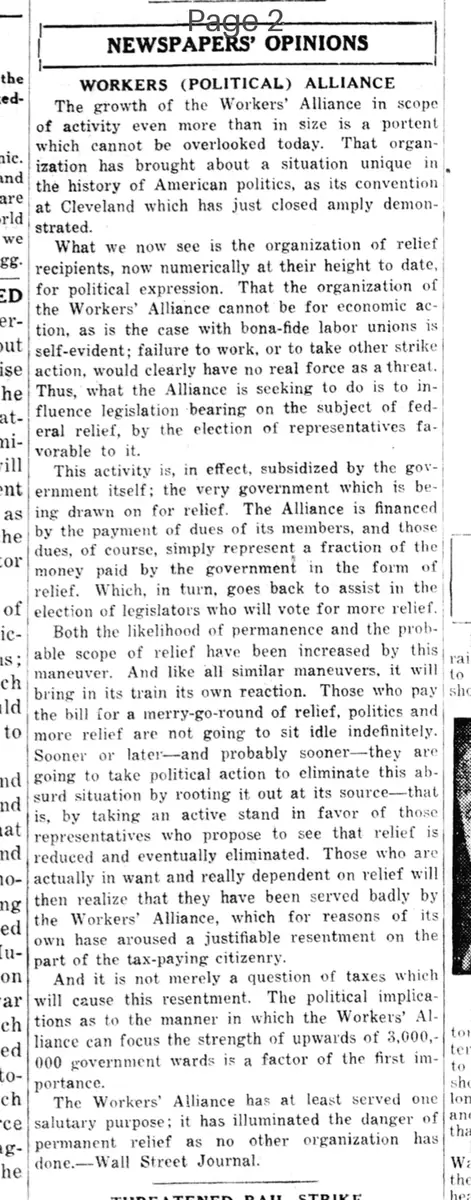
WORKERS (POLITICAL) ALLIANCE
The growth of the Workers' Alliance in scope of activity even more than in size is a portent which cannot be overlooked today. That organization has brought about a situation unique in the history of American politics, as its convention at Cleveland which has just closed amply demonstrated.
What we now see is the organization of relief recipients, now numerically at their height to date, for political expression. That the organization of the Workers' Alliance cannot be for economic action, as is the case with bona-fide labor unions is self-evident: failure to work, or to take other strike action, would clearly have no real force as a threat.
Thus, what the Alliance is seeking to do is to influence legislation bearing on the subject of federal relief, by the election of representatives favorable to it.
This activity is, in effect, subsidized by the government itself: the very government which is being drawn on for relief. The Alliance is financed by the payment of dues of its members, and those dues, of course, simply represent a fraction of the money paid by the government in the form of relief. Which, in turn, goes back to assist in the election of legislators who will vote for more relief.
Both the likelihood of permanence and the probable scope of relief have been increased by this maneuver. And like all similar maneuvers, it will bring in its train its own reaction. Those who pay the bill for a merry-go-round of relief, politics and more relief are not going to sit idle indefinitely.
Sooner or later--and probably sooner-they are going to take political action to eliminate this absurd situation by rooting it out at its source-that is, by taking an active stand in favor of those representatives who propose to see that relief is reduced and eventually eliminated. Those who are actually in want and really dependent on relief will then realize that they have been served badly by the Workers' Alliance, which for reasons of its own has aroused a justifiable resentment on the part of the tax-paying citizenry.
And it is not merely a question of taxes which will cause this resentment. The political implications as to the manner in which the Workers' Alliance can focus the strength of upwards of 3,000,000 government wards is a factor of the first importance.
The Workers' Alliance has at least served one salutary purpose: it has illuminated the danger of permanent relief as no other organization has done.--Wall Street Journal.
WORKERS (POLITICAL) ALLIANCE
The growth of the Workers' Alliance in scope of activity even more than in size is a portent which cannot be overlooked today. That organization has brought about a situation unique in the history of American politics, as its convention at Cleveland which has just closed amply demonstrated.
What we now see is the organization of relief recipients, now numerically at their height to date, for political expression. That the organization of the Workers' Alliance cannot be for economic action, as is the case with bona-fide labor unions is self-evident: failure to work, or to take other strike action, would clearly have no real force as a threat.
Thus, what the Alliance is seeking to do is to influence legislation bearing on the subject of federal relief, by the election of representatives favorable to it.
This activity is, in effect, subsidized by the government itself: the very government which is being drawn on for relief. The Alliance is financed by the payment of dues of its members, and those dues, of course, simply represent a fraction of the money paid by the government in the form of relief. Which, in turn, goes back to assist in the election of legislators who will vote for more relief.
Both the likelihood of permanence and the probable scope of relief have been increased by this maneuver. And like all similar maneuvers, it will bring in its train its own reaction. Those who pay the bill for a merry-go-round of relief, politics and more relief are not going to sit idle indefinitely.
Sooner or later--and probably sooner-they are going to take political action to eliminate this absurd situation by rooting it out at its source-that is, by taking an active stand in favor of those representatives who propose to see that relief is reduced and eventually eliminated. Those who are actually in want and really dependent on relief will then realize that they have been served badly by the Workers' Alliance, which for reasons of its own has aroused a justifiable resentment on the part of the tax-paying citizenry.
And it is not merely a question of taxes which will cause this resentment. The political implications as to the manner in which the Workers' Alliance can focus the strength of upwards of 3,000,000 government wards is a factor of the first importance.
The Workers' Alliance has at least served one salutary purpose: it has illuminated the danger of permanent relief as no other organization has done.--Wall Street Journal.
What sub-type of article is it?
Economic Policy
Partisan Politics
Labor
What keywords are associated?
Workers Alliance
Federal Relief
Political Influence
Taxpayer Resentment
Relief Permanence
Government Subsidies
Elections
Cleveland Convention
What entities or persons were involved?
Workers' Alliance
Relief Recipients
Government
Tax Paying Citizenry
Editorial Details
Primary Topic
Critique Of Workers' Alliance Political Influence On Relief Policy
Stance / Tone
Critical And Warning Against Subsidized Political Activity For Permanent Relief
Key Figures
Workers' Alliance
Relief Recipients
Government
Tax Paying Citizenry
Key Arguments
Growth Of Workers' Alliance Creates Unique Political Situation Via Cleveland Convention
Alliance Organizes Relief Recipients For Political Expression, Not Economic Action Like Unions
Seeks To Influence Federal Relief Legislation Through Electing Favorable Representatives
Alliance Financed By Government Relief Dues, Subsidizing Its Own Political Efforts
Increases Permanence And Scope Of Relief, Provoking Taxpayer Reaction
Taxpayers Will Support Reducing And Eliminating Relief To End The Cycle
Alliance Arouses Resentment Beyond Taxes Due To Focusing 3,000,000 Government Wards' Strength
Highlights Dangers Of Permanent Relief