Thank you for visiting SNEWPapers!
Sign up free
Story
March 18, 1888
The Morning News
Savannah, Chatham County, Georgia
What is this article about?
At Castle Garden, money changers discuss peculiarities in how immigrants from different nationalities carry and hide their money, such as English using watch-like cases, Irish sewing coins into dresses, Germans using belts, and others using boots, books, or tubes. Includes notes on foreign coins and a counterfeit incident.
Clipping
OCR Quality
95%
Excellent
Full Text
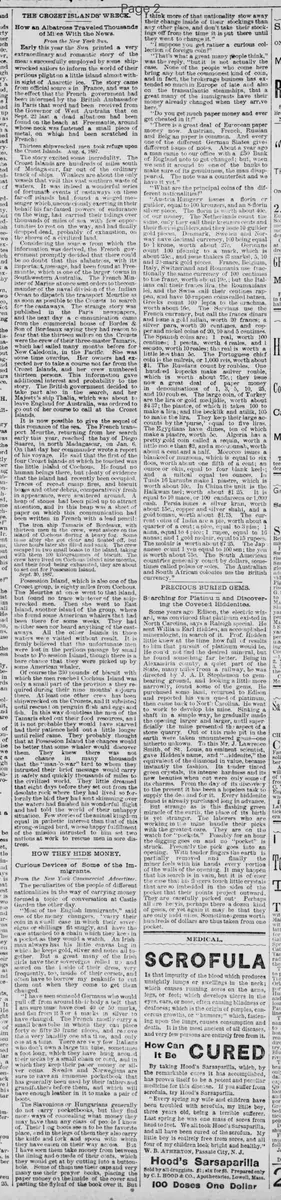
HOW THEY HIDE MONEY
Curious Devices of Some of the Immigrants.
From the New York Commercial Advertiser.
The peculiarities of the people of different nationalities in the way of carrying money formed a topic of conversation at Castle Garden the other day.
"Most of the English immigrants," said one of the money changers, "carry their coin in a small case in which their sovereigns or shillings fit snugly, and have the case attached to a chain which they keep in a pocket as they would a watch. An Irish man always has his little canvas bag in which he keeps gold, silver and notes all together. But a great many of the Irish girls have their sovereigns rolled up and sewed on the inside of their dress, very frequently, too, inside of their corsets, and often have to borrow my penknife to cut them out when they come to get them changed.
"I have seen some old Germans who would pull off from around their body a belt that I am sure must have cost 40 or 50 marks, and fish from it 3 or 4 marks in silver to have changed. The French mostly carry a small brass tube in which they can place forty or fifty 2-franc pieces, and remove them very handily one at a time, and only one at a time. There are very few Italians who don't own a large tin tube, sometimes a foot long, which they have hung around their necks by a small chain or cord, and in which they keep their paper money or silver coins. Swedes and Norwegians are sure to have an immense pocketbook that has generally been used by their fathers and grandfathers before them, and which will have enough leather in it to make a pair of boots.
The Slavonians or Hungarians generally do not carry pocketbooks, but they find more ways of concealing what money they may have than any class of people I know of. Their long boots seem to be the favorite place, and in the legs of them they also carry the knife and fork and spoon with which they have eaten on their way across. But I have seen them take money from between the lining and outside of their coats, which they would get at by cutting into a button-hole. Some of them use their caps and very many use their prayer books, placing the paper money on the inside of the cover and pasting the flyleaf of the book over it. But I think more of that nationality stow away their change inside of their stockings than any other place, and don't take their stockings off from the time it is put there until they went to change it."
"I suppose you get rather a curious collection of foreign coin?"
"That's what a great many people think," was the reply, "but it is not actually the case. None of the people who come here bring any but the commonest kind of coin, and in fact, the brokerage business has extended so much in Europe of late and also on the transatlantic steamships, that a great many of the immigrants have their money already changed when they arrive here."
"Do you get much paper money and ever get cheated in it?"
"There is a great deal of European paper money now. Austrian, French, Russian and Belgian paper is common. And every one of the different German States gives different issues of notes. About a year ago a man came to our office with a £50 Bank of England note to get changed; but, when we sent it around to one of the banks to make sure of its genuineness, the man disappeared. The note was a counterfeit and we have it yet."
"What are the principal coins of the different nationalities?"
"Austria-Hungary issues a florin or guilder, equal to 100 kreuzers, and an 8-florin silver piece. The florin is worth about 40c. of our money. The Netherlands count the same, only they call their kreuzers cents and their florins guilders, and they issue 10-guilder gold pieces. Denmark, Sweden and Norway have decimal currency, 100 being equal to 1 krone, worth about 27c. Germans count 100 pfennig to a mark, which is about 25c., and issue thalers (3 marks), 5, 10 and 20-mark gold pieces. France, Belgium, Italy, Switzerland and Roumania use fractionally the same currency of 100 centimes to the franc, worth about 19c.; but the Italians call their francs lire, the Roumanians lei, and the Swiss call their centimes rappen, and have 10-rappen coins called batzen. Greeks count 100 lepta to the drachma, worth about 16c. The Servians use the French currency, but call the francs dinars and issue a gold milan, worth 20 francs; a silver para, worth 20 centimes, and copper and nickel coins of 20, 10 and 5 centimes. The Spanish coins are: 1 real, worth 100 centimes; 1 peseta, worth 4 reales, and 1 escudo, worth 10 reales; the real is worth a little less than 5c. The Portuguese chief coin is the milreis, or 1,000 reis, worth about $1. The Russians count by roubles. One hundred kopecks make a silver rouble, which is worth about 75c.; they issue now a great deal of paper money in denominations of 1, 3, 5, 10, 25, and 100 roubles. The large coin of Turkey are the lira or gold medjidie, worth about $4.37; the piastre, of which it takes 100 to make a lira; and the para and atilik, 105 to make the lira. They keep their large accounts by the 'purse,' equal to five liras. The Egyptians have dimes, ten of which make a piastre, worth 5c. Algeria has a pretty gold coin called a sequin, worth a little more than $2, and a monzounah, worth about a cent and a half. Morocco issues a blankeel or muzoona, which is equal to six floos, worth about one fifth of a cent; an ounce or okia, equal to four blankeels; and a mitcal equal ten ounces. In Tunis 16 karnubs make 1 piastre, which is worth about 10c. In China the unit is the Haikwan tael, worth about $1.25. It is equal to 10 mace, or 100 candareens or 1,000 cash. Persia issues a silver kran, worth about 15c., copper and silver shahi, and a gold toman, worth about $1.75. The current coins of India are a pie, worth about a quarter of a cent; a pice, equal to 3 pies; 1 anna, equal to 4 pice; 1 rupee, equal to 16 annas; and 1 gold mohur, equal to 15 rupees. The mohur is worth about $7.25. The Japanese count 1 yen equal to 100 sen; the yen is worth about 75c. The South American countries generally count by dollars, sometimes called pesos or soles. The Australian and South African colonies use the British currency."
Curious Devices of Some of the Immigrants.
From the New York Commercial Advertiser.
The peculiarities of the people of different nationalities in the way of carrying money formed a topic of conversation at Castle Garden the other day.
"Most of the English immigrants," said one of the money changers, "carry their coin in a small case in which their sovereigns or shillings fit snugly, and have the case attached to a chain which they keep in a pocket as they would a watch. An Irish man always has his little canvas bag in which he keeps gold, silver and notes all together. But a great many of the Irish girls have their sovereigns rolled up and sewed on the inside of their dress, very frequently, too, inside of their corsets, and often have to borrow my penknife to cut them out when they come to get them changed.
"I have seen some old Germans who would pull off from around their body a belt that I am sure must have cost 40 or 50 marks, and fish from it 3 or 4 marks in silver to have changed. The French mostly carry a small brass tube in which they can place forty or fifty 2-franc pieces, and remove them very handily one at a time, and only one at a time. There are very few Italians who don't own a large tin tube, sometimes a foot long, which they have hung around their necks by a small chain or cord, and in which they keep their paper money or silver coins. Swedes and Norwegians are sure to have an immense pocketbook that has generally been used by their fathers and grandfathers before them, and which will have enough leather in it to make a pair of boots.
The Slavonians or Hungarians generally do not carry pocketbooks, but they find more ways of concealing what money they may have than any class of people I know of. Their long boots seem to be the favorite place, and in the legs of them they also carry the knife and fork and spoon with which they have eaten on their way across. But I have seen them take money from between the lining and outside of their coats, which they would get at by cutting into a button-hole. Some of them use their caps and very many use their prayer books, placing the paper money on the inside of the cover and pasting the flyleaf of the book over it. But I think more of that nationality stow away their change inside of their stockings than any other place, and don't take their stockings off from the time it is put there until they went to change it."
"I suppose you get rather a curious collection of foreign coin?"
"That's what a great many people think," was the reply, "but it is not actually the case. None of the people who come here bring any but the commonest kind of coin, and in fact, the brokerage business has extended so much in Europe of late and also on the transatlantic steamships, that a great many of the immigrants have their money already changed when they arrive here."
"Do you get much paper money and ever get cheated in it?"
"There is a great deal of European paper money now. Austrian, French, Russian and Belgian paper is common. And every one of the different German States gives different issues of notes. About a year ago a man came to our office with a £50 Bank of England note to get changed; but, when we sent it around to one of the banks to make sure of its genuineness, the man disappeared. The note was a counterfeit and we have it yet."
"What are the principal coins of the different nationalities?"
"Austria-Hungary issues a florin or guilder, equal to 100 kreuzers, and an 8-florin silver piece. The florin is worth about 40c. of our money. The Netherlands count the same, only they call their kreuzers cents and their florins guilders, and they issue 10-guilder gold pieces. Denmark, Sweden and Norway have decimal currency, 100 being equal to 1 krone, worth about 27c. Germans count 100 pfennig to a mark, which is about 25c., and issue thalers (3 marks), 5, 10 and 20-mark gold pieces. France, Belgium, Italy, Switzerland and Roumania use fractionally the same currency of 100 centimes to the franc, worth about 19c.; but the Italians call their francs lire, the Roumanians lei, and the Swiss call their centimes rappen, and have 10-rappen coins called batzen. Greeks count 100 lepta to the drachma, worth about 16c. The Servians use the French currency, but call the francs dinars and issue a gold milan, worth 20 francs; a silver para, worth 20 centimes, and copper and nickel coins of 20, 10 and 5 centimes. The Spanish coins are: 1 real, worth 100 centimes; 1 peseta, worth 4 reales, and 1 escudo, worth 10 reales; the real is worth a little less than 5c. The Portuguese chief coin is the milreis, or 1,000 reis, worth about $1. The Russians count by roubles. One hundred kopecks make a silver rouble, which is worth about 75c.; they issue now a great deal of paper money in denominations of 1, 3, 5, 10, 25, and 100 roubles. The large coin of Turkey are the lira or gold medjidie, worth about $4.37; the piastre, of which it takes 100 to make a lira; and the para and atilik, 105 to make the lira. They keep their large accounts by the 'purse,' equal to five liras. The Egyptians have dimes, ten of which make a piastre, worth 5c. Algeria has a pretty gold coin called a sequin, worth a little more than $2, and a monzounah, worth about a cent and a half. Morocco issues a blankeel or muzoona, which is equal to six floos, worth about one fifth of a cent; an ounce or okia, equal to four blankeels; and a mitcal equal ten ounces. In Tunis 16 karnubs make 1 piastre, which is worth about 10c. In China the unit is the Haikwan tael, worth about $1.25. It is equal to 10 mace, or 100 candareens or 1,000 cash. Persia issues a silver kran, worth about 15c., copper and silver shahi, and a gold toman, worth about $1.75. The current coins of India are a pie, worth about a quarter of a cent; a pice, equal to 3 pies; 1 anna, equal to 4 pice; 1 rupee, equal to 16 annas; and 1 gold mohur, equal to 15 rupees. The mohur is worth about $7.25. The Japanese count 1 yen equal to 100 sen; the yen is worth about 75c. The South American countries generally count by dollars, sometimes called pesos or soles. The Australian and South African colonies use the British currency."
What sub-type of article is it?
Curiosity
What themes does it cover?
Social Manners
What keywords are associated?
Immigrant Money Hiding
Nationality Customs
Foreign Currencies
Castle Garden
Counterfeit Note
Where did it happen?
Castle Garden
Story Details
Location
Castle Garden
Story Details
Money changers at Castle Garden describe unique methods immigrants use to carry and hide money based on nationality, including cases, bags, belts, tubes, boots, books, and stockings, followed by details on foreign currencies and a counterfeit note incident.