Thank you for visiting SNEWPapers!
Sign up free
Story
May 26, 1904
The Daily Morning Journal And Courier
New Haven, New Haven County, Connecticut
What is this article about?
Chicago restaurants debate importing premium French chickens like Normandy pullets and Brittany capons, which are milk-fed and preferred over American oatmeal-fed ones, sold at $1.50-$2 each. Merchant Tom O'Herne introduced them two years ago, outselling native birds amid game law restrictions.
Clipping
OCR Quality
98%
Excellent
Full Text
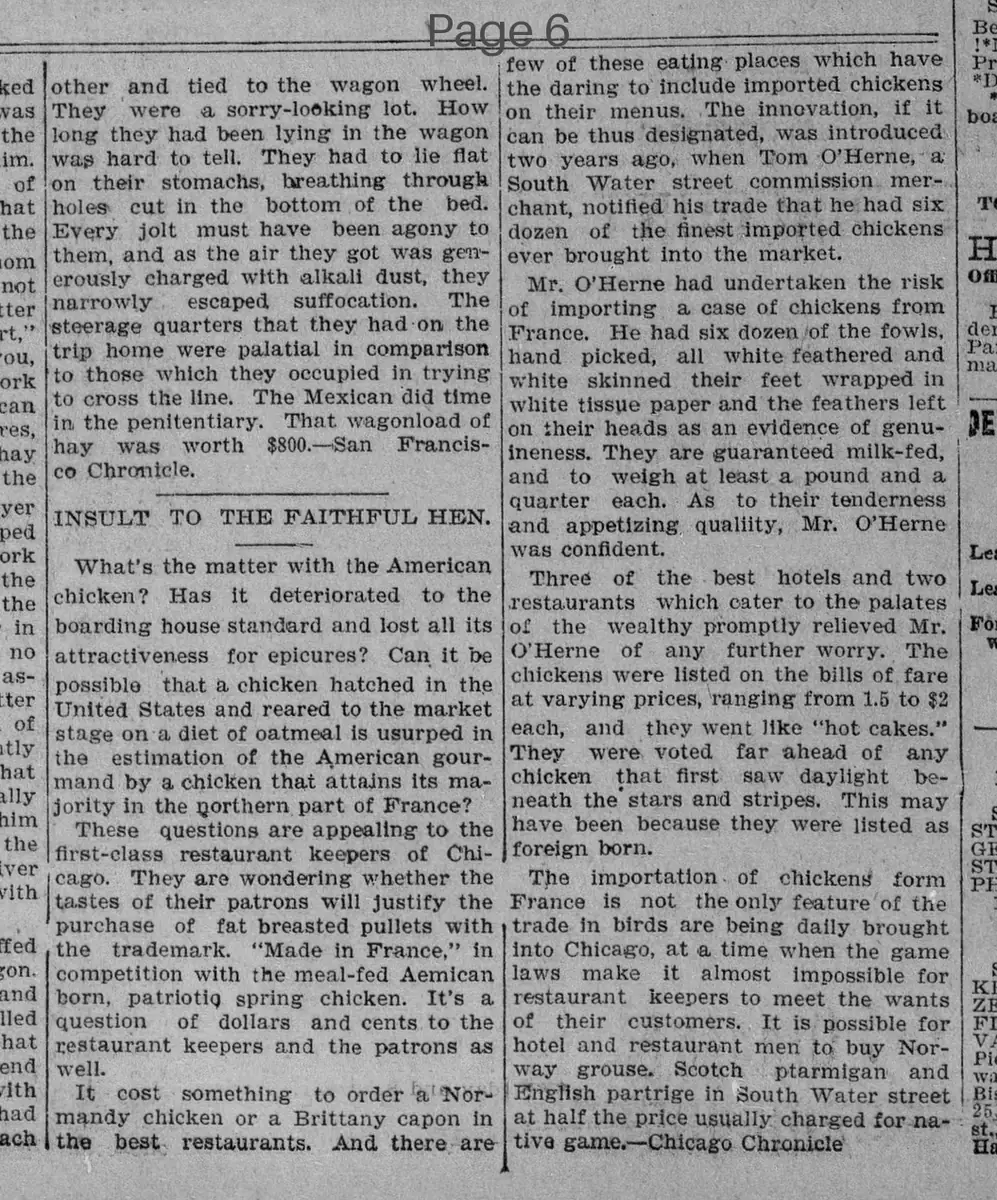
INSULT TO THE FAITHFUL HEN.
What's the matter with the American chicken? Has it deteriorated to the boarding house standard and lost all its attractiveness for epicures? Can it be possible that a chicken hatched in the United States and reared to the market stage on a diet of oatmeal is usurped in the estimation of the American gourmand by a chicken that attains its majority in the northern part of France? These questions are appealing to the first-class restaurant keepers of Chicago. They are wondering whether the tastes of their patrons will justify the purchase of fat breasted pullets with the trademark, "Made in France," in competition with the meal-fed American born, patriotic spring chicken. It's a question of dollars and cents to the restaurant keepers and the patrons as well.
It cost something to order a Normandy chicken or a Brittany capon in the best restaurants. And there are few of these eating places which have the daring to include imported chickens on their menus. The innovation, if it can be thus designated, was introduced two years ago, when Tom O'Herne, a South Water street commission merchant, notified his trade that he had six dozen of the finest imported chickens ever brought into the market.
Mr. O'Herne had undertaken the risk of importing a case of chickens from France. He had six dozen of the fowls, hand picked, all white feathered and white skinned their feet wrapped in white tissue paper and the feathers left on their heads as an evidence of genuineness. They are guaranteed milk-fed, and to weigh at least a pound and a quarter each. As to their tenderness and appetizing quality, Mr. O'Herne was confident.
Three of the best hotels and two restaurants which cater to the palates of the wealthy promptly relieved Mr. O'Herne of any further worry. The chickens were listed on the bills of fare at varying prices, ranging from $1.50 to $2 each, and they went like "hot cakes." They were voted far ahead of any chicken that first saw daylight beneath the stars and stripes. This may have been because they were listed as foreign born.
The importation of chickens from France is not the only feature of the trade in birds are being daily brought into Chicago, at a time when the game laws make it almost impossible for restaurant keepers to meet the wants of their customers. It is possible for hotel and restaurant men to buy Norway grouse, Scotch ptarmigan and English partridge in South Water street at half the price usually charged for native game.—Chicago Chronicle.
What's the matter with the American chicken? Has it deteriorated to the boarding house standard and lost all its attractiveness for epicures? Can it be possible that a chicken hatched in the United States and reared to the market stage on a diet of oatmeal is usurped in the estimation of the American gourmand by a chicken that attains its majority in the northern part of France? These questions are appealing to the first-class restaurant keepers of Chicago. They are wondering whether the tastes of their patrons will justify the purchase of fat breasted pullets with the trademark, "Made in France," in competition with the meal-fed American born, patriotic spring chicken. It's a question of dollars and cents to the restaurant keepers and the patrons as well.
It cost something to order a Normandy chicken or a Brittany capon in the best restaurants. And there are few of these eating places which have the daring to include imported chickens on their menus. The innovation, if it can be thus designated, was introduced two years ago, when Tom O'Herne, a South Water street commission merchant, notified his trade that he had six dozen of the finest imported chickens ever brought into the market.
Mr. O'Herne had undertaken the risk of importing a case of chickens from France. He had six dozen of the fowls, hand picked, all white feathered and white skinned their feet wrapped in white tissue paper and the feathers left on their heads as an evidence of genuineness. They are guaranteed milk-fed, and to weigh at least a pound and a quarter each. As to their tenderness and appetizing quality, Mr. O'Herne was confident.
Three of the best hotels and two restaurants which cater to the palates of the wealthy promptly relieved Mr. O'Herne of any further worry. The chickens were listed on the bills of fare at varying prices, ranging from $1.50 to $2 each, and they went like "hot cakes." They were voted far ahead of any chicken that first saw daylight beneath the stars and stripes. This may have been because they were listed as foreign born.
The importation of chickens from France is not the only feature of the trade in birds are being daily brought into Chicago, at a time when the game laws make it almost impossible for restaurant keepers to meet the wants of their customers. It is possible for hotel and restaurant men to buy Norway grouse, Scotch ptarmigan and English partridge in South Water street at half the price usually charged for native game.—Chicago Chronicle.
What sub-type of article is it?
Curiosity
What themes does it cover?
Social Manners
Fortune Reversal
What keywords are associated?
French Chickens
Imported Poultry
Chicago Restaurants
American Chicken
Normandy Pullets
Brittany Capon
Game Laws
What entities or persons were involved?
Tom O'herne
Where did it happen?
Chicago, South Water Street
Story Details
Key Persons
Tom O'herne
Location
Chicago, South Water Street
Event Date
Two Years Ago
Story Details
American chickens lose favor to imported French ones in Chicago restaurants; merchant Tom O'Herne imports milk-fed Normandy and Brittany chickens, which sell quickly at premium prices to wealthy patrons, outperforming native birds amid game shortages.