Thank you for visiting SNEWPapers!
Sign up free
Gazette Of The United States, & Philadelphia Daily Advertiser
Philadelphia, Philadelphia County, Pennsylvania
What is this article about?
In a congressional debate, Mr. Bayard spoke against reducing the U.S. standing army, arguing it was essential for defense against French aggression during ongoing hostilities. He warned that disbanding it would signal weakness abroad and cause domestic issues, emphasizing national resolve for independence over submission.
Clipping
OCR Quality
Full Text
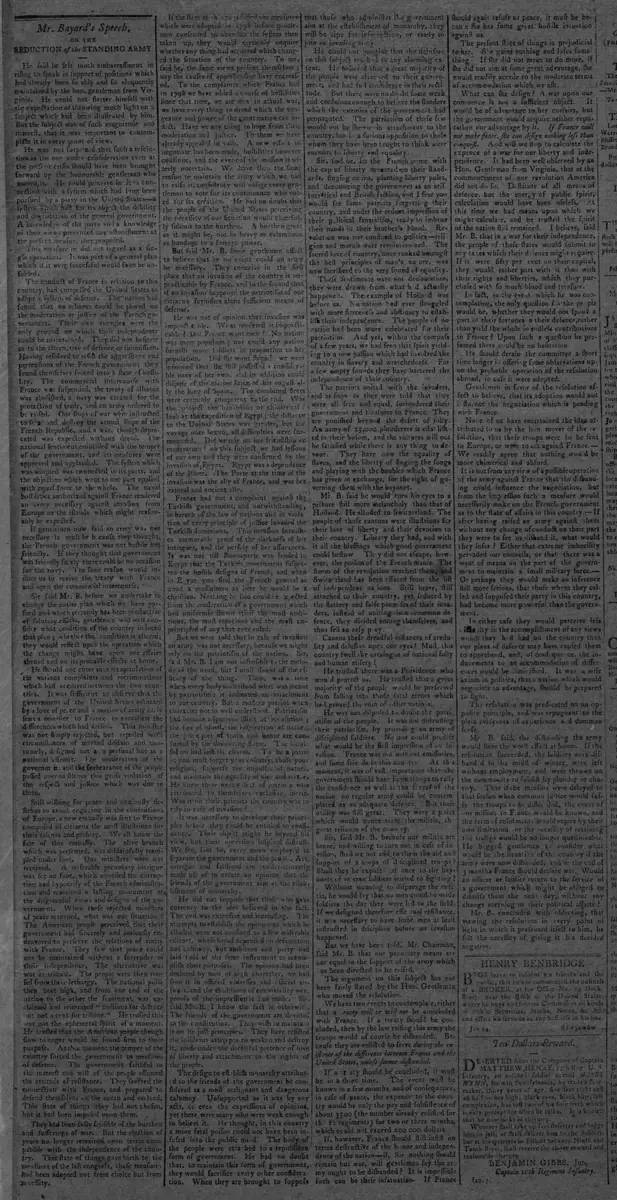
ON THE REDUCTION of the STANDING ARMY
He said he felt much embarrassment in rising to speak in support of positions which had already been so ably and so eloquently maintained by the hon. gentleman from Virginia. He could not flatter himself with the expectation of throwing much light on a subject which had been illustrated by him. But the subject was of such magnitude and interest, that it was important to contemplate it in every point of view.
He was not surprised that such a resolution as the one under consideration even at the present crisis should have been brought forward by the honourable gentleman who moved it. He could perceive in it a connection with a system which had long been pursued by a party in the United States--a system which had for its object the debility and degradation of the general government. A knowledge of the party and a knowledge of their views prevented any astonishment at the present measure they proposed.
This measure he did not regard as a single operation. It was part of a general plan which if it were successful would soon be unfolded.
The conduct of France in relation to this country, had compelled the United States to adopt a system of defence. The nation had found that no reliance could be placed on the moderation or justice of the French government. Their own energies were the only ground on which their independence could be maintained. They did not hesitate as to the alternative of defence or submission. Having resolved to resist the aggressions and pretensions of the French government they found themselves forced into a state of hostility. The commercial intercourse with France was suspended, the treaty of alliance was abolished, a navy was created for the protection of trade, and an army ordered to be raised. Our ships of war were instructed to seize and destroy the armed ships of the French Republic, and a war, though deprecated was expected without dread. The national sentiment coincided with the temper of the government, and its measures were approved and applauded. The system which was adopted was connected in its parts, and the objection which went to one part applied with equal force to the whole. The naval hostilities authorized against France rendered an army necessary against invasion from Europe or the islands which might reasonably be expected.
If gentlemen now said an army was not necessary it must be because they thought, the French government was not hostile but friendly. If they thought that government was friendly surely there could be no occasion for the navy. The same reason would induce us to revive the treaty with France and open the commercial intercourse.
Sir said Mr. B. before we undertake to change the entire plan which we have pursued and which certainly has been productive of salutary effects, gentlemen will well consider what condition of the country induced that plan; whether that condition is altered; they would reflect upon the operation which the change might have upon our affairs abroad and on its probable effects at home.
He should not enter into recapitulation of the various complaints and recriminations which had occurred between the two countries. It was sufficient to observe that the government of the United States actuated by a love of peace and a motive of amity early sent a minister to France to conciliate the differences which had arisen. This minister was not simply rejected, but repelled with circumstances of marked disdain and contumely, designed not as a personal but as a national affront. The moderation of the government and the forbearance of the people passed over in silence this gross violation of the respect and justice which was due to them.
Still wishing for peace and anxiously desirous to avoid engaging in the contentions of Europe, a new embassy was sent to France composed of citizens the most illustrious for their talents and probity. We all know the fate of this embassy. The olive branch which was presented, was disdainfully trampled under foot. Our ministers were not received. A miserable pecuniary intrigue was set on foot, which unveiled the corruption and hypocrisy of the French administration and remained a lasting monument of the disgraceful views and designs of the government. When these rejected ministers of peace returned, what was our situation? The American people perceived that their government had sincerely and zealously endeavored to preserve the relations of amity with France. They saw that peace could not be maintained without a surrender of their independence. The alternative was war or tribute. The people were then roused from their lethargy. The national pulse then beat high, and from one end of the nation to the other the sentiment was exclaimed and reiterated "millions for defence but not a cent for tribute." He trusted this was not the ephemeral spirit of a moment. He trusted that the American people though now to anger would be found firm to their purpose. At this moment the temper of the country forced the government to measures of defence. The government faithful to the interest and will of the people assumed the attitude of resistance. They severed the connection with France, and prepared to defend themselves on the ocean and on land. This state of things they had not chosen, but it had been imposed upon them. They had been fully sensible of the burthen and sufferings of war. But the election of peace no longer remained upon terms compatible with the independence of the country. This state of things gave birth to the measures of the last congress, those measures had been adopted not from choice but from necessity.
If the state of things justified the measures which were adopted in 1798 before gentlemen consented to abandon the system then taken up, they would certainly enquire whether any thing had occurred which changed the situation of the country. To me, said he, the same views present themselves; nay the causes of apprehension have increased. To the complaints which France had in 1798 we have added a course of hostilities since that time, we are now in actual war, we have every thing to dread which the vengeance and power of the great nation can inflict. Have we any thing to hope from their moderation and justice. To them we have already appealed in vain. A new effort to negotiate has been made, hostilities however continue, and the event of the mission is utterly uncertain. We have then the same reason to maintain the army which we had to raise it, consistency will oblige every gentleman to vote for its continuance who voted for its creation. He had no doubt that the people of the United States perceiving the necessity of our situation would cheerfully submit to the burthen. A burthen great as it might be, not so heavy or calamitous as bondage to a foreign power.
But said Mr. B. some gentlemen affect to believe that in no event could an army be necessary. They conceive in the first place that an invasion of the country is impracticable by France, and in the second that if an invasion happened the patriotism of our citizens furnishes alone sufficient means of defence.
He was not of opinion that invasion was impracticable. What rendered it impracticable? Did France want men? No nation was more populous; nor could any nation furnish more soldiers in proportion to her population. Did she want ships? we were informed that she still possessed a considerable navy of her own, and in addition could dispose of the marine force of her august ally the king of Spain. The combined fleets were certainly competent to the end. Was the project too hazardous or chimerical? look at the expedition of Egypt; the distance to the United States was greater, but the voyage once begun, all difficulties were surmounted. Did we rely on her friendship or moderation? on this subject we had lessons of our own and they were confirmed by the invasion of Egypt. Egypt was a dependence of the Porte. The Porte at the time of the invasion was the ally of France, and was her natural and ancient ally.
France had not a complaint against the Turkish government, and notwithstanding, in breach of the law of nations and in violation of every principle of justice invaded the Turkish dominions. This invasion furnishes memorable proof of the darkness of her intrigues, and the perfidy of her assurances. It was not till Buonaparte was landed in Egypt that the Turkish government suspected the hostile designs of France, and when in Egypt you find the French general as good a mussulman as here he would be a christian. Nothing he said could be expected from the moderation of a government which had uniformly shewn itself the most ambitious, the most rapacious and the most unprincipled of any that ever ruled.
But we were told that in case of invasion an army was not necessary, because we might rely on the patriotism of the nation. Sir, said Mr. B. I am not insensible to the melody of the word, but I must doubt of the efficacy of the thing. There was a time when every body understood what was meant by patriotism: it indicated an attachment to our country. But a modern patriot was a character not so well understood. Patriotism had become a spurious spirit of revolution: the ties of blood, the inspiration of nature the principles of truth and honor are consumed by the devouring flame. The natal soil had lost its charm. To be a patriot you must forget your country, abuse your religion, suppress the repulses of nature, and maintain the equality of vice and virtue. He knew there were a select of patriots who attributed to themselves exclusive merit. Was it on these patriots the country was to rely in case of invasion?
It was necessary to develope their principles before they could be entitled to confidence. Their object might be beyond his view, but their operation inspired distrust. We see, said he, every mean employed to separate the government and the people. Art, intrigue and falsehood are indiscriminately made use of to create an opinion that the friends of the government aim at the establishment of monarchy.
He did not suppose that those who gave currency to the idea believed in the fact. The evil was extensive and increasing. The attempts to establish the opinion to which he alluded were not confined to a few miserable editors, whose bread depended on defamation and calumny, but ambition and party had laid hold of the same instrument to accomplish their purposes. The opinion, had been declared by men of high character, we had seen it in official addresses and official answers, and the ebullitions of conviviality were proofs of the impression it had made. Sir, said Mr. B. I know the fact is otherwise. The friends of the government are devoted to the constitution. They wish to maintain it on its just principles. They have resisted the insidious attempts to weaken and destroy it, made under the deceitful pretence of love of liberty and attachment to the rights of the people.
The design to establish monarchy attributed to the friends of the government he considered as a most malignant and dangerous calumny. Unsupported as it was by any acts, or even the expression of opinions, yet there were many who were weak enough to believe it. He thought, in this country a more fatal poison could not have been infused into the public mind. The body of the people were attached to a republican form of government. He had no doubt that, to maintain this form of government, they would sacrifice every other consideration. When they are brought to suspect that those who administer the government aim at the establishment of monarchy, they will be ripe for insurrection, or ready to join an invading army.
He could not imagine that the delusion on this subject reached to any alarming extent. He believed that a great majority of the people were attached to their government, and had full confidence in their rectitude. But there were no doubt some weak and credulous enough to believe the slanders which the enemies of the government had propagated. The patriotism of these few would not be shewn in attachment to the country, but in a furious opposition to those whom they have been taught to think were enemies to liberty and equality.
Sir, said he, let the French come with the cap of liberty mounted on their standards, singing ca ira, planting liberty poles, and denouncing the government as an aristocratical and British faction, and I fear you would see some patriots forgetting their country, and under the ardent impression of their political fanaticism, ready to imbrue their hands in their brother's blood. Revolution was not confined to politics--religion and morals were revolutionized. The sacred love of country, once ranked amongst the best principles of man's nature, was now sacrificed to the very sound of equality. These sentiments were not declamation, they were drawn from what had actually happened. The example of Holland was before us. No nation had ever struggled with more fierceness and obstinacy to establish their independence. The people of no nation had been more celebrated for their patriotism. And yet, within the compass of a few years, we had seen that spirit yielding to a new passion which had involved the country in slavery and wretchedness. For a few empty sounds they have bartered the independence of their country. The patriots united with the invaders, and as soon as they were told that they were all free and equal, surrendered their government and treasures to France. They are punished beyond the desert of folly. An army of 25,000 plunderers is established in their bosom, and the vultures will not be satisfied while there is any thing to devour. They have now the equality of slaves, and the liberty of singing the songs and playing with the baubles which France has given in exchange, for the right of governing them with the bayonet.
Mr. B. said he would turn his eyes to a picture still more melancholy than that of Holland. He alluded to Switzerland. The people of those cantons were illustrious for their love of liberty and their devotion to their country. Liberty they had, and with it all the blessings which good government could bestow They did not escape, however, the poison of the French mania. The storm of the revolution reached them, and Switzerland has been effaced from the list of independent nations. Still brave, still attached to their country, yet seduced by the flattery and false promises of their invaders, instead of uniting in a common defence, they divided among themselves, and thus fell an easy prey.
Cannot the dreadful instances of credulity and delusion open our eyes! Must this country swell the catalogue of national folly and human misery! He trusted there was a Providence who would protect us. He trusted that a great majority of the people would be preserved from falling into those fatal errors which had proved the ruin of other nations. He was not disposed to doubt the patriotism of the people. It was not distrusting their patriotism, by providing an army of disciplined soldiers. No one could predict what would be the first impression of an invasion. France was not without emissaries, and some friends in this country At this moment, it was of vast importance that the government should have some troops to rally the confidence as well as the forces of the nation no regular army could be contemplated as an adequate defence. But their utility was still great. They were a point which would concentrate the militia, the great reliance of the country.
Sir, said Mr. B. because our militia are brave, and willing to turn out in case of invasion, shall we not add to them the aid and support of a corps of disciplined troops? Shall they be exposed at once to the bayonets of veteran soldiers inured to fighting? Without meaning to disparage the militia, he would say that no men could be made soldiers the day they were led to the field. If we designed therefore effectual resistance. it was necessary to have some men at least instructed in discipline before an invasion happened.
But we have been told, Mr. Chairman, said Mr. B. that our pecuniary means are not equal to the support of the army which has been directed to be raised. The argument on this subject has not been fairly stated by the Hon. Gentleman who moved the resolution. We have two events to contemplate, either that a treaty will or will not be concluded with France. If a treaty should be concluded, then by the law raising this army the troops would of course be disbanded. Because they are enlisted to serve during the existence of the difference between France and the United States, unless sooner disbanded. If a treaty should be concluded, it must be in a short time. The event must be known in a few months, and of consequence, in case of peace, the expense to the country would be only the pay and subsistence of about 3500 (the number already enlisted for the 12 regiments) for two or three months, which could not exceed 200,000 dollars.
If, however, France should still insist on terms destructive of the honor and independence of the nation-if, Sir nothing should remain but war, will gentlemen say the army ought to be disbanded? It is impossible such can be their infatuation- If France should again refuse us peace, it must be because she has some great hostile intention against us. The present state of things is prejudicial to her. She gains nothing and loses something If she did not mean to do more, if she did not aim at some great advantage, she would readily accede to the moderate terms of accommodation which we ask. What can she design? A war upon our commerce is not a sufficient object. It would be of advantage to her corsairs, but the government would acquire neither reputation nor advantage by it. If France will not make peace. she can design nothing less than conquest. And will we stop to calculate the expense of a war for our liberty and independence. It had been well observed by an Hon. Gentleman from Virginia, that at the commencement of our revolution America did not do so. Destitute of all means of defence. but the energy of public spirit, calculation would have been useless. At this time we had means upon which we might calculate, and he trusted the spirit of the nation still remained. I believe, said Mr. B. that in a war for their independence, the people of these states would submit to any taxes which their defence might require. If it were fifty per cent on their capital, they would rather part with it than with their rights and liberties, which they purchased with so much blood and treasure. In fact. in the event which he was contemplating, the only question for the people would be, whether they would not spend a part of their fortunes in their defence, rather than yield the whole in endless contributions to France ? Upon such a question he presumed there could be no hesitation.
He should detain the committee a short time longer in offering some observations upon the probable operation of the resolution abroad, in case it were adopted. Gentlemen in favor of the resolution affect to believe, that its adoption would not influence the negociation which is pending with France. None of us have entertained the idea attributed to us by the hon. mover of the resolution, that these troops were to be sent to Europe, or were to act against France. We readily agree that nothing would be more chimerical and absurd. It is not from any view of a possible operation of the army against France that the disbanding could influence the negociation, but from the impression such a measure would necessarily make on the French government as to the state of affairs in this country.-If after having raised an army against them without any change of conduct on their part they were to see us disband it, what would they infer ? Either that extreme imbecility pervaded our councils, or that there was a want of means on the part of the government to maintain a small military force. Or perhaps they would make an inference still more serious, that those whom they called and supposed their party in this country, had become more powerful than the government. In either case they would perceive less difficulty in the accomplishment of any views which they had had on the country than our plans of defence may have caused them to apprehend, and, of consequence, the inducements to an accommodation of differences would be diminished, It was. a wise axiom in politics, that a nation which would negotiate to advantage, should be prepared to fight.
The resolution was predicated on an opposite principle, and was repugnant to the plain evidences of experience and common sense
Mr. B. said, the disbanding the army would have the worst effect at home. If the resolution succeeded, the soldiers were disbanded in the midst of winter. were left without employment, and were thrown on the community to subsist by plunder or charity. That if the measure were delayed to that season when common justice would suffer the troops to be disbanded, the event of our mission to France would be known, and the term of enlistments would expire by their own limitation or the necessity of retaining the troops would be no longer questionable. He begged gentlemen to consider what would be the situation of the country if the army were now disbanded, and at the end of 3 months France should declare war. Would an officer or soldier return to the service of a government which might be obliged to dismiss them the next day, without any change accruing in their political affairs ?
Mr. B. concluded with observing, that viewing the resolution in every point of light in which it presented itself to him, he felt the necessity of giving it his decided negative.
What sub-type of article is it?
What keywords are associated?
What entities or persons were involved?
Domestic News Details
Key Persons
Outcome
mr. bayard argued against the resolution to reduce the standing army, emphasizing its necessity for defense and warning of negative domestic and international consequences if adopted.
Event Details
Mr. Bayard delivered a speech in support of maintaining the U.S. standing army amid tensions with France, critiquing the resolution to reduce it as part of a broader plan to weaken the government. He reviewed historical grievances with France, the necessity of defensive measures adopted in 1798, and dismissed arguments against the army's need by citing French capabilities for invasion and questioning reliance on untested patriotism. He highlighted examples from Holland and Switzerland to illustrate risks of revolutionary fervor aiding invaders and stressed the army's role in bolstering militia and national resolve.