Thank you for visiting SNEWPapers!
Sign up free
Southern Christian Advocate
Charleston, Charleston County, South Carolina
What is this article about?
Northern Methodist press reactions to Judge Nelson's decision in the Bascom vs. Lane church property suit, favoring Southern claimants. Critics argue it won't reunite the churches divided by slavery since 1844, with appeals possible and deep moral divides persisting.
Merged-components note: Continuation of the article on the church suit and spirit of the press.
Clipping
OCR Quality
Full Text
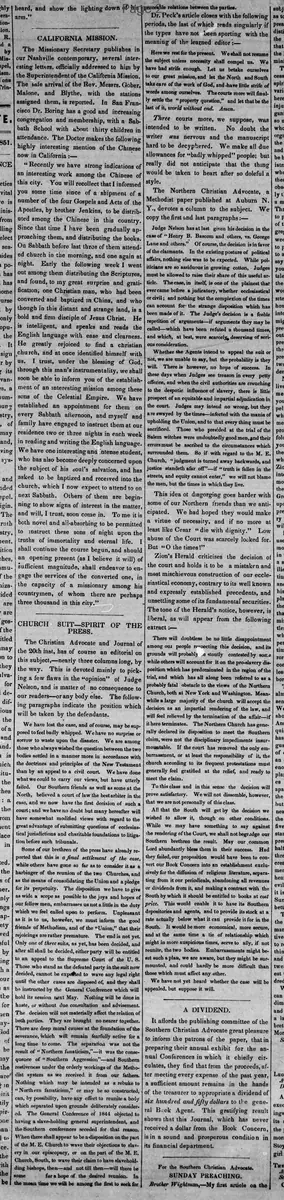
The Christian Advocate and Journal of the 20th inst, has of course an editorial on this subject,--nearly three columns long, by the way. This is devoted mainly to picking a few flaws in the "opinion" of Judge Nelson, and is matter of no consequence to our readers or any body else. The following paragraphs indicate the position which will be taken by the defendants.
We have lost the case, and of course, may be supposed to feel badly whipped. We have no surprise or sorrow to waste upon the disaster. We are among those who always wished the question between the two bodies settled in a manner more in accordance with the doctrines and principles of the New Testament than by an appeal to a civil court. We have done what we could to carry our views, but have utterly failed. Our Southern friends as well as some at the North, believed a court of law the best arbiter in the case, and we now have the first decision of such a court; and we have no doubt but many hereafter will have somewhat modified views with regard to the great advantage of submitting questions of ecclesiastical jurisdictions and charitable foundations to litigation before such tribunals.
Some of our brethren of the press have already reported that this is a final settlement of the case, while others have gone so far as to consider it as a harbinger of the reunion of the two Churches, and as the means of consolidating the Union and a pledge for its perpetuity. The disposition we have to give as wide a scope as possible to the joys and hopes of our fellow men, embarrasses us not a little in the duty which we feel called upon to perform. Unpleasant as it is to us, however, we must inform the good friends of Methodism, and of the "Union," that their rejoicings are rather premature. The end is not yet.
Only one of three suits, as yet, has been decided, and after all shall be decided, either party will be entitled to an appeal to the Supreme Court of the U. S. Those who stand as the defeated party in the suit now decided, cannot be expected to waive any legal right until the other cases are disposed of, and they shall be instructed by the General Conference which will hold its session next May. Nothing will be done in haste, or without due consultation and advisement.
The decision will not materially affect the relation of both parties. They are brought no nearer together. There are deep moral causes at the foundation of the severance, which will remain fearfully active for a long time to come. The separation was not the result of "Northern fanaticism,"--it was the consequence of "Southern Aggression"--and Southern restiveness under the orderly workings of the Methodist system as we received it from our fathers.
Nothing which may be intended as a rebuke to "Northern fanaticism," or may be so constructed, can, by possibility, have any effect to reunite a body which separated upon grounds deliberately considered. The General Conference of 1844 objected to having a slave-holding general superintendent, and the Southern conferences seceded for that reason.
When there shall appear to be a disposition on the part of the M. E. Church to waive their objections to slavery in our episcopacy, or on the part of the M. E. Church, South, to waive their claim to have slaveholding bishops, then and not till then--will there be some for a hope of the desired reunion. In the mean time we will be among the first to seek for
Dr. Peck's article closes with the following periods, the last of which reads singularly if the types have not been sporting with the meaning of the learned editor:
Here we rest for the present. We shall not resume the subject unless necessity shall compel us. We have had strife enough. Let us betake ourselves to our great mission, and let the North and South take care of the work of God, and have little strife of words among ourselves. The courts more will finally settle the "property question," and let that be the last of it, world without end. Amen.
Three courts more, we suppose, was intended to be written. No doubt the writer was nervous and the manuscript hard to be deciphered. We make all due allowances for "badly whipped" people; but really did not anticipate that the thing would be taken to heart after so doleful a style.
The Northern Christian Advocate, a Methodist paper published at Auburn N. Y., devotes a column to the subject. We copy the first and last paragraphs:--
Judge Nelson has at last given his decision in the case of "Henry B. Bascom and others, vs. George Lane and others." Of course, the decision is in favor of the claimants. In the existing posture of political affairs, nothing else was to be expected. While politicians are so assiduous in growing cotton, Judges must be allowed to raise their share of this useful article. The case, in itself, is one of the plainest that ever came before a judicatory, whether ecclesiastical or civil; and nothing but the complexion of the times can account for the strange disposition which has been made of it. The Judge's decision is a feeble repetition of arguments--if arguments they may be called--which have been refuted a thousand times. and which, at best, were scarcely deserving of serious consideration.
Whether the Agents intend to appeal the suit or not, we are unable to say, but the probability is they will. There is however, no hope of success. In these days when Judges see treason in every petty offense, and when the civil authorities are crouching to the despotic influence of slavery, there is little prospect of an equitable and impartial adjudication in the court. Judges may intend no wrong, but they are swayed by the times--infected with the mania of upholding the Union, and to that every thing must be sacrificed. Those who presided at the trial of the Salem witches were undoubtedly good men, and their errors must be ascribed to the circumstances which surrounded them. So it is with regard to the M. E. Church, "judgment is turned away backwards, and justice standeth afar off" if "truth is fallen in the streets, and equity cannot enter," we will not blame the men, but the times in which they live.
This idea of disgorging goes harder with some of our Northern friends than we anticipated. We had hoped they would make a virtue of necessity, and if no more at least like Cesar "die with dignity." Low abuse of the Court was scarcely looked for. But "O the times!"
Zion's Herald criticises the decision of the court and holds it to be a mistaken and most mischievous construction of our ecclesiastical economy, contrary to its well known and expressly established precedents, and unsettling some of its fundamental securities.
The tone of the Herald's notice, however, is liberal, as will appear from the following extract:
There will doubtless be no little disappointment among our people respecting this decision, and its grounds will probably be stoutly contested by some while others will account for it on the pro-slavery disposition which has predominated in the region of the trial, and which has all along been referred to as a probably fatal obstacle to the views of the Northern Church, both at New York and Washington. Meanwhile a large majority of the church will accept the decision as an impartial rendering of the law, and will feel relieved by the termination of the affair--if it here terminates. The Northern Church has generally declared its disposition to meet the Southern claim, were not the disciplinary impediments insurmountable. If the court has removed the only embarrassment, or at least the responsibility of it, the church according to its frequent protestations must generally feel gratified at the relief, and ready to meet the claim.
To this class and in this sense the decision will prove satisfactory. We will not dissemble, however, that we are not personally of this class.
All that the South will get by the decision we wished to allow it, though on other conditions. While we may have something to say against the rendering of the Court, we shall not begrudge our Southern brethren the result. May our common Lord abundantly bless them in their success. Had they failed, our proposition would have been to convert our Book Concern into an establishment exclusively for the diffusion of religious literature, separating from it our periodicals, abandoning all revenues or dividends from it, and making a contract with the South by which it should be entitled to books at cost price. This would enable it to have its Southern depositories and agents, and to provide its stock at a rate actually below what it can provide it for in the South. It would be more economical, more secure, and at the same time a tie of relationship which might in more auspicious times, serve to ally, if not reunite, the two bodies. Embarrassments might beset such a plan, we are aware, but they might be surmounted, and could hardly be more difficult than those which must affect any other.
We have not yet heard whether the case will be appealed, but suppose it will
What sub-type of article is it?
What themes does it cover?
What keywords are associated?
What entities or persons were involved?
Where did it happen?
Story Details
Key Persons
Location
Region Of The Trial (Pro Slavery Area); New York; Washington
Event Date
1844 (Schism); Recent Decision (20th Inst.); General Conference Next May
Story Details
Judge Nelson rules in favor of Southern Methodists in Bascom vs. Lane property suit. Northern press reacts with criticism, attributing bias to pro-slavery influences; argues decision won't reunite churches divided since 1844 over slavery in episcopacy; appeals likely; deep moral divides persist.