Thank you for visiting SNEWPapers!
Sign up free
The Daily Union
Washington, District Of Columbia
What is this article about?
In New Orleans court, Judge McHenry imprisons prominent lawyer Pierre Soulé for 24 hours and fines him $100 for contempt after Soulé withdraws from defending a client due to the judge's interruptions and perceived insults. Soulé, a noted senator, is praised for his eloquence amid the controversy.
Clipping
OCR Quality
Full Text
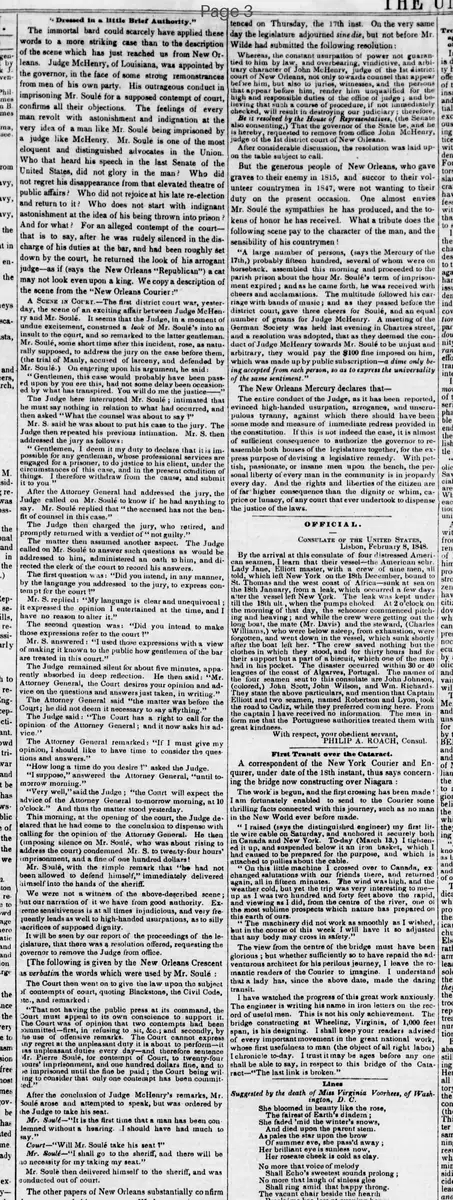
The immortal bard could scarcely have applied these words to a more striking case than to the description of the scene which has just reached us from New Orleans. Judge McHenry, of Louisiana, was appointed by the governor, in the face of some strong remonstrances from men of his own party. His outrageous conduct in imprisoning Mr. Soulé for a supposed contempt of court, confirms all their objections. The feelings of every man revolt with astonishment and indignation at the very idea of a man like Mr. Soulé being imprisoned by a judge like McHenry. Mr. Soule is one of the most eloquent and distinguished advocates in the Union. Who that heard his speech in the last Senate of the United States, did not glory in the man? Who did not regret his disappearance from that elevated theatre of public affairs? Who did not rejoice at his late re-election and return to it? Who does not start with indignant astonishment at the idea of his being thrown into prison? And for what? For an alleged contempt of the court—that is to say, after he was rudely silenced in the discharge of his duties at the bar, and had been roughly set down by the court, he returned the look of his arrogant judge—as if (says the New Orleans "Republican") a cat may not look even upon a king. We copy a description of the scene from the "New Orleans Courier:"
A SCENE IN COURT.—The first district court was, yesterday, the scene of an exciting affair between Judge McHenry and Mr. Soulé. It seems that the Judge, in a moment of undue excitement, construed a look of Mr. Soulé's into an insult to the court, and so remarked to the latter gentleman. Mr. Soulé, some short time after this incident, rose, as naturally supposed, to address the jury on the case before them, (the trial of Manly, accused of larceny, and defended by Mr. Soulé.) On entering upon his argument, he said:
"Gentlemen, this case would probably have been passed upon by you ere this, had not some delay been occasioned by what has transpired. You will do me the justice—"
The Judge here interrupted Mr. Soulé; intimated that he must say nothing in relation to what had occurred, and then asked "What the counsel was about to say?"
Mr. S. said he was about to put his case to the jury. The Judge then repeated his previous intimation. Mr. S. then addressed the jury as follows:
"Gentlemen, I deem it my duty to declare that it is impossible for any gentleman, whose professional services are engaged for a prisoner, to do justice to his client, under the circumstances of this case, and in the present condition of things. I therefore withdraw from the cause, and submit it to you."
After the Attorney General had addressed the jury, the Judge called on Mr. Soulé to know if he had anything to say. Mr. Soulé replied that "the accused has not the benefit of counsel in this case."
The Judge then charged the jury, who retired, and promptly returned with a verdict of "not guilty."
The matter then assumed another aspect. The Judge called on Mr. Soulé to answer such questions as would be addressed to him, administered an oath to him, and directed the clerk of the court to record his answers.
The first question was: "Did you intend, in any manner, by the language you addressed to the jury, to express contempt for the court?"
Mr. S. replied: "My language is clear and unequivocal; it expressed the opinion I entertained at the time, and I have no reason to alter it."
The second question was: "Did you intend to make those expressions refer to the court?"
Mr. S. answered: "I used those expressions with a view of making it known to the public how gentlemen of the bar are treated in this court."
The Judge remained silent for about five minutes, apparently absorbed in deep reflection. He then said: "Mr. Attorney General, the Court desires your opinion and advice on the questions and answers just taken, in writing."
The Attorney General said "the matter was before the Court; he did not deem it necessary to say anything."
The Judge said: "The Court has a right to call for the opinion of the Attorney General; and it now asks his advice."
The Attorney General remarked: "If I must give my opinion, I should like to have time to consider the questions and answers."
"How long a time do you desire?" asked the Judge.
"I suppose," answered the Attorney General, "until to-morrow morning."
"Very well," said the Judge; "the Court will expect the advice of the Attorney General to-morrow morning, at 10 o'clock." And thus the matter stood yesterday.
This morning, at the opening of the court, the Judge declared that he had come to the conclusion to dispense with calling for the opinion of the Attorney General. He then (imposing silence on Mr. Soulé, who was about rising to address the court) condemned Mr. S. to twenty-four hours imprisonment, and a fine of one hundred dollars!
Mr. Soulé, with the simple remark that "he had not been allowed to defend himself," immediately delivered himself into the hands of the sheriff.
We were not a witness of the above-described scene; but our narration of it we have from good authority. Extreme sensitiveness is at all times injudicious, and very frequently leads as well to high-handed usurpations, as to silly sacrifices of supposed dignity.
It will be seen by our report of the proceedings of the legislature, that there was a resolution offered, requesting the governor to remove the Judge from office.
[The following is given by the New Orleans Crescent as verbatim the words which were used by Mr. Soulé:
The Court then went on to give the law upon the subject of contempts of court, quoting Blackstone, the Civil Code, etc., and remarked:
"That not having the public press at its command, the Court must appeal to its own conscience to support it. The Court was of opinion that two contempts had been committed—first, in refusing to sit, &c.; and secondly, by the use of offensive remarks. The Court cannot express any regret at the unpleasant duty it is about to perform—it is unpleasant duties every day—and therefore sentence Mr. Pierre Soulé, for contempt of Court, to twenty-four hours' imprisonment, and one hundred dollars fine, and to be imprisoned until the fine be paid; the Court being willing to consider that only one contempt has been committed."
What sub-type of article is it?
What themes does it cover?
What keywords are associated?
What entities or persons were involved?
Where did it happen?
Story Details
Key Persons
Location
New Orleans, First District Court
Story Details
During a larceny trial, Judge McHenry interrupts and silences lawyer Pierre Soulé, who withdraws from the case citing inability to defend his client properly. After the jury acquits the defendant, the judge questions Soulé under oath, finds contempt in his statements, and sentences him to 24 hours imprisonment and a $100 fine without allowing defense. The incident sparks calls for the judge's removal.