Thank you for visiting SNEWPapers!
Sign up free
The Enquirer
Richmond, Henrico County, Virginia
What is this article about?
House of Commons debate on April 17 features petitions from manufacturing towns against Orders in Council, blamed for trade losses with America and distress. Ministers defend as retaliation to French decrees, highlighting maritime rights and rejecting repeal amid war risks. (248 characters)
Clipping
OCR Quality
Full Text
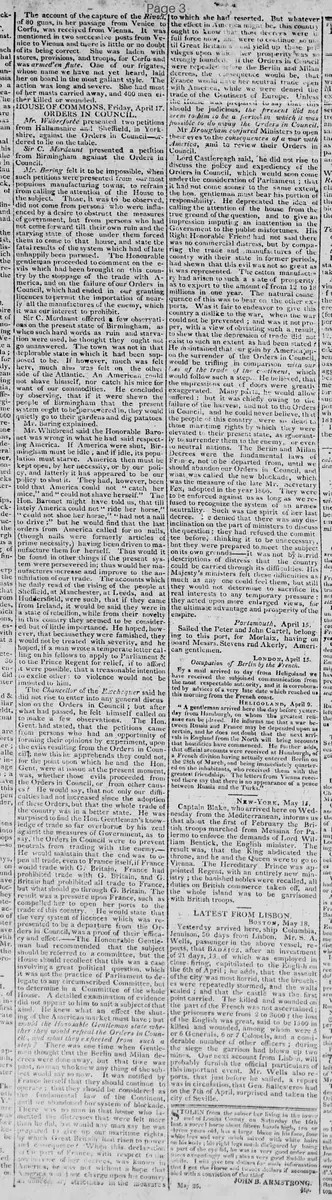
ORDERS IN COUNCIL.
Mr. Wilberforce presented two petitions from Hallamshire and Sheffield, in Yorkshire, against the Orders in Council--ordered to lie on the table.
Sir C. Mordaunt presented a petition from Birmingham against the Orders in Council.
Mr. Baring felt it to be impossible, when such petitions were presented from our most populous manufacturing towns, to refrain from calling the attention of the House to the subject. Those, it was to be observed, did not come from persons who were influenced by a desire to obstruct the measures of government, but from persons who had not come forward till their own ruin and the starving state of those under them forced them to come to that house, and state the fatal results of the system which had of late unhappily been pursued. The Honourable gentleman proceeded to comment on the evils which had been brought on this country by the stoppage of the trade with America, and on the failure of our Orders in Council, which had ended in our granting licences to permit the importation of nearly all the manufactures of the enemy, which it was our interest to prohibit.
Sir C. Mordaunt offered a few observations on the present state of Birmingham, as when such hard words as ruin and starvation were used, he thought they ought not go unanswered. The town was not in that deplorable state in which it had been supposed to be. If however, much was felt here, much also was felt on the other side of the Atlantic. An American could not shave himself, nor catch his mice for want of our commodities. He concluded by observing, that if it were shewn the people of Birmingham that the present system ought to be persevered in, they would quietly go to their gardens and dig potatoes.
Mr. Baring explained.
Mr. Whitbread said the Honorable Baronet was wrong in what he had said respecting America. If America were shut, Birmingham must be idle, and if idle, its population must starve. America then must be kept open, by her necessity, or by our policy, and latterly it has appeared to be our policy to shut it. They had, however, been told that America could not "catch her mice," and "could not shave herself." The Hon. Baronet might have told us, that till lately America could not "ride her horse," "could not shoe her horse," "had not a nail to drive ;" but he would find that the last orders from America called for no nails, (though nails were formerly articles of prime necessity,) having been driven to manufacture them for herself. Thus would it be found in other things if the present system were persevered in; thus would her manufactures increase and improve to the annihilation of our trade. The accounts which he daily read of the rising of the people at Sheffield, at Manchester, at Leeds, and at Huddersfield, were such, that if they came from Ireland, it would be said they were in a state of rebellion, while from their novelty in this country they seemed to be considered but of little importance. He hoped, however, that because they were famished, they would not be treated with severity, and he hoped, if a man wrote a temperate letter calling on his fellows to apply to Parliament & to the Prince Regent for relief, if to afford it were possible, that a treasonable intention to excite others to violence would not be imputed to him.
The Chancellor of the Exchequer said he did not rise to enter into any general discussion on the Orders in Council; but after what had passed, he felt himself called on to make a few observations. The Hon. Gent. had stated, that the petitions came from persons who had an opportunity of forming their opinions by experiment, upon the evils resulting from the Orders in Council; now this he apprehends they could not, for the point upon which he and the Hon. Gent. were at issue at the present moment, was, whether those evils proceeded from the Orders in Council, or from other causes? He would say, that not only our difficulties had not increased since the adoption of these Orders, but that the whole trade of the country was in a better state. He was surprised to find the Hon. Gentleman's knowledge of trade so far overborne by his zeal against the measures of Government, as to say, the Orders in Council were to prevent neutrals from trading with the enemy.- He would maintain that the end was to open all trade, even to France itself, if France would trade with G. Britain. France had prohibited trade with G. Britain, and G. Britain had prohibited all trade to France, but what should go through G. Britain. The result was a pressure upon France, such as compelled her to open her ports to the trade of this country. He would state that the very system of licences which was represented to be a departure from the Orders in Council, was a proof of their efficacy and effect.---The Honourable Gentleman had recommended that the subject should be referred to a committee, but the House should recollect that this was a case involving a great political question, which it was not the practice of Parliament to delegate to any circumscribed Committee, but to determine in a Committee of the whole House. A detailed examination of evidence did not appear to him to suit a subject of that kind. He knew what an effect the shutting of the American market must have; but would the Honourable Gentleman state whether they would repeal the Orders in Council, and what they expected from such a step ? There was one time when Gentlemen thought that the Berlin and Milan decrees were done away, but that time was past, no man who knew any thing of the subject would say so now. It was notified by France herself that they should continue to operate ; that they should be considered as the fundamental law of the Continent. Until we abandoned our system of blockade. There was no man in that house who lamented the distresses that were felt more than he did. But would any man say he was prepared to give up our maritime rights, by which Great Britain had risen to power and consequence? When this declaration on the part of France, with respect to the non-interference of her decrees, was known in America, he was not without a hope that America would not charge upon his Country d. vunce. a, strictness in the measures to which she had resorted. But whatever the effect in America might be, this country ought to know that those decrees were in full force now, and were to continue. so until Great Britain should yield up these privileges upon which her prosperity was strongly founded. If the Orders in Council were repealed before the Berlin and Milan decrees, the consequence would be, that France would have her neutral trade open with America, while we were denied the trade of the Continent of Europe. Unless the House was prepared to say that this should be judicious, the present did not seem to him to be a period in which it was possible to do away the Orders in Council.
Mr Brougham conjured Ministers to open their eyes to the consequences of a war with America, and to review their Orders in Council.
Lord Castlereagh said, he did not rise to discuss the policy and expediency of the Orders in Council, which would soon come under the consideration of Parliament ; that it had not come sooner to the same extent, the hon. gentleman must bear his portion of responsibility. He deprecated the idea of calling the attention of the house from the true ground of the question, and to give an impression imputing an inattention in the Government to the public misfortunes. His Right Honorable Friend had not said there was no commercial distress, but by comparing the trade and manufactures of the country with their state in former periods, had shown that this evil was not so great as it was represented. The cotton manufactory had arisen to such a state of prosperity as to export to the amount of from 12 to 18 millions in one year. The natural consequence of this was to bear on the other exports. Was it fair to endeavor to give this country a dislike to the war, when the war could not be prevented ; and was it not proper, with a view of obviating such a result, to shew that the depression of trade did not exist to such an extent as had been stated ? He maintained that our gain by America upon the surrender of the Orders in Council, would be trifling in comparison with our loss at the trade of the continent, which would follow such a step. He believed, that the impressions out of doors were greatly exaggerated. Many parts, he would allow suffered : but it was chiefly owing to the failure of the harvest. and not to the Orders in Council, and he could never believe, that the people of this country were so dead to those maritime rights by which they were elevated to their present state, as guarantee to surrender them to the enemy, or even to neutral nations. The Berlin and Milan Decrees were the fundamental laws of France, not to be departed from, until we should abandon our Orders in Council, and what was called the new blockade, which was the measure of the late Mr. secretary Fox; adopted in the year 1806. They were to be enforced against us as long as we refused to recognize the system of an armed neutrality. Such was the spirit of her last decree. He denied that there was any disinclination on the part of ministers to discuss the question; they had refused the committee before; thinking it to be unnecessary, but they were prepared to meet the subject on its own grounds---It was not by horrid descriptions of distress- that the country could be carried through its difficulties. His Majesty's ministers felt these difficulties as much as any one could feel them, but still they would not determine to sacrifice its real interests to any temporary pressure : they acted upon more enlarged views, for the ultimate advantage and prosperity of the empire.
What sub-type of article is it?
What keywords are associated?
What entities or persons were involved?
Where did it happen?
Foreign News Details
Primary Location
America
Event Date
Friday, April 17
Key Persons
Outcome
debate highlights manufacturing distress in british towns due to orders in council; ministers defend policy as necessary retaliation against french decrees, warning of greater losses if repealed; no immediate resolution.
Event Details
In House of Commons, petitions against Orders in Council presented from Hallamshire, Sheffield, and Birmingham. Mr. Baring criticizes policy for ruining trade with America and allowing enemy imports. Sir C. Mordaunt downplays Birmingham's distress and notes American shortages. Mr. Whitbread argues America will develop own manufactures, leading to British trade loss, and urges leniency toward protests. Chancellor defends Orders as effective pressure on France, rejecting committee referral. Mr. Brougham warns of war with America. Lord Castlereagh attributes some distress to harvest failure, emphasizes maritime rights, and affirms ministers' readiness to discuss.