Thank you for visiting SNEWPapers!
Sign up free
Editorial
July 8, 1805
Norfolk Gazette And Publick Ledger
Norfolk, Virginia
What is this article about?
The Society of Constitutional Republicans in Philadelphia defends Governor Thomas McKean against 'malcontent' opponents seeking his removal via a constitutional convention or rival candidacy. They deny libelous charges of corruption and tyranny, praise his administration's achievements in law enforcement, militia, agriculture, and education, and call for his re-election in 1805 while excluding hostile legislators.
Clipping
OCR Quality
98%
Excellent
Full Text
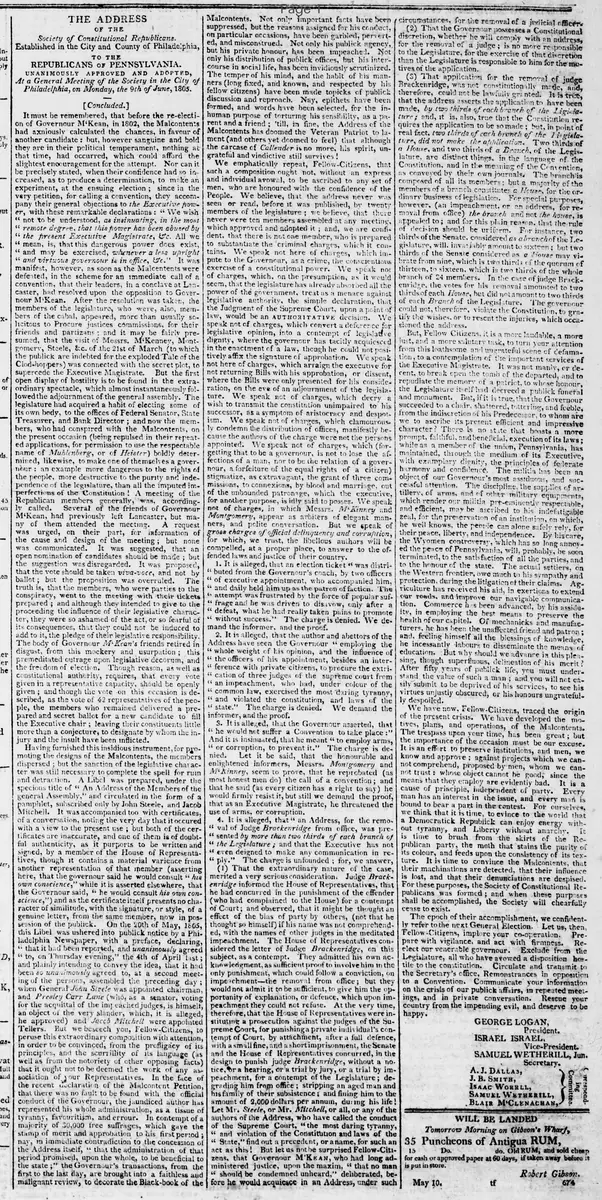
THE ADDRESS
OF THE
Society of Constitutional Republicans.
Established in the City and County of Philadelphia.
TO THE
REPUBLICANS OF PENNSYLVANIA.
UNANIMOUSLY APPROVED AND ADOPTED,
At a General Meeting of the Society in the City of Philadelphia, on Monday, the 9th of June, 1805.
[Concluded.]
It must be remembered, that before the re-election of Governor M'Kean, in 1802, the Malcontents had anxiously calculated the chances, in favour of another candidate: but, however sanguine and bold they are in their political temperament, nothing at that time, had occurred, which could afford the slightest encouragement for the attempt. Nor can it be precisely stated, when their confidence had so increased, as to produce a determination, to make an experiment, at the ensuing election; since in the very petition, for calling a convention, they accompany their general objections to the Executive power, with these remarkable declarations: "We wish not to be understood, as insinuating, in the most remote degree, that this power has been abused by the present Executive Magistrate, &c. All we mean, is, that this dangerous power does exist, and may be exercised, whenever a less upright and virtuous governor is in office, &c." It was manifest, however, as soon as the Malcontents were defeated, in the scheme for an immediate call of a convention, that their leaders, in a conclave at Lancaster, had resolved upon the opposition to Governor M'Kean. After the resolution was taken, the members of the legislature, who were, also, members of the cabal, appeared, more than usually solicitous to procure justices commissions, for their friends and partisans; and it may be fairly presumed, that the visit of Messrs. M'Kenney, Montgomery, Steele, &c. of the 21st of March (to which the publick are indebted for the exploded Tale of the Clod-hoppers) was connected with the secret plot, to supercede the Executive Magistrate. But the first open display of hostility is to be found in the extraordinary spectacle, which almost instantaneously followed the adjournment of the general assembly. The legislature had acquired a habit of electing some of its own body, to the offices of Federal Senator, State Treasurer, and Bank Director; and now the members, who had conspired with the Malcontents, on the present occasion (being repulsed in their repeated applications, for permission to use the respectable name of Muhlenberg, or of Heister) boldly determined, likewise, to make one of themselves a governor: an example more dangerous to the rights of the people, more destructive to the purity and independence of the legislature, than all the imputed imperfections of the Constitution! A meeting of the Republican members generally, was, accordingly called. Several of the friends of Governor M'Kean, had previously left Lancaster, but many of them attended the meeting. A request was urged, on their part, for information of the cause and design of the meeting; but none was communicated. It was suggested, that an open nomination of candidates should be made; but the suggestion was disregarded. It was proposed, that the vote should be taken viva-voce, and not by ballot; but the proposition was overruled. The truth is, that the members, who were parties to the conspiracy, went to the meeting with their tickets prepared; and although they intended to give to the proceeding the influence of their legislative character, they were so ashamed of the act, or so fearful of its consequences, that they could not be induced to add to it, the pledge of their legislative responsibility. The body of Governor M'Kean's friends retired in disgust, from this mockery and usurpation; this premeditated outrage upon legislative decorum, and the freedom of election. Though reason, as well as constitutional authority, requires, that every vote given in a representative capacity, should be openly given; and though the vote on this occasion is described, as the vote of 42 representatives of the people, the members who remained delivered a prepared and secret ballot for a new candidate to fill the Executive chair; leaving their constituents little more than a conjecture, to designate by whom the injury and the insult have been inflicted.
Having furnished this insidious instrument, for promoting the designs of the Malcontents, the members dispersed; but the sanction of the legislative character was still necessary to complete the spell for ruin and detraction. A Libel was prepared, under the specious title of "An Address of the Members of the general Assembly," and circulated in the form of a pamphlet, subscribed only by John Steele, and Jacob Mitchell. It was accompanied too with certificates, of a conversation, noting the very day that it occurred with a view to the present use; but both of the certificates are inaccurate, and one of them is of doubtful authenticity, as it purports to be written and signed, by a member of the House of Representatives, though it contains a material variance from another representation of that member (asserting here, that the governor said he would consult "his own conscience," while it is asserted elsewhere, that the Governor said, "he would consult his own conscience," ) and as the certificate itself presents no character of similitude, with the signature, or style, of a genuine letter, from the same member, now in possession of the publick. On the 20th of May, 1805, this Libel was ushered into publick notice by a Philadelphia Newspaper, with a preface, declaring, "that it had been reported, and unanimously agreed to, on Thursday evening," the 4th of April last; and plainly intending to convey the idea, that it had been so unanimously agreed to, at a second meeting of the persons, assembled the preceding day; when General John Steele was appointed chairman, and Presley Carr Lane (who, as a senator, voting for the acquittal of the impeached judges, is himself, an object of the very slander, which, it is alleged, he approved) and Jacob Mitchell were appointed Tellers. But we beseech you, Fellow-Citizens, to peruse this extraordinary composition with attention, in order to be convinced, from the profligacy of its principles, and the scurrility of its language (as well as from the notoriety of other opposing facts) that it ought not to be deemed the work of any association of your Representatives. In the face of the recent declaration of the Malcontent Petition, that there was no fault to be found with the official conduct of the Governor, the jaundiced author has represented his whole administration, as a tissue of tyranny, favouritism, and error. In contempt of a majority of 30,000 free suffrages, which gave the stamp of merit and approbation to his first period; nay, in immediate contradiction to the concession of the Address itself, "that the administration of that period promised, upon the whole, to be beneficial to the state;" the Governor's transactions, from the first to the last day, are brought into a faithless and malignant review, to decorate the Black-book of the Malcontents. Not only important facts have been suppressed, but the reasons assigned for his conduct, on particular occasions, have been garbled, perverted, and misconstrued. Not only his publick agency, but his private honour, has been impeached. Not only his distribution of publick offices, but his intercourse in social life, has been invidiously scrutinized. The temper of his mind, and the habit of his manners (long fixed, and known, and respected by his fellow citizens) have been made topics of publick discussion and reproach. Nay, epithets have been formed, and words have been selected, for the inhuman purpose of torturing his sensibility, as a parent and a friend: 'till, in fine, the Address of the Malcontents has doomed the Veteran Patriot to lament (and others yet doomed to feel) that although the carcase of Callender is no more, his spirit, ungrateful and vindictive still survives!
We emphatically repeat, Fellow-Citizens, that such a composition ought not, without an express and individual avowal, to be ascribed to any set of men, who are honoured with the confidence of the People. We believe, that the address never was seen or read, before it was published, by twenty members of the legislature; we believe, that there never were ten members assembled at any meeting, which approved and adopted it; and, we are confident, that there is not one member, who is prepared to substantiate the criminal charges, which it contains. We speak not here of charges, which impute to the Governor, as a crime, the conscientious exercise of a constitutional power. We speak not of charges, which, on the presumption, as it would seem, that the legislature has already absorbed all the power of the government, treat as a menace against legislative authority, the simple declaration, that the Judgment of the Supreme Court, upon a point of law, would be an AUTHORITATIVE decision. We speak not of charges, which convert a deference for legislative opinion, into a contempt of legislative dignity, where the governor has tacitly acquiesced in the enactment of a law, though he could not positively affix the signature of approbation. We speak not here of charges, which arraign the executive for not returning Bills with his approbation, or dissent, where the Bills were only presented for his consideration, on the eve of an adjournment of the legislature. We speak not of charges, which decry a wish to transmit the constitution unimpaired to his successor, as a symptom of aristocracy and despotism. We speak not of charges, which clamorously condemn the distribution of offices, manifestly because the authors of the charge were not the persons appointed: We speak not of charges, which (forgetting that to be a governor, is not to lose the affections of a man, nor to be the relation of a governor, a forfeiture of the equal rights of a citizen) stigmatize, as extravagant, the grant of three commissions, to connexions, by blood and marriage, out of the unbounded patronage, which the executive for another purpose, is idly said to possess. We speak not of charges, in which Messrs. M'Kinney and Montgomery, appear as arbiters of elegant manners, and polite conversation. But we speak of gross charges of official delinquency and corruption, for which, we trust, the libellous authors will be compelled, at a proper place, to answer to the offended laws and justice of their country.
1. It is alleged, that an election ticket "was distributed from the Governor's coach, by two officers of executive appointment, who accompanied him, and daily held him up as the patron of faction. The attempt was frustrated by the force of popular suffrage and he was driven to disavow, only after a defeat, what he had really taken pains to promote without success." The charge is denied. We demand the informer, and the proof.
2. It is alleged, that the author and abettors of the Address have seen the Governor "employing the whole weight of his opinion, and the influence of the officers of his appointment, besides an interference with private citizens, to procure the extrication of three judges of the supreme court from an impeachment, who had, under colour of the common law, exercised the most daring tyranny, and violated the constitution, and laws of the state." The charge is denied. We demand the informer, and the proof.
3. It is alleged, that the Governor asserted, that "he would not suffer a Convention to take place:" And it is insinuated, that he meant "to employ arms, or corruption, to prevent it." The charge is denied. Let it be said, that the honourable and enlightened informers, Messrs. Montgomery and M'Kinney, seem to prove, that he reprobated (as most honest men do) the call of a convention; and that he said (as every citizen has a right to say) he would firmly resist it, but still we demand the proof. that as an Executive Magistrate, he threatened the use of arms, or corruption.
4. It is alleged, that "an Address, for the removal of Judge Brackenridge from office, was presented by more than two thirds of each branch of the Legislature; and that the Executive has not even deigned to make any communication in reply." The charge is unfounded; for, we answer, (1) That the extraordinary nature of the case, merited a very serious consideration. Judge Brackenridge informed the House of Representatives, that he had concurred in the punishment of the offender (who had complained to the House) for a contempt of Court; and observed, that it might be thought an effect of the bias of party by others, (not that he thought so himself) if his name was not comprehended, with the names of other judges in the meditated impeachment. The House of Representatives considered the letter of Judge Brackenridge, on this subject, as a contempt. They admitted his own acknowledgment, as sufficient proof to involve him in the only punishment, which could follow a conviction, on impeachment—the removal from office; but they would not admit it to be sufficient, to give him the opportunity of explanation, or defence, which upon impeachment they could not refuse. At the very time, therefore, that the House of Representatives were instituting a prosecution against the judges of the Supreme Court, for punishing a private individual's contempt of Court, by attachment, after a full defence, with a small fine, and a short imprisonment, the Senate and the House of Representatives concurred, in the design to punish judge Brackenridge, without a notice, a hearing, or a trial by jury, or a trial by impeachment, for a contempt of the Legislature; degrading him from office; stripping an aged man and his family of their subsistence; and fining him to the amount of 2,000 dollars per annum, during his life! Let Mr. Steele, or Mr. Mitchell, or all, or any of the authors of the Address, who have called the conduct of the Supreme Court, "the most daring tyranny and violation of the Constitution and laws of the State," find out a precedent, or a name, for such an act as this! But let us not be surprised Fellow-Citizens, that Governor M'Kean, who had long administered justice, upon the maxim, "that no man should be condemned unheard," deliberated, before he would acquiesce in an Address, under such circumstances, or the removal of a judicial officer
(2) That the Governor possesses a Constitutional discretion, whether he will comply with an address, for the removal of a judge; is no more responsible to the Legislature, for the exercise of that discretion than the Legislature is responsible to him for the motives of the application.
(3) That application for the removal of judge Brackenridge, was not constitutionally made, and, therefore, could not be lawfully granted. It is true. that the address asserts the application to have been made, by two thirds of each branch of the Legislature; and, it is, also, true that the Constitution requires the application to be so made; but, in point of real fact., two thirds of each branch of the Legislature, did not make the application. Two thirds of a House, and two thirds of a Branch, of the Legislature, are distinct things. in the language of the Constitution, and in the meaning of the Convention, as conveyed by their own journals. The branch is composed of all its members; but a majority of the members of a branch constitutes a House, for the ordinary business of legislation. For special purposes, however, (an impeachment, or an address, for removal from office) the branch and not the house, is appealed to; and for this plain reason. that the rule of decision should be uniform. For instance, two thirds of the Senate, considered as a branch of the Legislature, will. invariably amount to sixteen; but two thirds of the Senate considered as a House may vibrate from nine, which is two thirds of the quorum of thirteen, to sixteen, which is two thirds of the whole branch of 24 members. In the case of judge Brackenridge, the votes for his removal amounted to two thirds of each House, but did not amount to two thirds of each Branch of the Legislature. The governor could not, therefore, violate the Constitution, to gratify the wishes, or to resent the injuries, which occasioned the address.
But, Fellow Citizens, it is a more laudable, a more just, and a more salutary task, to turn your attention from this loathsome and ungrateful scene of defamation, to a contemplation of the important services of the Executive Magistrate. It was not manly, or decent, to break open the tomb of the departed, and to repudiate the memory of a patriot, to whose honour, the Legislature itself had decreed a publick funeral and monument. But, if it is true, that the Governor succeeded to a chair, shattered, tottering, and feeble, from the indiscretion of his Predecessor, to whom are we to ascribe its present efficient and impressive character? There is no state that boasts a more prompt, faithful, and beneficial, execution of its laws; while as a member of the union, Pennsylvania, has maintained, through the medium of its Executive. with exemplary dignity, the principles of federate harmony and confidence. The militia has been an object of our Governor's most assiduous, and successful attention. The discipline, the supplies of artillery, of arms, and of other military equipments, which render our militia pre-eminently respectable, and efficient, may be ascribed to his indefatigable zeal, for the preservation of an institution, on which, he well knows, the people can alone safely rely, for their peace, liberty, and independence. By his care, the Wyoming controversy, which has so long annoyed the peace of Pennsylvania, will, probably, be soon terminated, to the satisfaction of all the parties, and to the honour of the state. The actual settlers, on the Western frontier, owe much to his sympathy and protection, during the litigation of their claims. Agriculture has received his aid, in exertions to extend our roads, and improve our navigable communication. Commerce has been advanced, by his assiduity, in employing the best means to preserve the health of our capitol. Of mechanics and manufacturers, he has been the unaffected friend and patron; and, feeling himself all the blessings of knowledge, he incessantly labours to disseminate the means of education. But why should we advance in this pleasing, though superfluous, delineation of his merit? After fifty years of publick life, you must understand the value of such a man; and you will not easily submit to be deprived of his services, to see his virtues unjustly obscured, or his honours ungratefully despoiled.
We have now, Fellow-Citizens, traced the origin of the present crisis. We have developed the motives, plans, and operations, of the Malcontents. The trespass upon your time, has been great; but the importance of the occasion must be our excuse. It is an effort to preserve institutions, and men, we know and approve; against projects which we cannot comprehend, proposed by men, whom we cannot trust: whose object cannot be good; since the means that they employ are evidently bad. It is a cause of principle, independent of party. Every man has an interest in the issue, and every man is bound to bear a part in the contest. For ourselves, we think that it is time, to evince to the world that a Democratick Republick can enjoy energy without tyranny, and Liberty without anarchy. It is time to brush from the skirts of the Republican party, the moth that stains the purity of its colour, and feeds upon the consistency of its texture. It is time to convince the Malcontents, that their machinations are detected, that their influence is lost, and that their denunciations are despised. For these purposes, the Society of Constitutional Republicans was formed; and when these purposes shall be accomplished, the Society will cheerfully cease to exist.
The epoch of their accomplishment, we confidently refer to the next General Election. Let us, then, Fellow-Citizens, implore your co-operation. Prepare with vigilance, and act with firmness. Re-elect our venerable governor. Exclude from the Legislature, all who have avowed a disposition hostile to the constitution. Circulate and transmit to the Secretary's office, Remonstrances in opposition to a Convention. Communicate your information on the crisis of our publick affairs, in repeated meetings, and in private conversation. Rescue your country from the impending evil, and deserve to be happy
GEORGE LOGAN,
President.
ISRAEL ISRAEL,
Vice-President.
SAMUEL WETHERILL, Jun.
Secretary.
A. J. DALLAS,
J. B. SMITH,
ISAAC WORRALL,
Corresponding Committee
BLAIR M'CLENACHAN
SAMUEL WETHERILL,
OF THE
Society of Constitutional Republicans.
Established in the City and County of Philadelphia.
TO THE
REPUBLICANS OF PENNSYLVANIA.
UNANIMOUSLY APPROVED AND ADOPTED,
At a General Meeting of the Society in the City of Philadelphia, on Monday, the 9th of June, 1805.
[Concluded.]
It must be remembered, that before the re-election of Governor M'Kean, in 1802, the Malcontents had anxiously calculated the chances, in favour of another candidate: but, however sanguine and bold they are in their political temperament, nothing at that time, had occurred, which could afford the slightest encouragement for the attempt. Nor can it be precisely stated, when their confidence had so increased, as to produce a determination, to make an experiment, at the ensuing election; since in the very petition, for calling a convention, they accompany their general objections to the Executive power, with these remarkable declarations: "We wish not to be understood, as insinuating, in the most remote degree, that this power has been abused by the present Executive Magistrate, &c. All we mean, is, that this dangerous power does exist, and may be exercised, whenever a less upright and virtuous governor is in office, &c." It was manifest, however, as soon as the Malcontents were defeated, in the scheme for an immediate call of a convention, that their leaders, in a conclave at Lancaster, had resolved upon the opposition to Governor M'Kean. After the resolution was taken, the members of the legislature, who were, also, members of the cabal, appeared, more than usually solicitous to procure justices commissions, for their friends and partisans; and it may be fairly presumed, that the visit of Messrs. M'Kenney, Montgomery, Steele, &c. of the 21st of March (to which the publick are indebted for the exploded Tale of the Clod-hoppers) was connected with the secret plot, to supercede the Executive Magistrate. But the first open display of hostility is to be found in the extraordinary spectacle, which almost instantaneously followed the adjournment of the general assembly. The legislature had acquired a habit of electing some of its own body, to the offices of Federal Senator, State Treasurer, and Bank Director; and now the members, who had conspired with the Malcontents, on the present occasion (being repulsed in their repeated applications, for permission to use the respectable name of Muhlenberg, or of Heister) boldly determined, likewise, to make one of themselves a governor: an example more dangerous to the rights of the people, more destructive to the purity and independence of the legislature, than all the imputed imperfections of the Constitution! A meeting of the Republican members generally, was, accordingly called. Several of the friends of Governor M'Kean, had previously left Lancaster, but many of them attended the meeting. A request was urged, on their part, for information of the cause and design of the meeting; but none was communicated. It was suggested, that an open nomination of candidates should be made; but the suggestion was disregarded. It was proposed, that the vote should be taken viva-voce, and not by ballot; but the proposition was overruled. The truth is, that the members, who were parties to the conspiracy, went to the meeting with their tickets prepared; and although they intended to give to the proceeding the influence of their legislative character, they were so ashamed of the act, or so fearful of its consequences, that they could not be induced to add to it, the pledge of their legislative responsibility. The body of Governor M'Kean's friends retired in disgust, from this mockery and usurpation; this premeditated outrage upon legislative decorum, and the freedom of election. Though reason, as well as constitutional authority, requires, that every vote given in a representative capacity, should be openly given; and though the vote on this occasion is described, as the vote of 42 representatives of the people, the members who remained delivered a prepared and secret ballot for a new candidate to fill the Executive chair; leaving their constituents little more than a conjecture, to designate by whom the injury and the insult have been inflicted.
Having furnished this insidious instrument, for promoting the designs of the Malcontents, the members dispersed; but the sanction of the legislative character was still necessary to complete the spell for ruin and detraction. A Libel was prepared, under the specious title of "An Address of the Members of the general Assembly," and circulated in the form of a pamphlet, subscribed only by John Steele, and Jacob Mitchell. It was accompanied too with certificates, of a conversation, noting the very day that it occurred with a view to the present use; but both of the certificates are inaccurate, and one of them is of doubtful authenticity, as it purports to be written and signed, by a member of the House of Representatives, though it contains a material variance from another representation of that member (asserting here, that the governor said he would consult "his own conscience," while it is asserted elsewhere, that the Governor said, "he would consult his own conscience," ) and as the certificate itself presents no character of similitude, with the signature, or style, of a genuine letter, from the same member, now in possession of the publick. On the 20th of May, 1805, this Libel was ushered into publick notice by a Philadelphia Newspaper, with a preface, declaring, "that it had been reported, and unanimously agreed to, on Thursday evening," the 4th of April last; and plainly intending to convey the idea, that it had been so unanimously agreed to, at a second meeting of the persons, assembled the preceding day; when General John Steele was appointed chairman, and Presley Carr Lane (who, as a senator, voting for the acquittal of the impeached judges, is himself, an object of the very slander, which, it is alleged, he approved) and Jacob Mitchell were appointed Tellers. But we beseech you, Fellow-Citizens, to peruse this extraordinary composition with attention, in order to be convinced, from the profligacy of its principles, and the scurrility of its language (as well as from the notoriety of other opposing facts) that it ought not to be deemed the work of any association of your Representatives. In the face of the recent declaration of the Malcontent Petition, that there was no fault to be found with the official conduct of the Governor, the jaundiced author has represented his whole administration, as a tissue of tyranny, favouritism, and error. In contempt of a majority of 30,000 free suffrages, which gave the stamp of merit and approbation to his first period; nay, in immediate contradiction to the concession of the Address itself, "that the administration of that period promised, upon the whole, to be beneficial to the state;" the Governor's transactions, from the first to the last day, are brought into a faithless and malignant review, to decorate the Black-book of the Malcontents. Not only important facts have been suppressed, but the reasons assigned for his conduct, on particular occasions, have been garbled, perverted, and misconstrued. Not only his publick agency, but his private honour, has been impeached. Not only his distribution of publick offices, but his intercourse in social life, has been invidiously scrutinized. The temper of his mind, and the habit of his manners (long fixed, and known, and respected by his fellow citizens) have been made topics of publick discussion and reproach. Nay, epithets have been formed, and words have been selected, for the inhuman purpose of torturing his sensibility, as a parent and a friend: 'till, in fine, the Address of the Malcontents has doomed the Veteran Patriot to lament (and others yet doomed to feel) that although the carcase of Callender is no more, his spirit, ungrateful and vindictive still survives!
We emphatically repeat, Fellow-Citizens, that such a composition ought not, without an express and individual avowal, to be ascribed to any set of men, who are honoured with the confidence of the People. We believe, that the address never was seen or read, before it was published, by twenty members of the legislature; we believe, that there never were ten members assembled at any meeting, which approved and adopted it; and, we are confident, that there is not one member, who is prepared to substantiate the criminal charges, which it contains. We speak not here of charges, which impute to the Governor, as a crime, the conscientious exercise of a constitutional power. We speak not of charges, which, on the presumption, as it would seem, that the legislature has already absorbed all the power of the government, treat as a menace against legislative authority, the simple declaration, that the Judgment of the Supreme Court, upon a point of law, would be an AUTHORITATIVE decision. We speak not of charges, which convert a deference for legislative opinion, into a contempt of legislative dignity, where the governor has tacitly acquiesced in the enactment of a law, though he could not positively affix the signature of approbation. We speak not here of charges, which arraign the executive for not returning Bills with his approbation, or dissent, where the Bills were only presented for his consideration, on the eve of an adjournment of the legislature. We speak not of charges, which decry a wish to transmit the constitution unimpaired to his successor, as a symptom of aristocracy and despotism. We speak not of charges, which clamorously condemn the distribution of offices, manifestly because the authors of the charge were not the persons appointed: We speak not of charges, which (forgetting that to be a governor, is not to lose the affections of a man, nor to be the relation of a governor, a forfeiture of the equal rights of a citizen) stigmatize, as extravagant, the grant of three commissions, to connexions, by blood and marriage, out of the unbounded patronage, which the executive for another purpose, is idly said to possess. We speak not of charges, in which Messrs. M'Kinney and Montgomery, appear as arbiters of elegant manners, and polite conversation. But we speak of gross charges of official delinquency and corruption, for which, we trust, the libellous authors will be compelled, at a proper place, to answer to the offended laws and justice of their country.
1. It is alleged, that an election ticket "was distributed from the Governor's coach, by two officers of executive appointment, who accompanied him, and daily held him up as the patron of faction. The attempt was frustrated by the force of popular suffrage and he was driven to disavow, only after a defeat, what he had really taken pains to promote without success." The charge is denied. We demand the informer, and the proof.
2. It is alleged, that the author and abettors of the Address have seen the Governor "employing the whole weight of his opinion, and the influence of the officers of his appointment, besides an interference with private citizens, to procure the extrication of three judges of the supreme court from an impeachment, who had, under colour of the common law, exercised the most daring tyranny, and violated the constitution, and laws of the state." The charge is denied. We demand the informer, and the proof.
3. It is alleged, that the Governor asserted, that "he would not suffer a Convention to take place:" And it is insinuated, that he meant "to employ arms, or corruption, to prevent it." The charge is denied. Let it be said, that the honourable and enlightened informers, Messrs. Montgomery and M'Kinney, seem to prove, that he reprobated (as most honest men do) the call of a convention; and that he said (as every citizen has a right to say) he would firmly resist it, but still we demand the proof. that as an Executive Magistrate, he threatened the use of arms, or corruption.
4. It is alleged, that "an Address, for the removal of Judge Brackenridge from office, was presented by more than two thirds of each branch of the Legislature; and that the Executive has not even deigned to make any communication in reply." The charge is unfounded; for, we answer, (1) That the extraordinary nature of the case, merited a very serious consideration. Judge Brackenridge informed the House of Representatives, that he had concurred in the punishment of the offender (who had complained to the House) for a contempt of Court; and observed, that it might be thought an effect of the bias of party by others, (not that he thought so himself) if his name was not comprehended, with the names of other judges in the meditated impeachment. The House of Representatives considered the letter of Judge Brackenridge, on this subject, as a contempt. They admitted his own acknowledgment, as sufficient proof to involve him in the only punishment, which could follow a conviction, on impeachment—the removal from office; but they would not admit it to be sufficient, to give him the opportunity of explanation, or defence, which upon impeachment they could not refuse. At the very time, therefore, that the House of Representatives were instituting a prosecution against the judges of the Supreme Court, for punishing a private individual's contempt of Court, by attachment, after a full defence, with a small fine, and a short imprisonment, the Senate and the House of Representatives concurred, in the design to punish judge Brackenridge, without a notice, a hearing, or a trial by jury, or a trial by impeachment, for a contempt of the Legislature; degrading him from office; stripping an aged man and his family of their subsistence; and fining him to the amount of 2,000 dollars per annum, during his life! Let Mr. Steele, or Mr. Mitchell, or all, or any of the authors of the Address, who have called the conduct of the Supreme Court, "the most daring tyranny and violation of the Constitution and laws of the State," find out a precedent, or a name, for such an act as this! But let us not be surprised Fellow-Citizens, that Governor M'Kean, who had long administered justice, upon the maxim, "that no man should be condemned unheard," deliberated, before he would acquiesce in an Address, under such circumstances, or the removal of a judicial officer
(2) That the Governor possesses a Constitutional discretion, whether he will comply with an address, for the removal of a judge; is no more responsible to the Legislature, for the exercise of that discretion than the Legislature is responsible to him for the motives of the application.
(3) That application for the removal of judge Brackenridge, was not constitutionally made, and, therefore, could not be lawfully granted. It is true. that the address asserts the application to have been made, by two thirds of each branch of the Legislature; and, it is, also, true that the Constitution requires the application to be so made; but, in point of real fact., two thirds of each branch of the Legislature, did not make the application. Two thirds of a House, and two thirds of a Branch, of the Legislature, are distinct things. in the language of the Constitution, and in the meaning of the Convention, as conveyed by their own journals. The branch is composed of all its members; but a majority of the members of a branch constitutes a House, for the ordinary business of legislation. For special purposes, however, (an impeachment, or an address, for removal from office) the branch and not the house, is appealed to; and for this plain reason. that the rule of decision should be uniform. For instance, two thirds of the Senate, considered as a branch of the Legislature, will. invariably amount to sixteen; but two thirds of the Senate considered as a House may vibrate from nine, which is two thirds of the quorum of thirteen, to sixteen, which is two thirds of the whole branch of 24 members. In the case of judge Brackenridge, the votes for his removal amounted to two thirds of each House, but did not amount to two thirds of each Branch of the Legislature. The governor could not, therefore, violate the Constitution, to gratify the wishes, or to resent the injuries, which occasioned the address.
But, Fellow Citizens, it is a more laudable, a more just, and a more salutary task, to turn your attention from this loathsome and ungrateful scene of defamation, to a contemplation of the important services of the Executive Magistrate. It was not manly, or decent, to break open the tomb of the departed, and to repudiate the memory of a patriot, to whose honour, the Legislature itself had decreed a publick funeral and monument. But, if it is true, that the Governor succeeded to a chair, shattered, tottering, and feeble, from the indiscretion of his Predecessor, to whom are we to ascribe its present efficient and impressive character? There is no state that boasts a more prompt, faithful, and beneficial, execution of its laws; while as a member of the union, Pennsylvania, has maintained, through the medium of its Executive. with exemplary dignity, the principles of federate harmony and confidence. The militia has been an object of our Governor's most assiduous, and successful attention. The discipline, the supplies of artillery, of arms, and of other military equipments, which render our militia pre-eminently respectable, and efficient, may be ascribed to his indefatigable zeal, for the preservation of an institution, on which, he well knows, the people can alone safely rely, for their peace, liberty, and independence. By his care, the Wyoming controversy, which has so long annoyed the peace of Pennsylvania, will, probably, be soon terminated, to the satisfaction of all the parties, and to the honour of the state. The actual settlers, on the Western frontier, owe much to his sympathy and protection, during the litigation of their claims. Agriculture has received his aid, in exertions to extend our roads, and improve our navigable communication. Commerce has been advanced, by his assiduity, in employing the best means to preserve the health of our capitol. Of mechanics and manufacturers, he has been the unaffected friend and patron; and, feeling himself all the blessings of knowledge, he incessantly labours to disseminate the means of education. But why should we advance in this pleasing, though superfluous, delineation of his merit? After fifty years of publick life, you must understand the value of such a man; and you will not easily submit to be deprived of his services, to see his virtues unjustly obscured, or his honours ungratefully despoiled.
We have now, Fellow-Citizens, traced the origin of the present crisis. We have developed the motives, plans, and operations, of the Malcontents. The trespass upon your time, has been great; but the importance of the occasion must be our excuse. It is an effort to preserve institutions, and men, we know and approve; against projects which we cannot comprehend, proposed by men, whom we cannot trust: whose object cannot be good; since the means that they employ are evidently bad. It is a cause of principle, independent of party. Every man has an interest in the issue, and every man is bound to bear a part in the contest. For ourselves, we think that it is time, to evince to the world that a Democratick Republick can enjoy energy without tyranny, and Liberty without anarchy. It is time to brush from the skirts of the Republican party, the moth that stains the purity of its colour, and feeds upon the consistency of its texture. It is time to convince the Malcontents, that their machinations are detected, that their influence is lost, and that their denunciations are despised. For these purposes, the Society of Constitutional Republicans was formed; and when these purposes shall be accomplished, the Society will cheerfully cease to exist.
The epoch of their accomplishment, we confidently refer to the next General Election. Let us, then, Fellow-Citizens, implore your co-operation. Prepare with vigilance, and act with firmness. Re-elect our venerable governor. Exclude from the Legislature, all who have avowed a disposition hostile to the constitution. Circulate and transmit to the Secretary's office, Remonstrances in opposition to a Convention. Communicate your information on the crisis of our publick affairs, in repeated meetings, and in private conversation. Rescue your country from the impending evil, and deserve to be happy
GEORGE LOGAN,
President.
ISRAEL ISRAEL,
Vice-President.
SAMUEL WETHERILL, Jun.
Secretary.
A. J. DALLAS,
J. B. SMITH,
ISAAC WORRALL,
Corresponding Committee
BLAIR M'CLENACHAN
SAMUEL WETHERILL,
What sub-type of article is it?
Partisan Politics
Constitutional
What keywords are associated?
Governor Mkean
Malcontents
Constitutional Republicans
Pennsylvania Election
Executive Power
Judge Brackenridge
Legislative Conspiracy
Constitutional Convention
What entities or persons were involved?
Governor M'kean
Society Of Constitutional Republicans
Malcontents
John Steele
Jacob Mitchell
Messrs. M'kenney
Montgomery
Judge Brackenridge
George Logan
Israel Israel
Samuel Wetherill
Editorial Details
Primary Topic
Defense Of Governor M'kean Against Malcontent Opposition And Calls For Constitutional Convention
Stance / Tone
Strongly Supportive Of Governor M'kean And Critical Of Malcontents And Legislative Conspirators
Key Figures
Governor M'kean
Society Of Constitutional Republicans
Malcontents
John Steele
Jacob Mitchell
Messrs. M'kenney
Montgomery
Judge Brackenridge
George Logan
Israel Israel
Samuel Wetherill
Key Arguments
Malcontents' Opposition To Governor M'kean Originated After Failed Convention Push In 1802
Legislators Conspired Secretly To Nominate Rival Candidate Via Ballot, Bypassing Open Process
Libelous 'Address Of The Members Of The General Assembly' Falsely Attributes Charges To Representatives
Denial Of Specific Charges Including Election Interference, Judicial Influence, Threats Against Convention, And Failure To Remove Judge Brackenridge
Governor's Discretion In Handling Address For Judge Brackenridge's Removal Was Constitutional
Praise For M'kean's Administration In Law Execution, Militia, Wyoming Controversy, Agriculture, Commerce, Education
Call To Re Elect M'kean, Exclude Hostile Legislators, Oppose Convention Via Remonstrances