Thank you for visiting SNEWPapers!
Sign up free
The Daily Alaska Empire
Juneau, Juneau County, Alaska
What is this article about?
The 80th Congress passes Public Law 254, amending the Terminal Leave Act to let WWII veterans cash terminal leave bonds starting Sept. 2, 1947, following vetoes of tax bills. Treasury official Edward Bartelt explains redemption process and urges holding bonds for 2.5% interest amid $1.8B in bonds.
Clipping
OCR Quality
Full Text
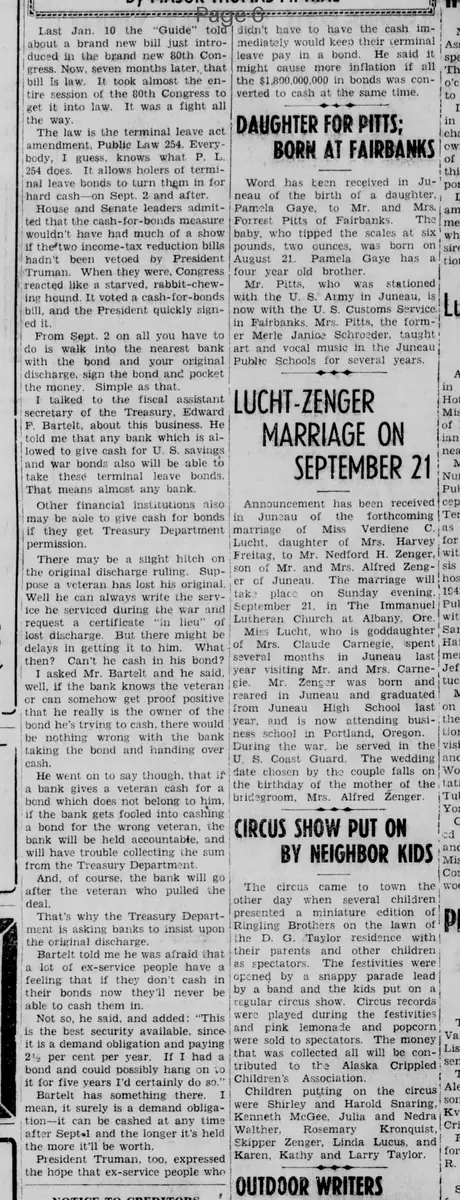
The law is the terminal leave act amendment. Public Law 254. Everybody, I guess, knows what P. L. 254 does. It allows holders of terminal leave bonds to turn them in for hard cash-on Sept. 2 and after.
House and Senate leaders admitted that the cash-for-bonds measure wouldn't have had much of a show if the two income-tax reduction bills hadn't been vetoed by President Truman. When they were, Congress reacted like a starved, rabbit-chewing hound. It voted a cash-for-bonds bill, and the President quickly signed it.
From Sept. 2 on all you have to do is walk into the nearest bank with the bond and your original discharge, sign the bond and pocket the money. Simple as that.
I talked to the fiscal assistant secretary of the Treasury, Edward F. Bartelt, about this business. He told me that any bank which is allowed to give cash for U. S. savings and war bonds also will be able to take these terminal leave bonds. That means almost any bank.
Other financial institutions also may be able to give cash for bonds if they get Treasury Department permission.
There may be a slight hitch on the original discharge ruling. Suppose a veteran has lost his original. Well he can always write the service he serviced during the war and request a certificate "in lieu" of lost discharge. But there might be delays in getting it to him. What then? Can't he cash in his bond?
I asked Mr. Bartelt and he said, well, if the bank knows the veteran or can somehow get proof positive that he really is the owner of the bond he's trying to cash, there would be nothing wrong with the bank taking the bond and handing over cash.
He went on to say though, that if a bank gives a veteran cash for a bond which does not belong to him, if the bank gets fooled into cashing a bond for the wrong veteran, the bank will be held accountable, and will have trouble collecting the sum from the Treasury Department.
And, of course, the bank will go after the veteran who pulled the deal.
That's why the Treasury Department is asking banks to insist upon the original discharge.
Bartelt told me he was afraid that a lot of ex-service people have a feeling that if they don't cash in their bonds now they'll never be able to cash them in.
Not so, he said, and added: "This is the best security available, since it is a demand obligation and paying 2 1/2 per cent per year. If I had a bond and could possibly hang on to it for five years I'd certainly do so."
Bartelt has something there. I mean, it surely is a demand obligation-it can be cashed at any time after Sept 1 and the longer it's held the more it'll be worth.
President Truman, too, expressed the hope that ex-service people who didn't have to have the cash immediately would keep their terminal leave pay in a bond. He said it might cause more inflation if all the $1,800,000,000 in bonds was converted to cash at the same time.
What sub-type of article is it?
What themes does it cover?
What keywords are associated?
What entities or persons were involved?
Where did it happen?
Story Details
Key Persons
Location
United States
Event Date
January 10, 1947 To September 2, 1947
Story Details
The Terminal Leave Act Amendment (Public Law 254) allows veterans to redeem terminal leave bonds for cash starting September 2, 1947, after a contentious legislative battle in the 80th Congress. The process involves presenting the bond and original discharge at a bank. Officials advise holding bonds for interest accrual to avoid inflation.