Thank you for visiting SNEWPapers!
Sign up free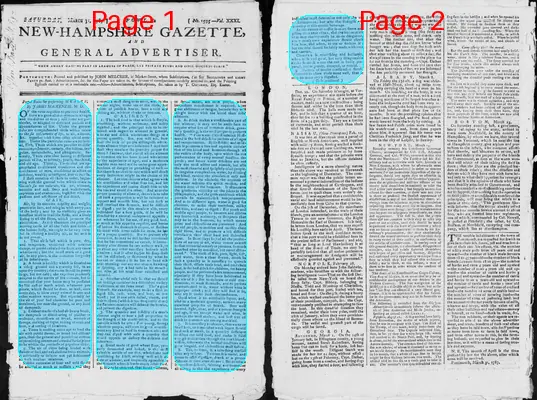
Fowle's New Hampshire Gazette And General Advertiser
Portsmouth, Rockingham County, New Hampshire
What is this article about?
Essay by James Mackenzie, M.D., on rules for preserving health. Covers general rules related to Galen's six non-naturals: air (choosing pure, dry air; healthy housing), and aliment (wholesome, moderate eating and drinking; praises water, wine, beer; advises against excess variety). To be continued.
Merged-components note: This is a clear continuation of the essay on health preservation rules, as indicated by the '(To be continued.)' at the end of the second component and sequential reading order across pages.
Clippings
1 of 2
OCR Quality
Full Text
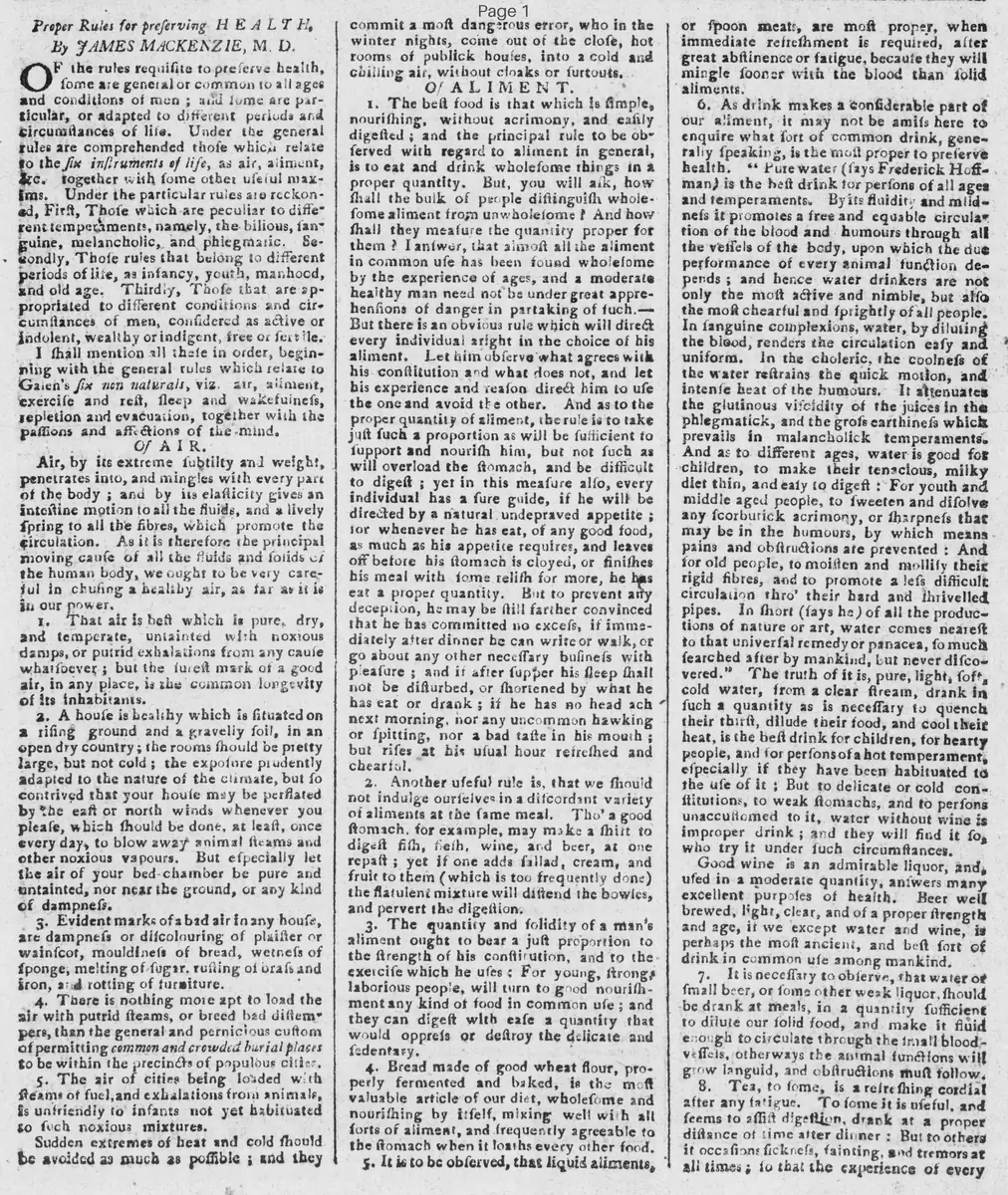
By JAMES MACKENZIE, M. D.
Of the rules requisite to preserve health, some are general or common to all ages and conditions of men; and some are particular, or adapted to different periods and circumstances of life. Under the general rules are comprehended those which relate to the six instruments of life, as air, aliment, etc. together with some other useful maxims. Under the particular rules are also reckoned, First, Those which are peculiar to different temperaments, namely, the bilious, sanguine, melancholic, and phlegmatic. Secondly, Those rules that belong to different periods of life, as infancy, youth, manhood, and old age. Thirdly, Those that are appropriated to different conditions and circumstances of men, considered as active or indolent, wealthy or indigent, free or servile. I shall mention all these in order, beginning with the general rules which relate to Galen's six non-naturals, viz. air, aliment, exercise and rest, sleep and wakefulness, repletion and evacuation, together with the passions and affections of the mind.
Of AIR.
Air, by its extreme subtlety and weight, penetrates into, and mingles with every part of the body; and by its elasticity gives an intestine motion to all the fluids, and a lively spring to all the fibres, which promote the circulation. As it is therefore the principal moving cause of all the fluids and solids of the human body, we ought to be very careful in choosing a healthy air, as far as it is in our power.
1. That air is best which is pure, dry, and temperate, untainted with noxious damps, or putrid exhalations from any cause whatsoever; but the surest mark of a good air, in any place, is the common longevity of its inhabitants.
2. A house is healthy which is situated on a rising ground and a gravelly soil, in an open dry country; the rooms should be pretty large, but not cold; the exposure prudently adapted to the nature of the climate, but so contrived that your house may be perfated by the east or north winds whenever you please, which should be done, at least, once every day, to blow away animal steams and other noxious vapours. But especially let the air of your bed-chamber be pure and untainted, nor near the ground, or any kind of dampness.
3. Evident marks of a bad air in any house, are dampness or discolouring of plaster or wainscot, mouldiness of bread, wetness of sponge, melting of sugar, rusting of brass and iron, and rotting of furniture.
There is nothing more apt to load the air with putrid steams, or breed bad distempers, than the general and pernicious custom of permitting common and crowded burial places to be within the precincts of populous cities.
5. The air of cities being loaded with steams of fuel, and exhalations from animals, is unfriendly to infants not yet habituated to such noxious mixtures.
Sudden extremes of heat and cold should be avoided as much as possible; and they commit a most dangerous error, who in the winter nights, come out of the close, hot rooms of publick houses, into a cold and chilling air, without cloaks or surtouts.
OF ALIMENT.
1. The best food is that which is simple, nourishing, without acrimony, and easily digested; and the principal rule to be observed with regard to aliment in general, is to eat and drink wholesome things in a proper quantity. But, you will ask, how shall the bulk of people distinguish wholesome aliment from unwholesome? And how shall they measure the quantity proper for them? I answer, that almost all the aliment in common use has been found wholesome by the experience of ages, and a moderate healthy man need not be under great apprehensions of danger in partaking of such. But there is an obvious rule which will direct every individual aright in the choice of his aliment. Let him observe what agrees with his constitution and what does not, and let his experience and reason direct him to use the one and avoid the other. And as to the proper quantity of aliment, the rule is to take just such a proportion as will be sufficient to support and nourish him, but not such as will overload the stomach, and be difficult to digest; yet in this measure also, every individual has a sure guide, if he will be directed by a natural undepraved appetite; for whenever he has eat, of any good food, as much as his appetite requires, and leaves off before his stomach is cloyed, or finishes his meal with some relish for more, he has eat a proper quantity. But to prevent any deception, he may be still farther convinced that he has committed no excess, if immediately after dinner he can write or walk, or go about any other necessary business with pleasure; and if after supper his sleep shall not be disturbed, or shortened by what he has eat or drank; if he has no head ach next morning, nor any uncommon hawking or spitting, nor a bad taste in his mouth; but rises at his usual hour refreshed and cheerful.
2. Another useful rule is, that we should not indulge ourselves in a discordant variety of aliments at the same meal. Tho' a good stomach, for example, may make a shift to digest fish, flesh, wine, and beer, at one repast; yet if one adds salad, cream, and fruit to them (which is too frequently done) the flatulent mixture will distend the bowels, and pervert the digestion.
3. The quantity and solidity of a man's aliment ought to bear a just proportion to the strength of his constitution, and to the exercise which he uses: For young, strong, laborious people, will turn to good nourishment any kind of food in common use; and they can digest with ease a quantity that would oppress or destroy the delicate and sedentary.
4. Bread made of good wheat flour, properly fermented and baked, is the most valuable article of our diet, wholesome and nourishing by itself, mixing well with all sorts of aliment, and frequently agreeable to the stomach when it loaths every other food.
5. It is to be observed, that liquid aliments, or spoon meats, are most proper, when immediate refreshment is required, after great abstinence or fatigue, because they will mingle sooner with the blood than solid aliments.
6. As drink makes a considerable part of our aliment, it may not be amiss here to enquire what sort of common drink, generally speaking, is the most proper to preserve health. "Pure water (says Frederick Hoffman) is the best drink for persons of all ages and temperaments. By its fluidity and mildness it promotes a free and equable circulation of the blood and humours through all the vessels of the body, upon which the due performance of every animal function depends; and hence water drinkers are not only the most active and nimble, but also the most cheerful and sprightly of all people. In sanguine complexions, water, by diluting the blood, renders the circulation easy and uniform. In the choleric, the coolness of the water restrains the quick motion, and intense heat of the humours. It attenuates the glutinous viscidity of the juices in the phlegmatick, and the gross earthiness which prevails in melancholick temperaments. And as to different ages, water is good for children, to make their tenacious, milky diet thin, and easy to digest: For youth and middle aged people, to sweeten and dissolve any scorbutick acrimony, or sharpness that may be in the humours, by which means pains and obstructions are prevented: And for old people, to moisten and mollify their rigid fibres, and to promote a less difficult circulation thro' their hard and shrivelled pipes. In short (says he) of all the productions of nature or art, water comes nearest to that universal remedy or panacea, so much searched after by mankind, but never discovered." The truth of it is, pure, light, soft, cold water, from a clear stream, drank in such a quantity as is necessary to quench their thirst, dilute their food, and cool their heat, is the best drink for children, for hearty people, and for persons of a hot temperament, especially if they have been habituated to the use of it; But to delicate or cold constitutions, to weak stomachs, and to persons unaccustomed to it, water without wine is improper drink; and they will find it so who try it under such circumstances.
Good wine is an admirable liquor, and, used in a moderate quantity, answers many excellent purposes of health. Beer well brewed, light, clear, and of a proper strength and age, if we except water and wine, is perhaps the most ancient, and best sort of drink in common use among mankind.
7. It is necessary to observe, that water or small beer, or some other weak liquor, should be drank at meals, in a quantity sufficient to dilute our solid food, and make it fluid enough to circulate through the small blood-vessels, otherwise the animal functions will grow languid, and obstructions must follow.
8. Tea, to some, is a refreshing cordial after any fatigue. To some it is useful, and seems to assist digestion, drank at a proper distance of time after dinner: But to others it occasions sickness, fainting, and tremors at all times; so that the experience of every individual must determine the use of it.
Every individual must determine not only the use or forbearance, but also the strength and quantity of this exotic beverage.
As the nature of coffee is more fierce and active than that of tea, and the frequent use of it may consequently be more dangerous, every man's own experience should direct him how and when to use or forbear it: but the trial should be fairly made with care and caution.
Chocolate is nourishing and balsamic when fresh and good, but very disagreeable to the stomach when the nut is badly prepared, and is greasy, decayed, or rancid.
Persons of tender constitution should be careful to chew their meat well, that it may be more easily digested.
(To be continued.)
What sub-type of article is it?
What themes does it cover?
What keywords are associated?
What entities or persons were involved?
Literary Details
Title
Proper Rules For Preserving Health.
Author
By James Mackenzie, M. D.
Subject
Rules For Preserving Health
Key Lines