Thank you for visiting SNEWPapers!
Sign up free
The Enquirer
Richmond, Henrico County, Virginia
What is this article about?
House of Representatives debate on January 25 regarding a bill to authorize the President to employ 1272 additional seamen for U.S. service to man unmanned gun-boats, amid seamen unemployment from the embargo. Discussion covers defense necessity, humanitarian relief, and naval policy. Bill passes 108-10 after amendments rejected.
Clipping
OCR Quality
Full Text
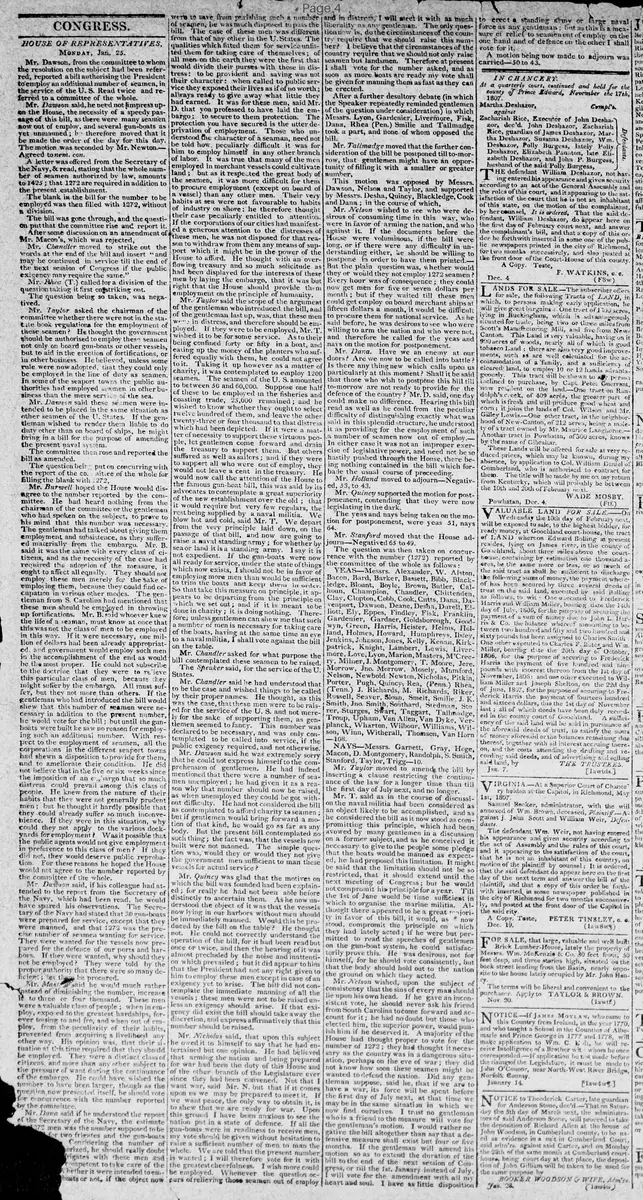
HOUSE OF REPRESENTATIVES
Monday, Jan. 25.
Mr. Dawson, from the committee to whom the resolution on the subject had been referred, reported a bill authorising the President to employ an additional number of seamen, in the service of the U. S. Read twice and referred to a committee of the whole.
Mr. Dawson said, he need not impress upon the House, the necessity of a speedy passage of this bill, as there were many seamen now out of employ, and several gun-boats as yet unmanned; he therefore moved that it be made the order of the day for this day.
The motion was seconded by Mr. Newton.—Agreed to-morrow.
A letter was offered from the Secretary of the Navy, & read, stating that the whole number of seamen authorized by law, amounts to 1425; that 1272 are required in addition to the present establishment.
The blank in the bill for the number to be employed was then filled with 1272, without a division.
The bill was gone through, and the question put that the committee rise and report it.
After some discussion on an amendment of Mr. Macon's, which was rejected,
Mr. Chandler moved to strike out the words at the end of the bill and insert "and may be continued in service till the end of the next session of Congress if the public exigency may require the same."
Mr. Rhea (T.) called for a division of the question taking it first on striking out.
The question being so taken, was negatived.
Mr. Taylor asked the chairman of the committee whether there were not in the statute book regulations for the employment of these seamen? He thought the government should be authorised to employ these seamen not only on board gun-boats or other vessels, but to aid in the erection of fortifications, or in other business. He believed, unless some rule were now adopted, that they could only be employed in the line of duty as seamen.
In some of the seaport towns the public authorities had employed seamen in other business than the mere service of the sea.
Mr. Dawson said these seamen were intended to be placed in the same situation as other seamen of the U. States. If the gentleman wished to render them liable to do duty other than on board of ships, he might bring in a bill for the purpose of amending the present naval system.
The committee then rose and reported the bill as amended.
The question being put on concurring with the report of the committee of the whole for filling the blank with 1272,
Mr. Burwell hoped the House would disagree to the number reported by the committee. He had heard nothing from the chairman of the committee or the gentlemen who had spoken on the subject, to prove to his mind that this number was necessary.
The gentleman had talked about giving them employment and subsistence, as they suffered materially from the embargo. Mr. B. said it was the same with every class of citizens, and as the necessity of the case had required the adoption of the measure, it ought to affect all equally. They should not employ these men merely for the sake of employing them, because they could find occupation in various other modes. The gentleman from S. Carolina had mentioned that these men should be employed in throwing up fortifications. Mr. B. said whoever knew the life of a seaman, must know at once that this was not the class of men to be employed in this way. If it were necessary, one million of dollars had been already appropriated, and government would employ such men in the accomplishment of the end as would be the most proper. He could not subscribe to the doctrine that they were to relieve this particular class of men, because they might suffer by the embargo. All must suffer, but they not more than others. If the gentleman who had introduced the bill would shew that this number of seamen were necessary in addition to the present number, he would vote for the bill; but until the gun-boats were built he saw no reason for employing such an additional number. With respect to the employment of seamen, all the corporations in the different seaport towns had shewn a disposition to provide for them, and to ameliorate their condition. He did not believe that in the five or six weeks since the imposition of an embargo that so much distress could prevail among this class of people. He knew from the nature of their habits that they were not generally prudent men; but he thought it hardly possible that they could already suffer so much inconvenience. If they were in this situation, why could they not apply to the various dock-yards for employment? Was it possible that the public agents would not give employment in preference to this class of men? If they did not, they would deserve public reprobation. For these reasons he hoped the House would not agree to the number reported by the committee of the whole.
Mr. Dawson said, if his colleague had attended to the report from the Secretary of the Navy, which had been read, he would have spared his observations. The Secretary of the Navy had stated that 30 gun-boats were prepared for service, except that they were unmanned, and that 1272 was the precise number of seamen wanting for service. They were wanted for the vessels now prepared for the defence of our ports and harbors. If they were wanted, why should they not be employed? They were told by the proper authority that there were so many deficient: Yet they be procured.
Mr. Macon said he would much rather instead of diminishing the number, increase it to three or four thousand. These men were a valuable class of people: when in employ, exposed to the greatest hardships, forever tossing to and fro, and when out of employ, from the peculiarity of their habits, prevented from acquiring a livelihood any other way. His opinion was, that their situation at this time required that they should be employed. They were a distinct class of citizens, and more than any other subject to the pressure of want during the continuance of the embargo. He could have wished the number to have been larger, though as the question now presented itself, he should vote for concurrence with the number reported by the committee.
Mr. Dana said if he understood the report of the Secretary of the Navy, the estimate 1272 men was the number supposed to be for two frigates and the gun-boats Considering the number of authorized, he should really doubt frigates with these men and competent to take care of the Whether it were intended to em- bouts or not, if the object now were to save from perishing such a number of seamen, he was much disposed to pass the bill. The case of these men was different from that of any other in the U. States. The qualities which fitted them for service unfitted them for taking care of themselves: of all men on the earth they were the first that would divide their purses with those in distress: to be provident and saving was not their character: when called to public service they exposed their lives as if of no worth; always ready to give away what little they had earned. It was for these men, said Mr. D. that you professed to have laid the embargo: to secure to them protection. The protection you have secured is the utter deprivation of employment. Those who understood the character of a seaman, need not be told how peculiarly difficult it was for him to employ himself in any other branch of labor. It was true that many of the men employed in merchant vessels could cultivate land; but as it respected the great body of the seamen, it was more difficult for them to procure employment (except on board of a vessel) than any other men. Their very habits at sea were not favourable to habits of industry on shore: he therefore thought their case peculiarly entitled to attention. If the corporations of our cities had manifested a generous attention to the distresses of these men, he was not disposed for that reason to withdraw from them any means of support which it might be in the power of the House to afford. He thought with an overflowing treasury and so much solicitude as had been displayed for the interests of these men by laying the embargo, that it was but right that the House should provide them employment on the principle of humanity.
Mr. Taylor said the scope of the argument of the gentleman who introduced the bill, and of the gentleman last up, was, that these men were in distress, and therefore should be employed. If they were to be employed, Mr. T. wished it to be for some service. As to their being confined forty or fifty in a boat, and eating up the money of the planters who suffered equally with them, he could not agree to it. Taking it up however as a matter of charity, it was contemplated to employ 1200 seamen. The seamen of the U. S. amounted to between 50 and 60,000. Suppose one half of these to be employed in the fisheries and coasting trade, 25,000 remained; and he wished to know whether they ought to select twelve hundred of them, and leave the other twenty-three or four thousand to that distress which had been depicted. If it were a matter of necessity to support these virtuous people, let gentlemen come forward and drain the treasury to support them. But others suffered as well as sailors; and if they were to support all who were out of employ, they would not leave a cent in the treasury. He would now call the attention of the House to the famous gun-boat bill, this was said by its advocates to contemplate a great superiority of the new establishment over the old; that it would require but very few regulars, the rest being supplied by a naval militia. We blow hot and cold, said Mr. T. We depart from the very principle laid down, on the passage of that bill, and now are going to raise a naval standing army; for whether by sea or land it is a standing army. I say it is not expedient. If the gun-boats were now all ready for service, under the state of things which now exists, I should not be in favor of employing more men than would be sufficient to trim the boats and keep them in order.
So that take this measure on principle, it appears to be departing from the principle on which we set out; and if it is meant to be done in charity; it is doing nothing: Therefore, unless gentlemen can shew me that such a number of men is necessary for taking care of the boats, having at the same time an eye to a naval militia, I shall vote against the bill on the table.
Mr. Chandler asked for what purpose the bill contemplated these seamen to be raised.
The Speaker said, for the service of the U. States.
Mr. Chandler said he had understood that to be the case and wished things to be called by their proper names. He thought, as this was the case, that these men were to be raised for the service of the U. S. and not merely for the sake of supporting them, as gentlemen seemed to fancy. This number was declared to be necessary, and was only contemplated to be called into service, if the public exigency required, and not otherwise.
Mr. Dawson said he was extremely sorry that he could not express himself to the comprehension of gentlemen. He had indeed mentioned that there were a number of seamen unemployed; he had given it as a reason why that number should now be raised, as when unemployed they could be got without difficulty. He had not considered the bill as contemplated to afford charity to seamen; but if gentlemen would bring forward a motion of that kind, he would go as far as any body. But the present bill contemplated no such thing; the fact was, that the vessels now built were not manned. The simple question was, would they or would they not give the government men sufficient to man these vessels for actual service?
Mr. Quincy was glad that the motives on which the bill was founded had been explained: for really he had not been able before distinctly to ascertain them. As he now understood the object of it was that the vessels now lying in our harbors without men should be immediately manned. Would this be produced by the bill on the table? He thought not. He could not correctly understand the operation of the bill, for it had been read but once or twice, and then the hearing of it was almost precluded by the noise and inattention which prevailed; but it did appear to him that the President had not any right given to him to employ these men except in case of an exigency yet to arise. The bill did not contemplate the immediate manning of all the vessels: these men were not to be raised unless an exigency should arise. If that exigency did exist the bill should take away the discretion, and express affirmatively that this number should be raised.
Mr. Nicholas said, that upon this subject he owed it to himself to say that he had entertained but one opinion. He had believed that arming the nation and being prepared for war had been the duty of this House and of the other branch of the Legislature ever since they had been convened. Not that I want war, said Mr. N. but that if it comes upon us we may be prepared to meet it. If we want peace, the only way to obtain it, is to shew that we are ready for war. Upon this ground I have been anxious to see the nation put in a state of defence. If all the gun-boats were in readiness to receive men, my vote should be given without hesitation to raise a sufficient number of men to man the whole. We are told that the present number is wanted; I will therefore vote for it with the greatest cheerfulness. I wish more could be employed. Whenever the question occurs of relieving those seamen out of employ and in distress, I will meet it with as much liberality as any gentleman. The only question now is, do the circumstances of the country require that we should raise this number? I believe that the circumstances of the country require that we should not only raise seamen but landsmen. Therefore at present I shall vote for the number asked, and as soon as more boats are ready my vote shall be given for manning them as fast as they can be erected.
After a further desultory debate (in which the Speaker repeatedly reminded gentlemen of the question under consideration) in which Messrs. Lyon, Gardenier, Livermore, Fisk, Dana, Rhea (Penn.) Smilie and Tallmadge took a part, and none of whom opposed the bill.
Mr. Tallmadge moved that the further consideration of the bill be postponed till to-morrow, that gentlemen might have an opportunity of filling it with a smaller or greater number.
This motion was opposed by Messrs. Dawson, Nelson and Taylor, and supported by Messrs. Desha, Quincy, Blackledge, Cook and Dana; in the course of which,
Mr. Nelson wished to see who were desirous of consuming time in this way, who were in favor of arming the nation, and who against it. If the documents before the House were voluminous, if the bill were long, or if there were any difficulty in understanding either, he should be willing to postpone in order to have them printed.—But the plain question was, whether would they or would they not employ 1272 seamen? Every hour was of consequence; they could now get men for five or seven dollars per month; but if they waited till these men could get employ on board merchant ships at fifteen dollars a month, it would be difficult to procure them for national service. As he said before, he was desirous to see who were willing to arm the nation and who were not, and therefore he called for the yeas and nays on the motion for postponement.
Mr. Dana. Have we an enemy at our doors? Are we now to be called into battle? Is there any thing new which calls upon us particularly at this moment? Shall it be said that those who wish to postpone this bill till to-morrow are not ready to provide for the defence of the country? Mr. D. said, one day could make no difference. Hearing this bill read as well as he could from the peculiar difficulty of distinguishing exactly what was said in this splendid structure, he understood it as providing for the employment of such a number of seamen now out of employ.—In either case it was not an improper exercise of legislative power, and need not be so hastily pushed through the House, there being nothing contained in the bill which forbade the usual course of proceeding.
Mr. Holland moved to adjourn—Negatived, 53, to 43.
Mr. Quincy supported the motion for postponement, contending that they were now legislating in the dark.
The yeas and nays being taken on the motion for postponement, were yeas 51, nays 64.
Mr. Stanford moved that the House adjourn—Negatived 65 to 49.
The question was then taken on concurrence with the number (1272) reported by the committee of the whole as follows:
YEAS—Messrs. Alexander, W. Alston, Bacon, Bard, Barker, Bassett, Bibb, Black-ledge. Blount, Boyle, Brown, Butler, Cal-houn, Champion, Chandler, Chittenden, Clay, Clopton, Cobb, Cook, Cutts, Dana, Da-venport, Dawson, Deane, Desha, Durell, El-liott, Ely, Eppes, Findley, Fisk, Franklin, Gardenier, Gardner, Goldsborough, Good-wyn, Green, Harris, Heister, Heinis, Hol-land, Holmes, Howard, Humphreys, Ilsley, Jenkins, Johnson, Jones, Kelly, Kenan, Kirk-patrick, Knight, Lambert, Lewis, Liver-more, Love, Lyon, Marion, Masters, M'Creery, Milner, J. Montgomery, T. Moore, Jere. Morrow, Jno. Morrow, Mosely, Mumford, Nelson, Newbold. Newton, Nicholas, Pitkin, Porter, Pugh, Quincy, Rea, (Penn.) Rhea, (Tenn.) J. Richards, M. Richards, Riker, Russell, Seaver, Sloan, Smelt, Smilie, J. K. Smith, Jno. Smith, Southard, Stedman, Sto-rer, Sturges, Swart, Taggart, Tallmadge, Troup, Upham, Van Rensselaer, Van Dyke, Ver-planck, Wharton, Wilbour, Williams, Wil-son, Winn, Witherell, Thompson, Van Horn—108.
NAYS—Messrs. Garnett, Gray, Hoge Macon, D. Montgomery, Randolph, S. Smith, Stanford. Taylor, Trigg—10.
Mr. Taylor moved to amend the bill by inserting a clause restricting the continuance of the law for a longer time than till the first day of July next, and no longer.
Mr. T. said as in the course of discussion the naval militia had been considered as an object likely to be accomplished, and as he considered the bill as it now stood as compromising this principle, which had been avowed by many gentlemen in a discussion on a former subject, and as he conceived it necessary to give to the people some pledge that the boats would be manned as expected, he had proposed this limitation. It might be said that the limitation should not be so restricted, that it should extend until the next meeting of Congress; but he would not compromise his principle for a year. Till the 1st of July would be time sufficient in which to organise the marine militia. Although there appeared to be a great majority in favor of this bill, it would, as now stood, compromise the principle on which they had lately acted; if he were but permitted to read the speeches of gentlemen on the gun-boat system, he could satisfactorily prove this. He was desirous, not for himself, for he should vote consistently, but that the body should hold out to the nation the ground on which they acted.
Mr. Nelson wished, upon the subject of consistency that the sins of every man should lie upon his own head. If he gave an inconsistent vote, he should never ask his friend from South Carolina to come forward and account for it: he had no doubt but those who elected him, the superior power, would punish him if he deserved it. A majority of the House had thought proper to vote for the number of 1272; they had thought it necessary as the country was in a dangerous situation, perhaps on the eve of war; they did not know how soon these seamen might be wanted to defend the nation. Did any gentleman suppose, said he, that if we are to have a war, its force will be spent before the first day of July next, at that time we may be in the same situation in which we now find ourselves. I trust no gentleman who is a friend to the measure will vote for the gentleman's motion. I would rather negative the bill altogether than say that a defensive measure shall exist but four or five months. If the gentleman will amend his motion so as to extend the duration of the bill to the end of the next session of Congress, or till the 1st January instead of July, I will vote for the amendment with all my heart and soul. I have as little disposition to erect a standing army or large naval force as any gentleman; but as this is a measure of relief to seamen out of employ on the one hand and of defence on the other I shall vote for it.
A motion being now made to adjourn was carried—50 to 43.
What sub-type of article is it?
What themes does it cover?
What keywords are associated?
What entities or persons were involved?
Where did it happen?
Story Details
Key Persons
Location
House Of Representatives
Event Date
Monday, Jan. 25.
Story Details
Mr. Dawson reports a bill authorizing the President to employ additional seamen for U.S. service. Secretary of Navy's letter specifies 1272 needed to man 30 gun-boats. Debate addresses defense needs, seamen distress from embargo, employment alternatives, and naval militia principles. Amendments rejected; bill concurs on 1272 with 108-10 vote; further amendment on duration pending adjournment.