Thank you for visiting SNEWPapers!
Sign up free
Story
August 5, 1823
The Rhode Island American, And General Advertiser
Providence, Providence County, Rhode Island
What is this article about?
Biographical tribute by Henry Wheaton to William Pinkney, praising his profound legal knowledge, eloquence, and role in Supreme Court cases upholding the US Constitution against state claims. His death lamented as a public loss.
Clipping
OCR Quality
95%
Excellent
Full Text
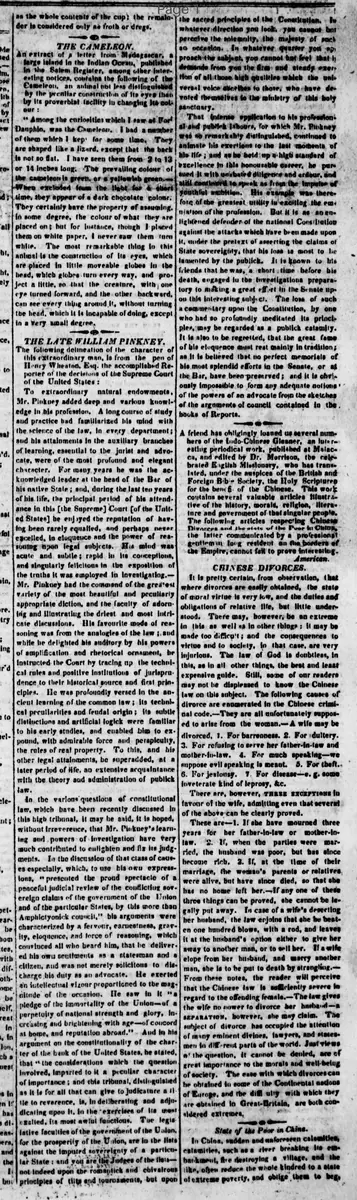
THE LATE WILLIAM PINKNEY.
The following delineation of the character of this extraordinary man, is from the pen of Henry Wheaton, Esq. the accomplished Reporter of the decisions of the Supreme Court of the United States:
To extraordinary natural endowments, Mr. Pinkney added deep and various knowledge in his profession. A long course of study and practice had familiarized his mind with the science of the law, in every department; and his attainments in the auxiliary branches of learning, essential to the jurist and advocate, were of the most profound and elegant character. For many years he was the acknowledged leader at the head of the Bar of his native State; and, during the last ten years of his life, the principal period of his attendance in this [the Supreme] Court [of the United States] he enjoyed the reputation of having been rarely equalled, and perhaps never excelled, in eloquence and the power of reasoning upon legal subjects. His mind was acute and subtle; rapid in its conceptions, and singularly felicitous in the exposition of the truths it was employed in investigating. Mr. Pinkney had the command of the greatest variety of the most beautiful and peculiarly appropriate diction, and the faculty of adorning and illustrating the driest and most intricate discussions. His favourite mode of reasoning was from the analogies of the law; and while he delighted his auditory by his powers of amplification and rhetorical ornament, he instructed the Court by tracing up the technical rules and positive institutions of jurisprudence to their historical source and first principles. He was profoundly versed in the ancient learning of the common law: its technical peculiarities and feudal origin; its subtle distinctions and artificial logic were familiar to his early studies, and enabled him to expound, with admirable force and perspicuity, the rules of real property. To this, and his other legal attainments, he superadded, at a later period of life, an extensive acquaintance with the theory and administration of public law.
In the various questions of constitutional law, which have been recently discussed in this high tribunal, it may be said, it is hoped, without irreverence, that Mr. Pinkney's learning and powers of investigation have very much contributed to enlighten and to its judgments. In the discussion of that class of causes especially, which, to use his own expressions, "presented the proud spectacle of a peaceful judicial review of the conflicting sovereign claims of the government of the Union and of the particular States, by this more than Amphictyonic council," his arguments were characterized by a fervent, earnestness, gravity, eloquence, and force of reasoning, which convinced all who heard him, that he delivered his own sentiments as a statesman and a citizen, and was not merely solicitous to discharge his duty as an advocate. He exerted an intellectual vigour proportioned to the magnitude of the occasion. He saw in it "a pledge of the immortality of the Union—of a perpetuity of national strength and glory, increasing and brightening with age—of concord at home, and reputation abroad." And in his argument on the constitutionality of the charter of the Bank of the United States, he stated, that "the considerations which the question involved, imparted to it a peculiar character of importance; and this tribunal, distinguished as it is for all that can give to judicature a title to reverence, is, in deliberating and adjudicating upon it, in the exercise of its most elevated, its most awful functions. The legislative faculties of the government of the Union for the prosperity of the Union, are in the lists for the State: and you are the Judges of the lists—against the imputed sovereignty of a particular State—not indeed upon the romantick and chivalrous principles of tilts and tournaments,—but upon the sacred principles of the Constitution. In whatever direction you look, you cannot but perceive the solemnity, the majesty of such an occasion. In whatever quarter you approach the subject, you cannot but feel that it demands from you the firm and steady exertion of all those high qualities which the universal voice ascribes to those who have devoted themselves to the ministry of this holy sanctuary."
That intense application to his profession and public labours, for which Mr. Pinkney was so remarkably distinguished, continued to animate his exertions to the last moments of his life; and as he held up a high standard of excellence in this honourable career, he pursued it with unabated diligence and ardour, and still continued to speak as from the impulses of youthful ambition. His example was therefore of the greatest utility in exciting the emulation of the profession. But, it is as an enlightened defender of the national Constitution against the attacks which have been made upon it, under the pretext of asserting the claims of State sovereignty, that his loss is most to be lamented by the publick. It is known to his friends that he was, a short time before his death, engaged in the investigations preparatory to making a great effort in the Senate upon this interesting subject. The loss of such a commentator upon the Constitution, by one who had so profoundly meditated its principles, may be regarded as a publick calamity. It is also to be regretted, that the great fame of his eloquence must rest mainly in tradition; as it is believed that no perfect memorials of his most splendid efforts in the Senate, or at the Bar, have been preserved; and it is obviously impossible to form any adequate notion of the powers of an advocate from the sketches of the arguments of counsel contained in the books of Reports.
The following delineation of the character of this extraordinary man, is from the pen of Henry Wheaton, Esq. the accomplished Reporter of the decisions of the Supreme Court of the United States:
To extraordinary natural endowments, Mr. Pinkney added deep and various knowledge in his profession. A long course of study and practice had familiarized his mind with the science of the law, in every department; and his attainments in the auxiliary branches of learning, essential to the jurist and advocate, were of the most profound and elegant character. For many years he was the acknowledged leader at the head of the Bar of his native State; and, during the last ten years of his life, the principal period of his attendance in this [the Supreme] Court [of the United States] he enjoyed the reputation of having been rarely equalled, and perhaps never excelled, in eloquence and the power of reasoning upon legal subjects. His mind was acute and subtle; rapid in its conceptions, and singularly felicitous in the exposition of the truths it was employed in investigating. Mr. Pinkney had the command of the greatest variety of the most beautiful and peculiarly appropriate diction, and the faculty of adorning and illustrating the driest and most intricate discussions. His favourite mode of reasoning was from the analogies of the law; and while he delighted his auditory by his powers of amplification and rhetorical ornament, he instructed the Court by tracing up the technical rules and positive institutions of jurisprudence to their historical source and first principles. He was profoundly versed in the ancient learning of the common law: its technical peculiarities and feudal origin; its subtle distinctions and artificial logic were familiar to his early studies, and enabled him to expound, with admirable force and perspicuity, the rules of real property. To this, and his other legal attainments, he superadded, at a later period of life, an extensive acquaintance with the theory and administration of public law.
In the various questions of constitutional law, which have been recently discussed in this high tribunal, it may be said, it is hoped, without irreverence, that Mr. Pinkney's learning and powers of investigation have very much contributed to enlighten and to its judgments. In the discussion of that class of causes especially, which, to use his own expressions, "presented the proud spectacle of a peaceful judicial review of the conflicting sovereign claims of the government of the Union and of the particular States, by this more than Amphictyonic council," his arguments were characterized by a fervent, earnestness, gravity, eloquence, and force of reasoning, which convinced all who heard him, that he delivered his own sentiments as a statesman and a citizen, and was not merely solicitous to discharge his duty as an advocate. He exerted an intellectual vigour proportioned to the magnitude of the occasion. He saw in it "a pledge of the immortality of the Union—of a perpetuity of national strength and glory, increasing and brightening with age—of concord at home, and reputation abroad." And in his argument on the constitutionality of the charter of the Bank of the United States, he stated, that "the considerations which the question involved, imparted to it a peculiar character of importance; and this tribunal, distinguished as it is for all that can give to judicature a title to reverence, is, in deliberating and adjudicating upon it, in the exercise of its most elevated, its most awful functions. The legislative faculties of the government of the Union for the prosperity of the Union, are in the lists for the State: and you are the Judges of the lists—against the imputed sovereignty of a particular State—not indeed upon the romantick and chivalrous principles of tilts and tournaments,—but upon the sacred principles of the Constitution. In whatever direction you look, you cannot but perceive the solemnity, the majesty of such an occasion. In whatever quarter you approach the subject, you cannot but feel that it demands from you the firm and steady exertion of all those high qualities which the universal voice ascribes to those who have devoted themselves to the ministry of this holy sanctuary."
That intense application to his profession and public labours, for which Mr. Pinkney was so remarkably distinguished, continued to animate his exertions to the last moments of his life; and as he held up a high standard of excellence in this honourable career, he pursued it with unabated diligence and ardour, and still continued to speak as from the impulses of youthful ambition. His example was therefore of the greatest utility in exciting the emulation of the profession. But, it is as an enlightened defender of the national Constitution against the attacks which have been made upon it, under the pretext of asserting the claims of State sovereignty, that his loss is most to be lamented by the publick. It is known to his friends that he was, a short time before his death, engaged in the investigations preparatory to making a great effort in the Senate upon this interesting subject. The loss of such a commentator upon the Constitution, by one who had so profoundly meditated its principles, may be regarded as a publick calamity. It is also to be regretted, that the great fame of his eloquence must rest mainly in tradition; as it is believed that no perfect memorials of his most splendid efforts in the Senate, or at the Bar, have been preserved; and it is obviously impossible to form any adequate notion of the powers of an advocate from the sketches of the arguments of counsel contained in the books of Reports.
What sub-type of article is it?
Biography
What themes does it cover?
Moral Virtue
Justice
Triumph
What keywords are associated?
William Pinkney
Legal Eloquence
Constitutional Law
Supreme Court
Union Defense
What entities or persons were involved?
William Pinkney
Henry Wheaton
Where did it happen?
Supreme Court Of The United States
Story Details
Key Persons
William Pinkney
Henry Wheaton
Location
Supreme Court Of The United States
Story Details
Delineation of William Pinkney's extraordinary legal endowments, eloquence, and contributions to constitutional law, particularly in defending the Union against state sovereignty claims, as written by Henry Wheaton.