Thank you for visiting SNEWPapers!
Sign up free
Literary
September 8, 1895
The Morning News
Savannah, Chatham County, Georgia
What is this article about?
Humorous essay from Hartford Times on whether women should propose marriage, citing Shakespeare's heroines like Miranda and Juliet, historical examples like Mlle. de Praga to De Lesseps, and clever modern anecdotes where women subtly lead men to propose.
Clipping
OCR Quality
95%
Excellent
Full Text
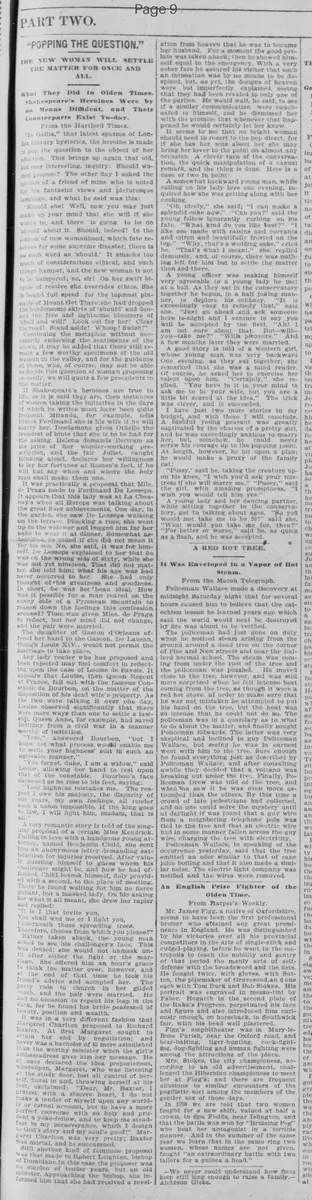
PART TWO.
"POPPING THE QUESTION."
THE NEW WOMAN WILL SETTLE THE MATTER FOR ONCE AND ALL.
What They Did in Olden Times.
Shakespeare's Heroines Were by no Means Different, and Their Counterparts Exist To-day.
From the Hartford Times.
"In 'Gailda,' that latest spasm of London literary hysterics, the heroine is made to pop the question to the object of her affection. This brings up again that old, but ever interesting, inquiry: Should women propose? The other day I asked the opinion of a friend of mine who is noted for his fantastic views and picturesque language, and what he said was this:
Should she! Well, now you may just make up your mind that she will if she wants to, and there is going to be no should about it. Should, indeed! In the lexicon of new womanhood, which fate reserves for some supreme disaster, there is no such word as 'should.' It smacks too much of considerations ethical, and such things hamper, and the new woman is not to be hampered; no, sir! On her swift bicycle of resolve she overrides ethics. She is bound full speed for the topmost pinnacle of Mount Get There; she has dropped the burdensome skirts of 'should' and donned the free and lightsome bloomers of shall and will! Look out for her! Clear the road! Stand aside! Whoop! Swish!"
(Continuing the metaphor without necessarily endorsing the sentiments of the above, it may be added that there still remain a few worthy specimens of the old woman in the valley, and for the guidance of those, who, of course, may not be able to decide this question of woman proposing so easily, we will quote a few precedents in the matter.
If Shakespeare's heroines are true to life, as it is said they are, then instances of women taking the initiative in the days of which he writes must have been quite frequent. Miranda, for example, tells Prince Ferdinand she is his wife if he will marry her. Desdemona gives Othello the broadest of hints that she is to be had for the asking. Helena demands Bertram as the price of her wonder-working prescription, and the fair Juliet, caught thinking aloud, declares her willingness to lay her fortunes at Romeo's feet, if he will but say when and where the holy man shall make them one.
It was practically a proposal that Mlle. de Praga made to Ferdinand De Lesseps. It appears that this lady was at La Chesnay's when all Europe was talking about the great Suez achievements. One day, in the garden, she saw De Lesseps walking on the terrace. Plucking a rose, she went up to the widower and begged him for her sake to wear it at dinner. Somewhat astonished he asked if she did not mean it for his son. No, she said, it was for himself. De Lesseps explained to her that he was on the wrong side of sixty, while she was not yet nineteen. That did not matter, she told him; what his age was had never occurred to her. She had only thought of his greatness and goodness. In short, he was her 'beau ideal.' How was it possible for a man reared on the sunny side of a Pyrenean mountain to reason down the feelings this confession aroused? Time was given Mlle. de Praga to reflect, but her mind did not change, and the pair were married.
The daughter of Gaston d'Orleans offered her hand to the Gascon, De Lausan, though Louis XIV. would not permit the marriage to take place.
Any lady reader who has proposed and been rejected may find comfort in reflecting upon the case of Louise de Savoie. It appears that Louise, then Queen Regent of France, fell out with the famous Constable de Bourbon, on the matter of the disposition of his dead wife's property. As the two were talking it over one day, Louise observed significantly that there were more ways than one to settle a lawsuit. Queen Anne, for example, had saved Brittany from a civil war in a manner worthy of imitation.
"True," answered Bourbon, "but I know not what process would enable me to settle your highness' suit in such an agreeable manner."
"You forget, duke, I am a widow," said Louise, allowing her hand to rest upon that of the constable. Bourbon's face darkened as he rose to his feet, saying:
"Your highness mistakes me. The respect I owe his majesty, the disparity of our years, my own feelings, all render such a union impossible. If the king goes to law, I will fight him, madam, that is all!"
A very romantic story is told of the singular proposal of a certain Miss Kendrick. Falling in love with a handsome young attorney, named Benjamin Child, she sent him an anonymous letter demanding satisfaction for injuries received. After vainly puzzling himself to guess whom his challenger might be, and how he had offended, Child betook himself, duly provided with a second, to the place of meeting. There he found waiting for him no fierce gallant, but a masked lady. On his asking her what it all meant, she drew her rapier and replied:
It is I that invite you,
You shall wed me or I fight you,
Underneath those spreading trees.
Therefore, choose from which you please!
Rather taken aback, the young man asked to see his challenger's face. This was denied; she would not unmask until after either the fight or the marriage. She offered him an hour's grace to think the matter over, however, and at the end of that time he took his friend's advice and accepted her. The party rode to church in her gilded coach, and the pair were married. He had no occasion to repent his leap in the dark, for he found his bride possessed of beauty, position and wealth.
It was in a very different fashion that Margaret Charlton proposed to Richard Baxter. At first Margaret sought to attain her end by negotiation; and never was a bachelor of 45 more astonished than the worthy minister when the girl's ambassadress gave him her message. He at once declared the idea preposterous, whereupon, Margaret, who was listening the study door, lost all control of herself, burst in and, throwing herself at his feet, exclaimed: "Dear Mr. Baxter, I protest with a sincere heart, I do not make a tender of myself upon any worldly or carnal account, but to have a more perfect converse with so holy and prudent a yoke-fellow, and to keep me steadfast in my perseverance, which I design to God's glory and my soul's good!" Margaret Charlton was very pretty; Baxter was mortal, and he succumbed.
Still another kind of feminine proposal was that made to Robert Leighton, bishop of Dumblane. In this case the proposer was no maiden of tender years, but an old spinster. Approaching the bishop, she informed him that she had received a revelation from heaven that he was to become her husband. For a moment the good prelate was taken aback; then he showed himself equal to the emergency. With a very sober face he assured his visitor that such an intimation was by no means to be despised, but, as yet, the designs of heaven were but imperfectly explained, seeing that they had been revealed to only one of the parties. He would wait, he said, to see if a similar communication were vouchsafed to himself, and he dismissed her with the promise that whenever that happened he would certainly let her know.
It seems to me that no bright woman should need to resort to the pop direct, for if she has her wits about her she may bring her lover to the point on almost any occasion. A clever turn of the conversation, the quick manipulation of a casual remark, and the thing is done. Here is a case or two in point:
A somewhat backward young man, while calling on his lady love one evening, inquired how she was getting along with her cooking.
"Oh, nicely," she said; "I can make a splendid cake now."
"Can you?" said the young fellow ignorantly rushing on his fate. "What kind do you like best?"
"I like one made with raisins and currants and citron and beautifully frosted on the top."
"Why, that's a wedding cake," cried he.
"That's what I meant," she replied demurely, and, of course, there was nothing left for him but to settle the matter then and there.
A young officer was making himself very agreeable to a young lady he met at a ball. As they sat in the conservatory together he began, in a half joking manner, to deplore his celibacy.
"It is exceedingly easy to remedy that," said she. "Just go ahead and ask someone here to-night and I venture to say you will be accepted by the first."
"Ah! I am not sure about that. But—will you—take me?"
"With pleasure." And a few months later they were married.
A good story is told of a western girl, whose young man was very backward. One evening, as they sat together, she remarked that she was a mind reader.
Of course, he asked her to exercise her talent upon him.
"Certainly," she replied. "You have it in your mind to ask me to be your wife, but you are a little bit scared at the idea." The trick was clever, and it succeeded.
I have just two more stories in my budget, and with these I will conclude.
A bashful young peasant was greatly captivated by the charms of a pretty girl, and he was exceedingly anxious to marry her, but, somehow, he could never screw his courage up to the popping point. At length, however, he hit upon a plan; he would make a proxy of the family cat:
"Pussy," said he, taking the creature upon his knee, "I wish you'd ask your mistress if she will marry me."
"Pussy," said the girl, with amazing promptness, "I wish you would tell him yes."
A young lady and her dancing partner, while sitting together in the conservatory, got to talking about ages.
"So you would not take me to be 20?" said she.
"What would you take me for, then?"
"For better or worse," said he, as quick as a flash, and he was accepted.
"POPPING THE QUESTION."
THE NEW WOMAN WILL SETTLE THE MATTER FOR ONCE AND ALL.
What They Did in Olden Times.
Shakespeare's Heroines Were by no Means Different, and Their Counterparts Exist To-day.
From the Hartford Times.
"In 'Gailda,' that latest spasm of London literary hysterics, the heroine is made to pop the question to the object of her affection. This brings up again that old, but ever interesting, inquiry: Should women propose? The other day I asked the opinion of a friend of mine who is noted for his fantastic views and picturesque language, and what he said was this:
Should she! Well, now you may just make up your mind that she will if she wants to, and there is going to be no should about it. Should, indeed! In the lexicon of new womanhood, which fate reserves for some supreme disaster, there is no such word as 'should.' It smacks too much of considerations ethical, and such things hamper, and the new woman is not to be hampered; no, sir! On her swift bicycle of resolve she overrides ethics. She is bound full speed for the topmost pinnacle of Mount Get There; she has dropped the burdensome skirts of 'should' and donned the free and lightsome bloomers of shall and will! Look out for her! Clear the road! Stand aside! Whoop! Swish!"
(Continuing the metaphor without necessarily endorsing the sentiments of the above, it may be added that there still remain a few worthy specimens of the old woman in the valley, and for the guidance of those, who, of course, may not be able to decide this question of woman proposing so easily, we will quote a few precedents in the matter.
If Shakespeare's heroines are true to life, as it is said they are, then instances of women taking the initiative in the days of which he writes must have been quite frequent. Miranda, for example, tells Prince Ferdinand she is his wife if he will marry her. Desdemona gives Othello the broadest of hints that she is to be had for the asking. Helena demands Bertram as the price of her wonder-working prescription, and the fair Juliet, caught thinking aloud, declares her willingness to lay her fortunes at Romeo's feet, if he will but say when and where the holy man shall make them one.
It was practically a proposal that Mlle. de Praga made to Ferdinand De Lesseps. It appears that this lady was at La Chesnay's when all Europe was talking about the great Suez achievements. One day, in the garden, she saw De Lesseps walking on the terrace. Plucking a rose, she went up to the widower and begged him for her sake to wear it at dinner. Somewhat astonished he asked if she did not mean it for his son. No, she said, it was for himself. De Lesseps explained to her that he was on the wrong side of sixty, while she was not yet nineteen. That did not matter, she told him; what his age was had never occurred to her. She had only thought of his greatness and goodness. In short, he was her 'beau ideal.' How was it possible for a man reared on the sunny side of a Pyrenean mountain to reason down the feelings this confession aroused? Time was given Mlle. de Praga to reflect, but her mind did not change, and the pair were married.
The daughter of Gaston d'Orleans offered her hand to the Gascon, De Lausan, though Louis XIV. would not permit the marriage to take place.
Any lady reader who has proposed and been rejected may find comfort in reflecting upon the case of Louise de Savoie. It appears that Louise, then Queen Regent of France, fell out with the famous Constable de Bourbon, on the matter of the disposition of his dead wife's property. As the two were talking it over one day, Louise observed significantly that there were more ways than one to settle a lawsuit. Queen Anne, for example, had saved Brittany from a civil war in a manner worthy of imitation.
"True," answered Bourbon, "but I know not what process would enable me to settle your highness' suit in such an agreeable manner."
"You forget, duke, I am a widow," said Louise, allowing her hand to rest upon that of the constable. Bourbon's face darkened as he rose to his feet, saying:
"Your highness mistakes me. The respect I owe his majesty, the disparity of our years, my own feelings, all render such a union impossible. If the king goes to law, I will fight him, madam, that is all!"
A very romantic story is told of the singular proposal of a certain Miss Kendrick. Falling in love with a handsome young attorney, named Benjamin Child, she sent him an anonymous letter demanding satisfaction for injuries received. After vainly puzzling himself to guess whom his challenger might be, and how he had offended, Child betook himself, duly provided with a second, to the place of meeting. There he found waiting for him no fierce gallant, but a masked lady. On his asking her what it all meant, she drew her rapier and replied:
It is I that invite you,
You shall wed me or I fight you,
Underneath those spreading trees.
Therefore, choose from which you please!
Rather taken aback, the young man asked to see his challenger's face. This was denied; she would not unmask until after either the fight or the marriage. She offered him an hour's grace to think the matter over, however, and at the end of that time he took his friend's advice and accepted her. The party rode to church in her gilded coach, and the pair were married. He had no occasion to repent his leap in the dark, for he found his bride possessed of beauty, position and wealth.
It was in a very different fashion that Margaret Charlton proposed to Richard Baxter. At first Margaret sought to attain her end by negotiation; and never was a bachelor of 45 more astonished than the worthy minister when the girl's ambassadress gave him her message. He at once declared the idea preposterous, whereupon, Margaret, who was listening the study door, lost all control of herself, burst in and, throwing herself at his feet, exclaimed: "Dear Mr. Baxter, I protest with a sincere heart, I do not make a tender of myself upon any worldly or carnal account, but to have a more perfect converse with so holy and prudent a yoke-fellow, and to keep me steadfast in my perseverance, which I design to God's glory and my soul's good!" Margaret Charlton was very pretty; Baxter was mortal, and he succumbed.
Still another kind of feminine proposal was that made to Robert Leighton, bishop of Dumblane. In this case the proposer was no maiden of tender years, but an old spinster. Approaching the bishop, she informed him that she had received a revelation from heaven that he was to become her husband. For a moment the good prelate was taken aback; then he showed himself equal to the emergency. With a very sober face he assured his visitor that such an intimation was by no means to be despised, but, as yet, the designs of heaven were but imperfectly explained, seeing that they had been revealed to only one of the parties. He would wait, he said, to see if a similar communication were vouchsafed to himself, and he dismissed her with the promise that whenever that happened he would certainly let her know.
It seems to me that no bright woman should need to resort to the pop direct, for if she has her wits about her she may bring her lover to the point on almost any occasion. A clever turn of the conversation, the quick manipulation of a casual remark, and the thing is done. Here is a case or two in point:
A somewhat backward young man, while calling on his lady love one evening, inquired how she was getting along with her cooking.
"Oh, nicely," she said; "I can make a splendid cake now."
"Can you?" said the young fellow ignorantly rushing on his fate. "What kind do you like best?"
"I like one made with raisins and currants and citron and beautifully frosted on the top."
"Why, that's a wedding cake," cried he.
"That's what I meant," she replied demurely, and, of course, there was nothing left for him but to settle the matter then and there.
A young officer was making himself very agreeable to a young lady he met at a ball. As they sat in the conservatory together he began, in a half joking manner, to deplore his celibacy.
"It is exceedingly easy to remedy that," said she. "Just go ahead and ask someone here to-night and I venture to say you will be accepted by the first."
"Ah! I am not sure about that. But—will you—take me?"
"With pleasure." And a few months later they were married.
A good story is told of a western girl, whose young man was very backward. One evening, as they sat together, she remarked that she was a mind reader.
Of course, he asked her to exercise her talent upon him.
"Certainly," she replied. "You have it in your mind to ask me to be your wife, but you are a little bit scared at the idea." The trick was clever, and it succeeded.
I have just two more stories in my budget, and with these I will conclude.
A bashful young peasant was greatly captivated by the charms of a pretty girl, and he was exceedingly anxious to marry her, but, somehow, he could never screw his courage up to the popping point. At length, however, he hit upon a plan; he would make a proxy of the family cat:
"Pussy," said he, taking the creature upon his knee, "I wish you'd ask your mistress if she will marry me."
"Pussy," said the girl, with amazing promptness, "I wish you would tell him yes."
A young lady and her dancing partner, while sitting together in the conservatory, got to talking about ages.
"So you would not take me to be 20?" said she.
"What would you take me for, then?"
"For better or worse," said he, as quick as a flash, and he was accepted.
What sub-type of article is it?
Essay
Satire
What themes does it cover?
Social Manners
Love Romance
What keywords are associated?
Women Proposing
Marriage Customs
Shakespeare Heroines
New Woman
Historical Anecdotes
Courtship
What entities or persons were involved?
From The Hartford Times.
Literary Details
Title
Popping The Question.
Author
From The Hartford Times.
Subject
Should Women Propose?
Form / Style
Humorous Essay With Historical Anecdotes.
Key Lines
Should She! Well, Now You May Just Make Up Your Mind That She Will If She Wants To, And There Is Going To Be No Should About It.
It Is I That Invite You,
You Shall Wed Me Or I Fight You,
Underneath Those Spreading Trees.
Therefore, Choose From Which You Please!
"Pussy," Said He, Taking The Creature Upon His Knee, "I Wish You'd Ask Your Mistress If She Will Marry Me."
"Pussy," Said The Girl, With Amazing Promptness, "I Wish You Would Tell Him Yes."