Thank you for visiting SNEWPapers!
Sign up free
Editorial
March 28, 1760
The New Hampshire Gazette
Portsmouth, Rockingham County, New Hampshire
What is this article about?
An editorial praising Britain's merciful declaration for peace with France after military successes, contrasting it with aggressive historical conquerors. It criticizes French ambition, urges readiness for war if needed, and highlights Britain's moral and Christian stance favoring peace over exploitation.
Clipping
OCR Quality
95%
Excellent
Full Text
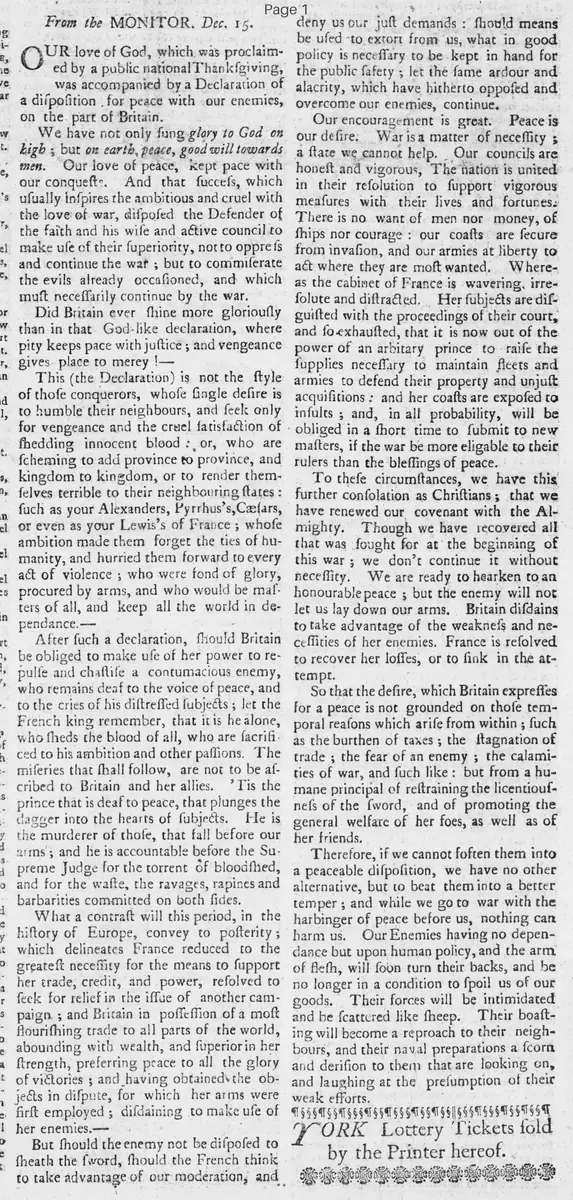
From the MONITOR. Dec. 15.
OUR love of God, which was proclaimed by a public national Thanksgiving, was accompanied by a Declaration of a disposition for peace with our enemies, on the part of Britain.
We have not only sung glory to God on high: but on earth, peace, good will towards men.
Our love of peace, kept pace with our conquests. And that success, which usually inspires the ambitious and cruel with the love of war, disposed the Defender of the faith and his wise and active council to make use of their superiority, not to oppress and continue the war; but to commiserate the evils already occasioned, and which must necessarily continue by the war.
Did Britain ever shine more gloriously than in that God-like declaration, where pity keeps pace with justice; and vengeance gives place to mercy!
This (the Declaration) is not the style of those conquerors, whose single desire is to humble their neighbours, and seek only for vengeance and the cruel satisfaction of shedding innocent blood: or, who are scheming to add province to province, and kingdom to kingdom, or to render themselves terrible to their neighbouring states: such as your Alexanders, Pyrrhus's, Cæsars, or even as your Lewis's of France; whose ambition made them forget the ties of humanity, and hurried them forward to every act of violence; who were fond of glory, procured by arms, and who would be masters of all, and keep all the world in dependence.
After such a declaration, should Britain be obliged to make use of her power to repulse and chastise a contumacious enemy, who remains deaf to the voice of peace, and to the cries of his distressed subjects: let the French king remember, that it is he alone, who sheds the blood of all, who are sacrificed to his ambition and other passions. The miseries that shall follow, are not to be ascribed to Britain and her allies. 'Tis the prince that is deaf to peace, that plunges the dagger into the hearts of subjects. He is the murderer of those, that fall before our arms; and he is accountable before the Supreme Judge for the torrent of bloodshed, and for the waste, the ravages, rapines and barbarities committed on both sides.
What a contrast will this period, in the history of Europe, convey to posterity; which delineates France reduced to the greatest necessity for the means to support her trade, credit, and power, resolved to seek for relief in the issue of another campaign; and Britain in possession of a most flourishing trade to all parts of the world, abounding with wealth, and superior in her strength, preferring peace to all the glory of victories; and having obtained the objects in dispute, for which her arms were first employed; disdaining to make use of her enemies'.
But should the enemy not be disposed to sheathe the sword, should the French think to take advantage of our moderation, and deny us our just demands: should means be used to extort from us, what in good policy is necessary to be kept in hand for the public safety; let the same ardour and alacrity, which have hitherto opposed and overcome our enemies, continue.
Our encouragement is great. Peace is our desire: War is a matter of necessity: a state we cannot help. Our councils are honest and vigorous, The nation is united in their resolution to support vigorous measures with their lives and fortunes: There is no want of men nor money, of ships nor courage: our coasts are secure from invasion, and our armies at liberty to act where they are most wanted. Whereas the cabinet of France is wavering, irresolute and distracted. Her subjects are disgusted with the proceedings of their court, and so exhausted, that it is now out of the power of an arbitrary prince to raise the supplies necessary to maintain fleets and armies to defend their property and unjust acquisitions: and her coasts are exposed to insults; and, in all probability, will be obliged in a short time to submit to new masters, if the war be more eligible to their rulers than the blessings of peace.
To these circumstances, we have this further consolation as Christians; that we have renewed our covenant with the Almighty. Though we have recovered all that was fought for at the beginning of this war; we don't continue it without necessity. We are ready to hearken to an honourable peace; but the enemy will not let us lay down our arms. Britain disdains to take advantage of the weakness and necessities of her enemies. France is resolved to recover her losses, or to sink in the attempt.
So that the desire, which Britain expresses for a peace is not grounded on those temporal reasons which arise from within; such as the burthen of taxes; the stagnation of trade; the fear of an enemy; the calamities of war, and such like: but from a humane principle of restraining the licentiousness of the sword, and of promoting the general welfare of her foes, as well as of her friends.
Therefore, if we cannot soften them into a peaceable disposition, we have no other alternative, but to beat them into a better temper; and while we go to war with the harbinger of peace before us, nothing can harm us. Our Enemies having no dependence but upon human policy, and the arm of flesh, will soon turn their backs, and be no longer in a condition to spoil us of our goods. Their forces will be intimidated and be scattered like sheep. Their boasting will become a reproach to their neighbours, and their naval preparations a scorn and derision to them that are looking on, and laughing at the presumption of their weak efforts.
OUR love of God, which was proclaimed by a public national Thanksgiving, was accompanied by a Declaration of a disposition for peace with our enemies, on the part of Britain.
We have not only sung glory to God on high: but on earth, peace, good will towards men.
Our love of peace, kept pace with our conquests. And that success, which usually inspires the ambitious and cruel with the love of war, disposed the Defender of the faith and his wise and active council to make use of their superiority, not to oppress and continue the war; but to commiserate the evils already occasioned, and which must necessarily continue by the war.
Did Britain ever shine more gloriously than in that God-like declaration, where pity keeps pace with justice; and vengeance gives place to mercy!
This (the Declaration) is not the style of those conquerors, whose single desire is to humble their neighbours, and seek only for vengeance and the cruel satisfaction of shedding innocent blood: or, who are scheming to add province to province, and kingdom to kingdom, or to render themselves terrible to their neighbouring states: such as your Alexanders, Pyrrhus's, Cæsars, or even as your Lewis's of France; whose ambition made them forget the ties of humanity, and hurried them forward to every act of violence; who were fond of glory, procured by arms, and who would be masters of all, and keep all the world in dependence.
After such a declaration, should Britain be obliged to make use of her power to repulse and chastise a contumacious enemy, who remains deaf to the voice of peace, and to the cries of his distressed subjects: let the French king remember, that it is he alone, who sheds the blood of all, who are sacrificed to his ambition and other passions. The miseries that shall follow, are not to be ascribed to Britain and her allies. 'Tis the prince that is deaf to peace, that plunges the dagger into the hearts of subjects. He is the murderer of those, that fall before our arms; and he is accountable before the Supreme Judge for the torrent of bloodshed, and for the waste, the ravages, rapines and barbarities committed on both sides.
What a contrast will this period, in the history of Europe, convey to posterity; which delineates France reduced to the greatest necessity for the means to support her trade, credit, and power, resolved to seek for relief in the issue of another campaign; and Britain in possession of a most flourishing trade to all parts of the world, abounding with wealth, and superior in her strength, preferring peace to all the glory of victories; and having obtained the objects in dispute, for which her arms were first employed; disdaining to make use of her enemies'.
But should the enemy not be disposed to sheathe the sword, should the French think to take advantage of our moderation, and deny us our just demands: should means be used to extort from us, what in good policy is necessary to be kept in hand for the public safety; let the same ardour and alacrity, which have hitherto opposed and overcome our enemies, continue.
Our encouragement is great. Peace is our desire: War is a matter of necessity: a state we cannot help. Our councils are honest and vigorous, The nation is united in their resolution to support vigorous measures with their lives and fortunes: There is no want of men nor money, of ships nor courage: our coasts are secure from invasion, and our armies at liberty to act where they are most wanted. Whereas the cabinet of France is wavering, irresolute and distracted. Her subjects are disgusted with the proceedings of their court, and so exhausted, that it is now out of the power of an arbitrary prince to raise the supplies necessary to maintain fleets and armies to defend their property and unjust acquisitions: and her coasts are exposed to insults; and, in all probability, will be obliged in a short time to submit to new masters, if the war be more eligible to their rulers than the blessings of peace.
To these circumstances, we have this further consolation as Christians; that we have renewed our covenant with the Almighty. Though we have recovered all that was fought for at the beginning of this war; we don't continue it without necessity. We are ready to hearken to an honourable peace; but the enemy will not let us lay down our arms. Britain disdains to take advantage of the weakness and necessities of her enemies. France is resolved to recover her losses, or to sink in the attempt.
So that the desire, which Britain expresses for a peace is not grounded on those temporal reasons which arise from within; such as the burthen of taxes; the stagnation of trade; the fear of an enemy; the calamities of war, and such like: but from a humane principle of restraining the licentiousness of the sword, and of promoting the general welfare of her foes, as well as of her friends.
Therefore, if we cannot soften them into a peaceable disposition, we have no other alternative, but to beat them into a better temper; and while we go to war with the harbinger of peace before us, nothing can harm us. Our Enemies having no dependence but upon human policy, and the arm of flesh, will soon turn their backs, and be no longer in a condition to spoil us of our goods. Their forces will be intimidated and be scattered like sheep. Their boasting will become a reproach to their neighbours, and their naval preparations a scorn and derision to them that are looking on, and laughing at the presumption of their weak efforts.
What sub-type of article is it?
War Or Peace
Foreign Affairs
Moral Or Religious
What keywords are associated?
Britain Peace Declaration
France War Ambition
Mercy Justice
Christian Consolation
European Contrast
Military Superiority
What entities or persons were involved?
Britain
France
French King
Defender Of The Faith
Alexanders
Pyrrhus's
Cæsars
Lewis's Of France
Editorial Details
Primary Topic
Britain's Declaration For Peace With France After Conquests
Stance / Tone
Supportive Of Britain's Merciful Peace Efforts, Critical Of French Ambition
Key Figures
Britain
France
French King
Defender Of The Faith
Alexanders
Pyrrhus's
Cæsars
Lewis's Of France
Key Arguments
Britain's Declaration Shows Mercy And Pity Alongside Justice, Contrasting With Aggressive Conquerors
French King Is Responsible For Bloodshed Due To Rejecting Peace
Britain Prefers Peace Despite Superiority, Having Achieved War Objectives
France Is Weakened And Exhausted, While Britain Is Strong And United
Britain's Peace Desire Stems From Humane And Christian Principles, Not Weakness
If Peace Is Rejected, Britain Must Continue War Vigorously