Thank you for visiting SNEWPapers!
Sign up free
Editorial
February 12, 1819
The Rhode Island American, And General Advertiser
Providence, Providence County, Rhode Island
What is this article about?
The National Advocate editorial quotes 1818 letters from Jefferson, Adams, and Madison supporting religious toleration for Jews, critiquing Maryland's legislative decision against it and advocating equal rights and education to combat prejudice.
Clipping
OCR Quality
98%
Excellent
Full Text
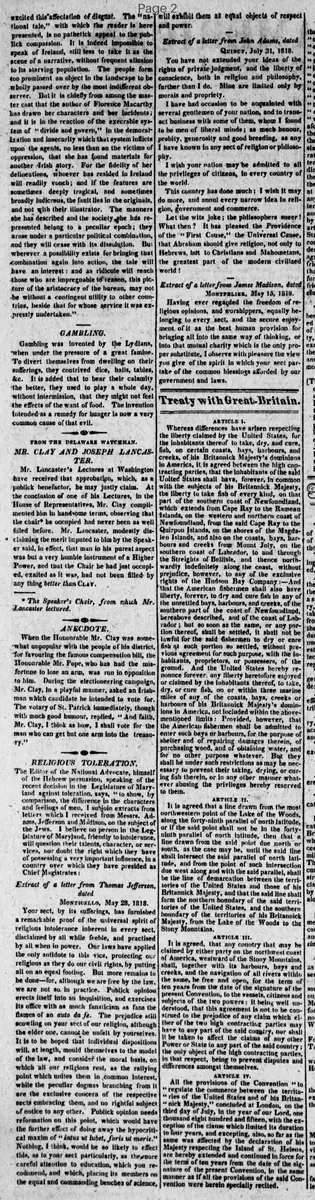
RELIGIOUS TOLERATION.
The Editor of the National Advocate, himself of the Hebrew persuasion, speaking of the recent decision in the Legislature of Maryland against toleration, says, "to show, by comparison, the difference in the characters and feelings of men, I subjoin extracts from letters which I received from Messrs. Adams, Jefferson and Madison, on the subject of the Jews. I believe no person in the Legislature of Maryland, friendly to intolerance, will question their talents, character, or services, nor doubt the right which they have of possessing a very important influence, in a country over which they have presided as Chief Magistrates:"
Extract of a letter from Thomas Jefferson dated
MONTICELLO, May 28, 1818.
Your sect, by its sufferings, has furnished a remarkable proof of the universal spirit of religious intolerance inherent in every sect, disclaimed by all while feeble, and practised by all when in power. Our laws have applied the only antidote to this vice, protecting our religious as they do our civil rights, by putting all on an equal footing. But more remains to be done--for, although we are free by the law, we are not so in practice. Public opinion erects itself into an inquisition, and exercises its office with as much fanaticism as fans the flames of an auto da fe. The prejudice still scowling on your sect of our religion, although the elder one, cannot be unfelt by yourselves. It is to be hoped that individual dispositions will, at length, mould themselves to the model of the law, and consider the moral basis, on which all our religions rest, as the rallying point which unites them in common interest, while the peculiar dogmas branching from it are the exclusive concern of the respective sects embracing them, and no rightful subject of notice to any other.' Public opinion needs reformation on this point, which would have the further effect of doing away the hypocritical maxim of "intus ut lubet, foris ut moris." Nothing, I think, would be so likely to effect this, as to your sect particularly, as the more careful attention to education, which you recommend, and which, placing its members on the equal and commanding benches of science, will exhibit them as equal objects of respect and power.
Extract of a letter from John Adams, dated
QUINCY, July 31, 1818.
You have not extended your ideas of the rights of private judgment, and the liberty of conscience, both in religion and philosophy, further than I do. Mine are limited only by morals and propriety. I have had occasion to be acquainted with several gentlemen of your nation, and to transact business with some of them, whom I found to be men of liberal minds; as much honour, probity, generosity and good breeding, as any I have known in any sect of religion or philosophy. I wish your nation may be admitted to all the privileges of citizens, in every country of the world. This country has done much; I wish it may do more, and annul every narrow idea in religion, government and commerce. Let the wits joke; the philosophers sneer! What then? It has pleased the Providence of the "First Cause," the Universal Cause, that Abraham should give religion, not only to Hebrews, but to Christians and Mahometans, the greatest part of the modern civilized world!
Extract of a letter from James Madison, dated
MONTPELIER, May 15, 1818.
Having ever regarded the freedom of religious opinions, and worshippers, equally belonging to every sect, and the secure enjoyment of it as the best human provision for bringing all into the same way of thinking, or into that mutual charity which is the only proper substitute, I observe with pleasure the view you give of the spirit in which your sect partake of the common blessings afforded by our government and laws.
The Editor of the National Advocate, himself of the Hebrew persuasion, speaking of the recent decision in the Legislature of Maryland against toleration, says, "to show, by comparison, the difference in the characters and feelings of men, I subjoin extracts from letters which I received from Messrs. Adams, Jefferson and Madison, on the subject of the Jews. I believe no person in the Legislature of Maryland, friendly to intolerance, will question their talents, character, or services, nor doubt the right which they have of possessing a very important influence, in a country over which they have presided as Chief Magistrates:"
Extract of a letter from Thomas Jefferson dated
MONTICELLO, May 28, 1818.
Your sect, by its sufferings, has furnished a remarkable proof of the universal spirit of religious intolerance inherent in every sect, disclaimed by all while feeble, and practised by all when in power. Our laws have applied the only antidote to this vice, protecting our religious as they do our civil rights, by putting all on an equal footing. But more remains to be done--for, although we are free by the law, we are not so in practice. Public opinion erects itself into an inquisition, and exercises its office with as much fanaticism as fans the flames of an auto da fe. The prejudice still scowling on your sect of our religion, although the elder one, cannot be unfelt by yourselves. It is to be hoped that individual dispositions will, at length, mould themselves to the model of the law, and consider the moral basis, on which all our religions rest, as the rallying point which unites them in common interest, while the peculiar dogmas branching from it are the exclusive concern of the respective sects embracing them, and no rightful subject of notice to any other.' Public opinion needs reformation on this point, which would have the further effect of doing away the hypocritical maxim of "intus ut lubet, foris ut moris." Nothing, I think, would be so likely to effect this, as to your sect particularly, as the more careful attention to education, which you recommend, and which, placing its members on the equal and commanding benches of science, will exhibit them as equal objects of respect and power.
Extract of a letter from John Adams, dated
QUINCY, July 31, 1818.
You have not extended your ideas of the rights of private judgment, and the liberty of conscience, both in religion and philosophy, further than I do. Mine are limited only by morals and propriety. I have had occasion to be acquainted with several gentlemen of your nation, and to transact business with some of them, whom I found to be men of liberal minds; as much honour, probity, generosity and good breeding, as any I have known in any sect of religion or philosophy. I wish your nation may be admitted to all the privileges of citizens, in every country of the world. This country has done much; I wish it may do more, and annul every narrow idea in religion, government and commerce. Let the wits joke; the philosophers sneer! What then? It has pleased the Providence of the "First Cause," the Universal Cause, that Abraham should give religion, not only to Hebrews, but to Christians and Mahometans, the greatest part of the modern civilized world!
Extract of a letter from James Madison, dated
MONTPELIER, May 15, 1818.
Having ever regarded the freedom of religious opinions, and worshippers, equally belonging to every sect, and the secure enjoyment of it as the best human provision for bringing all into the same way of thinking, or into that mutual charity which is the only proper substitute, I observe with pleasure the view you give of the spirit in which your sect partake of the common blessings afforded by our government and laws.
What sub-type of article is it?
Moral Or Religious
Constitutional
What keywords are associated?
Religious Toleration
Jews
Intolerance
Maryland Legislature
Jefferson Letter
Adams Letter
Madison Letter
Religious Freedom
What entities or persons were involved?
Thomas Jefferson
John Adams
James Madison
National Advocate Editor
Maryland Legislature
Jews
Editorial Details
Primary Topic
Advocacy For Religious Toleration For Jews
Stance / Tone
Supportive Of Religious Freedom And Equality
Key Figures
Thomas Jefferson
John Adams
James Madison
National Advocate Editor
Maryland Legislature
Jews
Key Arguments
Religious Intolerance Is Inherent In Sects When In Power But Laws Protect Equal Rights
Public Opinion Still Discriminates Against Jews Despite Legal Equality
Education Can Elevate Jews To Equal Respect
Jews Deserve Full Citizen Privileges Everywhere
Freedom Of Religious Opinions Benefits All Sects
Government And Laws Provide Common Blessings To All Sects