Thank you for visiting SNEWPapers!
Sign up free
The Ely Miner
Ely, Saint Louis County, Minnesota
What is this article about?
Article discusses the high nutritive value of artichokes for animal feed, especially hogs and cows, with a comparison table to other roots. J.H. Van Ness shares cultivation, harvesting, and storage methods, noting yields up to 800 bushels per acre and resistance to pests.
Merged-components note: The table provides the nutritional analysis referenced in the artichoke story; sequential reading order and spatial adjacency.
Clipping
OCR Quality
Full Text
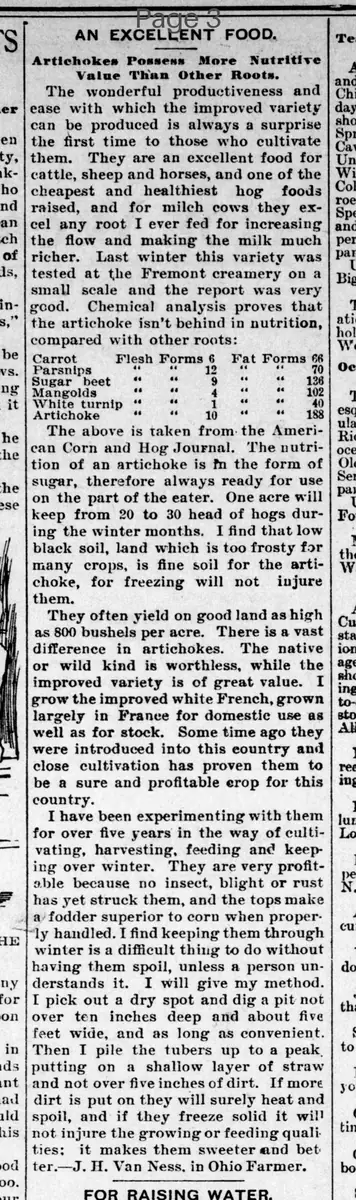
| Carrot | Flesh | Forms | 6 | Fat | Forms | 66 |
| Parsnips | “ | “ | 12 | “ | “ | 70 |
| Sugar | “ | “ | 9 | “ | “ | 136 |
| Mangolds | “ | “ | 4 | “ | “ | 102 |
| White turnip | “ | “ | 1 | “ | “ | 40 |
| Artichoke | “ | “ | 10 | “ | “ | 188 |
AN EXCELLENT FOOD.
Artichokes Possess More Nutritive Value Than Other Roots.
The wonderful productiveness and ease with which the improved variety can be produced is always a surprise the first time to those who cultivate them. They are an excellent food for cattle, sheep and horses, and one of the cheapest and healthiest hog foods raised, and for milch cows they excel any root I ever fed for increasing the flow and making the milk much richer. Last winter this variety was tested at the Fremont creamery on a small scale and the report was very good. Chemical analysis proves that the artichoke isn't behind in nutrition, compared with other roots:
The above is taken from the American Corn and Hog Journal. The nutrition of an artichoke is in the form of sugar, therefore always ready for use on the part of the eater. One acre will keep from 20 to 30 head of hogs during the winter months. I find that low black soil, land which is too frosty for many crops, is fine soil for the artichoke, for freezing will not injure them.
They often yield on good land as high as 800 bushels per acre. There is a vast difference in artichokes. The native or wild kind is worthless, while the improved variety is of great value. I grow the improved white French, grown largely in France for domestic use as well as for stock. Some time ago they were introduced into this country and close cultivation has proven them to be a sure and profitable crop for this country.
I have been experimenting with them for over five years in the way of cultivating, harvesting, feeding and keeping over winter. They are very profitable because no insect, blight or rust has yet struck them, and the tops make a fodder superior to corn when properly handled. I find keeping them through winter is a difficult thing to do without having them spoil, unless a person understands it. I will give my method.
I pick out a dry spot and dig a pit not over ten inches deep and about five feet wide, and as long as convenient. Then I pile the tubers up to a peak putting on a shallow layer of straw and not over five inches of dirt. If more dirt is put on they will surely heat and spoil, and if they freeze solid it will not injure the growing or feeding qualities: it makes them sweeter and better.—J. H. Van Ness, in Ohio Farmer.
What sub-type of article is it?
What themes does it cover?
What keywords are associated?
What entities or persons were involved?
Where did it happen?
Story Details
Key Persons
Location
Fremont Creamery
Event Date
Last Winter
Story Details
Artichokes are highlighted for their superior nutritive value in sugar and fat forms compared to other roots, excellent for feeding livestock like hogs and cows, with high yields and cultivation tips shared by the author after five years of experimentation.