Thank you for visiting SNEWPapers!
Sign up free
Story
September 21, 1896
The Topeka State Journal
Topeka, Shawnee County, Kansas
What is this article about?
William Jennings Bryan speaks to massive crowds in Baltimore (30,000) and Washington on Sept. 21, enduring rain. He criticizes Secretary Carlisle's policy on silver redemption as deceptive and criminal, pushing for honest civil service and American financial policy independent of foreign influence.
Clipping
OCR Quality
95%
Excellent
Full Text
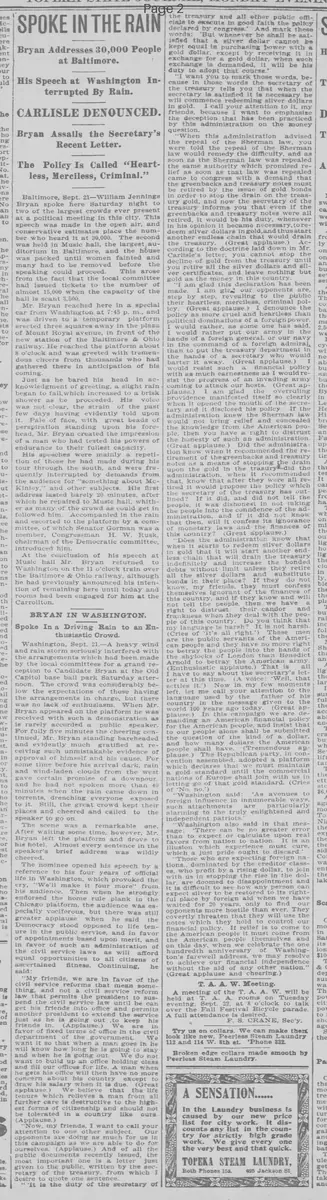
SPOKE IN THE RAIN.
Bryan Addresses 30,000 People at Baltimore.
His Speech at Washington Interrupted By Rain.
CARLISLE DENOUNCED.
Bryan Assails the Secretary's Recent Letter.
The Policy Is Called Heartless, Merciless, Criminal.
Baltimore, Sept. 21—William Jennings Bryan spoke here Saturday night to two of the largest crowds ever present at a political meeting in this city. This speech was made in the open air, and conservative estimates place the number who heard it at 30,000. The second was held in Music hall, the largest auditorium in Baltimore, and the house was packed until women fainted and many had to be removed before the speaking could proceed. This arose from the fact that the local committee had issued tickets to the number of almost 15,000 when the capacity of the hall is scant 3,500.
Mr. Bryan reached here in a special car from Washington at 7:45 p. m., and was driven to a temporary platform erected three squares away in the plaza of Mount Royal avenue, in front of the new station of the Baltimore & Ohio railway. He reached the platform about 8 o'clock and was greeted with tremendous cheers from thousands who had gathered there in anticipation of his coming.
Just as he bared his head in acknowledgment of greeting, a slight rain began to fall, which increased to a brisk shower as he proceeded. His voice was not clear, the strain of the past few days having evidently told upon it. Pale of face, with great beads of perspiration standing upon his forehead, Mr. Bryan created the impression of a man who had tested his powers of endurance to their fullest capacity.
His speeches were mainly a repetition of those he had made during his tour through the south, and were frequently interrupted by demands from the audience for "something about McKinley," and other subjects. His first address lasted barely 20 minutes, after which he repaired to Music hall, whither as many of the crowd as could get in followed him. Accompanied in the rain and escorted to the platform by a committee, of which Senator Gorman was a member, Congressman H. W. Rusk, chairman of the Democratic committee, introduced him.
At the conclusion of his speech at Music hall Mr. Bryan returned to Washington on the 11 o'clock train over the Baltimore & Ohio railway, although he had previously announced his intention of remaining here until today and rooms had been engaged for him at the Carrollton.
BRYAN IN WASHINGTON.
Spoke In a Driving Rain to an Enthusiastic Crowd.
Washington, Sept. 21.—A heavy wind and rain storm seriously interfered with the arrangements which had been made by the local committees for a grand reception to Candidate Bryan at the Old Capitol base ball park Saturday afternoon. The crowd was considerably below the expectations of those having the arrangements in charge, but there was no lack of enthusiasm. When Mr. Bryan appeared on the platform he was received with such a demonstration as is rarely accorded a public speaker. For fully five minutes the cheering continued, Mr. Bryan standing bareheaded and evidently much gratified at receiving such unmistakable evidence of approval of himself and his cause.
For some time before his arrival dark, rain and wind-laden clouds from the west gave certain promise of a downpour, and he had not spoken more than 40 minutes when the rain came down in torrents, drenching everyone exposed to it. Still, the great crowd kept their places and cheered and called to the speaker to go on.
The scene was a remarkable one. After waiting some time, however, Mr. Bryan left the platform and drove to his hotel. Almost every sentence in the speaker's brief address was wildly cheered.
The nominee opened his speech by a reference to his four years of official life in Washington, which provoked the cry, "We'll make it four more" from his audience. Then when he strongly endorsed the home rule plank in the Chicago platform, the audience was especially vociferous, but there was still greater applause when he said the Democracy stood opposed to life tenure in the public service, and in favor of appointments based upon merit, and in favor of such an administration of the civil service laws as will afford equal opportunities to all citizens of ascertained fitness. Continuing, he said:
"My friends, we are in favor of the civil service reforms that mean something, and not a civil service reform law that permits the president to suspend the civil service law until he can get his friends into office and permits another president to extend the service just as he is going out, to keep his friends in. (Applause.) We are in favor of fixed terms of office in the civil department of the government. We want it so that when a man goes in he will know how long he is going to stay and when he is going out. We do not want to build up an office holding class and fill our offices for life. A man when he gets his office will then have no more concern about his country except to draw his salary when it is due. (Great applause.) We believe that the life tenure which relieves a man from all further care is destructive to the highest forms of citizenship and should not be tolerated in a country like ours. (Applause.)
"Now, my friends, I want to call your attention to one other subject. Our opponents are doing as much for us in this campaign as we are able to do for ourselves. (Applause.) And of all the public documents recently issued, the most important one is a letter just given to the public, written by the secretary of the treasury, from which I desire to quote one sentence.
"'It is the duty of the secretary of the treasury and all other public officials to execute in good faith the policy declared by congress.' And mark these words: But whenever he shall be satisfied that a silver dollar cannot be kept equal in purchasing power with a gold dollar, except by receiving it in exchange for a gold dollar, when such exchange is demanded, it will be his duty to adopt that course.'
"I want you to mark those words, because in those words the secretary of the treasury tells you that when the secretary is satisfied it is necessary he will commence redeeming silver dollars in gold. I call your attention to it, my friends, because I want to emphasize the deception that has been practiced by this administration on the money question.
"When this administration advised the repeal of the Sherman law, you were told the repeal of the Sherman law would remedy the difficulty, and as soon as the Sherman law was repealed the same authority which promised relief as soon as that law was repealed came to congress with a demand that the greenbacks and treasury notes must be retired by the issue of gold bonds in order to stop the drain on the treasury gold, and now the secretary of the treasury informs you that even if the greenbacks and treasury notes were all retired, it would be his duty, whenever in his opinion it became necessary, to redeem silver dollars in gold, and thus start another endless chain that would drain the treasury. (Great applause.) According to the doctrine laid down in Mr. Carlisle's letter, you cannot stop the decline of gold from the treasury until you retire all the silver dollars and silver certificates, and leave nothing but gold as the money in this country.
"I am glad this declaration has been made. I am glad our opponents are, step by step, revealing to the public their heartless, merciless, criminal policy. (Great applause.) I denounce the policy as more cruel and heartless than political dominations of a foreign power. I would rather, as some one has said, I would rather put our army in the hands of a foreign general, or our navy in the command of a foreign admiral, than to put the treasury department in the hands of a secretary who would barter it away. (Great applause.) I would resist such a financial policy with as much earnestness as I would resist the progress of an invading army coming to attack our homes. (Great applause.) I am glad the overruling providence manifested itself so clearly when it opened the mouth of the secretary and it disclosed his policy. If the administration knew the Sherman law would not bring relief and concealed the knowledge from the American people, then you have a right to distrust the honesty of such an administration. (Great applause.) Did the administration, when it recommended the retirement of the greenbacks and treasury notes as a means of stopping the drain upon the gold in the treasury, did the administration, when it recommended that, know that after they were all retired it would propose the policy which the secretary of the treasury has outlined? If it did, and did not tell the people, it was dishonest in not taking the people into the confidence of the administration, and if it did not know that then, will it confess its ignorance of monetary laws and the finances of this country? (Great applause.)
Does the administration know that when it starts to redeem silver dollars in gold that it will start another endless chain that will drain the treasury indefinitely and increase the bonded debts without limit unless they retire all the silver dollars and substitute bonds in their place? If they do not know, my friends, they must confess themselves ignorant of the finances of this country, and if they know and will not tell the people, then we have a right to distrust their candor and frankness when they deal with the people of this country. Do you think my language is harsh? It is not harsh. (Cries of 'It's all right.') These men are the public servants of the American people and they have no more right to betray the people into the hands of the shylocks of London than Benedict Arnold to betray the American army. (Enthusiastic applause.) That is all I have to say about the secretary's letter at this time. (A voice: Well, that settles it.) Now in my few moments left, let me call your attention to the language used by the father of his country in the message given to the world 100 years ago today. (Great applause.) In this campaign we are demanding an American financial policy for the American people, and insist that to our people alone shall be submitted the question of the kind of a dollar, and how many dollars the American people shall have. (Tremendous applause.) The Republican party, in convention assembled, adopted a platform which declares that we must maintain a gold standard until the commercial nations of Europe shall join with us in letting go of that gold standard. (Cries of 'No, no.')
"Washington said: As avenues to foreign influence in innumerable ways, such attachments are particularly alarming to the truly enlightened and independent patriots.'
"Washington also said in that message: There can be no greater error than to expect or calculate upon real favors from nation to nation. It is an illusion which experience must cure, which a just pride ought to discard.'
"Those who are expecting foreign nations, dominated by the creditor classes, who profit by a rising dollar, to join with us in stopping the rise in the dollar, are doomed to disappointment and it is difficult to see how any person can expect silver to be restored to its rightful place by foreign aid when we have waited for 20 years, only to find our opponents more hostile than ever. They covertly threaten that they will use the bonds which they hold to control our financial policy. If relief is to come to the American people it must come from the American people themselves and on this day, when we celebrate the one hundredth anniversary of Washington's farewell address, we may resolve to achieve our financial independence without the aid of any other nation." (Great applause and cheering.)
Bryan Addresses 30,000 People at Baltimore.
His Speech at Washington Interrupted By Rain.
CARLISLE DENOUNCED.
Bryan Assails the Secretary's Recent Letter.
The Policy Is Called Heartless, Merciless, Criminal.
Baltimore, Sept. 21—William Jennings Bryan spoke here Saturday night to two of the largest crowds ever present at a political meeting in this city. This speech was made in the open air, and conservative estimates place the number who heard it at 30,000. The second was held in Music hall, the largest auditorium in Baltimore, and the house was packed until women fainted and many had to be removed before the speaking could proceed. This arose from the fact that the local committee had issued tickets to the number of almost 15,000 when the capacity of the hall is scant 3,500.
Mr. Bryan reached here in a special car from Washington at 7:45 p. m., and was driven to a temporary platform erected three squares away in the plaza of Mount Royal avenue, in front of the new station of the Baltimore & Ohio railway. He reached the platform about 8 o'clock and was greeted with tremendous cheers from thousands who had gathered there in anticipation of his coming.
Just as he bared his head in acknowledgment of greeting, a slight rain began to fall, which increased to a brisk shower as he proceeded. His voice was not clear, the strain of the past few days having evidently told upon it. Pale of face, with great beads of perspiration standing upon his forehead, Mr. Bryan created the impression of a man who had tested his powers of endurance to their fullest capacity.
His speeches were mainly a repetition of those he had made during his tour through the south, and were frequently interrupted by demands from the audience for "something about McKinley," and other subjects. His first address lasted barely 20 minutes, after which he repaired to Music hall, whither as many of the crowd as could get in followed him. Accompanied in the rain and escorted to the platform by a committee, of which Senator Gorman was a member, Congressman H. W. Rusk, chairman of the Democratic committee, introduced him.
At the conclusion of his speech at Music hall Mr. Bryan returned to Washington on the 11 o'clock train over the Baltimore & Ohio railway, although he had previously announced his intention of remaining here until today and rooms had been engaged for him at the Carrollton.
BRYAN IN WASHINGTON.
Spoke In a Driving Rain to an Enthusiastic Crowd.
Washington, Sept. 21.—A heavy wind and rain storm seriously interfered with the arrangements which had been made by the local committees for a grand reception to Candidate Bryan at the Old Capitol base ball park Saturday afternoon. The crowd was considerably below the expectations of those having the arrangements in charge, but there was no lack of enthusiasm. When Mr. Bryan appeared on the platform he was received with such a demonstration as is rarely accorded a public speaker. For fully five minutes the cheering continued, Mr. Bryan standing bareheaded and evidently much gratified at receiving such unmistakable evidence of approval of himself and his cause.
For some time before his arrival dark, rain and wind-laden clouds from the west gave certain promise of a downpour, and he had not spoken more than 40 minutes when the rain came down in torrents, drenching everyone exposed to it. Still, the great crowd kept their places and cheered and called to the speaker to go on.
The scene was a remarkable one. After waiting some time, however, Mr. Bryan left the platform and drove to his hotel. Almost every sentence in the speaker's brief address was wildly cheered.
The nominee opened his speech by a reference to his four years of official life in Washington, which provoked the cry, "We'll make it four more" from his audience. Then when he strongly endorsed the home rule plank in the Chicago platform, the audience was especially vociferous, but there was still greater applause when he said the Democracy stood opposed to life tenure in the public service, and in favor of appointments based upon merit, and in favor of such an administration of the civil service laws as will afford equal opportunities to all citizens of ascertained fitness. Continuing, he said:
"My friends, we are in favor of the civil service reforms that mean something, and not a civil service reform law that permits the president to suspend the civil service law until he can get his friends into office and permits another president to extend the service just as he is going out, to keep his friends in. (Applause.) We are in favor of fixed terms of office in the civil department of the government. We want it so that when a man goes in he will know how long he is going to stay and when he is going out. We do not want to build up an office holding class and fill our offices for life. A man when he gets his office will then have no more concern about his country except to draw his salary when it is due. (Great applause.) We believe that the life tenure which relieves a man from all further care is destructive to the highest forms of citizenship and should not be tolerated in a country like ours. (Applause.)
"Now, my friends, I want to call your attention to one other subject. Our opponents are doing as much for us in this campaign as we are able to do for ourselves. (Applause.) And of all the public documents recently issued, the most important one is a letter just given to the public, written by the secretary of the treasury, from which I desire to quote one sentence.
"'It is the duty of the secretary of the treasury and all other public officials to execute in good faith the policy declared by congress.' And mark these words: But whenever he shall be satisfied that a silver dollar cannot be kept equal in purchasing power with a gold dollar, except by receiving it in exchange for a gold dollar, when such exchange is demanded, it will be his duty to adopt that course.'
"I want you to mark those words, because in those words the secretary of the treasury tells you that when the secretary is satisfied it is necessary he will commence redeeming silver dollars in gold. I call your attention to it, my friends, because I want to emphasize the deception that has been practiced by this administration on the money question.
"When this administration advised the repeal of the Sherman law, you were told the repeal of the Sherman law would remedy the difficulty, and as soon as the Sherman law was repealed the same authority which promised relief as soon as that law was repealed came to congress with a demand that the greenbacks and treasury notes must be retired by the issue of gold bonds in order to stop the drain on the treasury gold, and now the secretary of the treasury informs you that even if the greenbacks and treasury notes were all retired, it would be his duty, whenever in his opinion it became necessary, to redeem silver dollars in gold, and thus start another endless chain that would drain the treasury. (Great applause.) According to the doctrine laid down in Mr. Carlisle's letter, you cannot stop the decline of gold from the treasury until you retire all the silver dollars and silver certificates, and leave nothing but gold as the money in this country.
"I am glad this declaration has been made. I am glad our opponents are, step by step, revealing to the public their heartless, merciless, criminal policy. (Great applause.) I denounce the policy as more cruel and heartless than political dominations of a foreign power. I would rather, as some one has said, I would rather put our army in the hands of a foreign general, or our navy in the command of a foreign admiral, than to put the treasury department in the hands of a secretary who would barter it away. (Great applause.) I would resist such a financial policy with as much earnestness as I would resist the progress of an invading army coming to attack our homes. (Great applause.) I am glad the overruling providence manifested itself so clearly when it opened the mouth of the secretary and it disclosed his policy. If the administration knew the Sherman law would not bring relief and concealed the knowledge from the American people, then you have a right to distrust the honesty of such an administration. (Great applause.) Did the administration, when it recommended the retirement of the greenbacks and treasury notes as a means of stopping the drain upon the gold in the treasury, did the administration, when it recommended that, know that after they were all retired it would propose the policy which the secretary of the treasury has outlined? If it did, and did not tell the people, it was dishonest in not taking the people into the confidence of the administration, and if it did not know that then, will it confess its ignorance of monetary laws and the finances of this country? (Great applause.)
Does the administration know that when it starts to redeem silver dollars in gold that it will start another endless chain that will drain the treasury indefinitely and increase the bonded debts without limit unless they retire all the silver dollars and substitute bonds in their place? If they do not know, my friends, they must confess themselves ignorant of the finances of this country, and if they know and will not tell the people, then we have a right to distrust their candor and frankness when they deal with the people of this country. Do you think my language is harsh? It is not harsh. (Cries of 'It's all right.') These men are the public servants of the American people and they have no more right to betray the people into the hands of the shylocks of London than Benedict Arnold to betray the American army. (Enthusiastic applause.) That is all I have to say about the secretary's letter at this time. (A voice: Well, that settles it.) Now in my few moments left, let me call your attention to the language used by the father of his country in the message given to the world 100 years ago today. (Great applause.) In this campaign we are demanding an American financial policy for the American people, and insist that to our people alone shall be submitted the question of the kind of a dollar, and how many dollars the American people shall have. (Tremendous applause.) The Republican party, in convention assembled, adopted a platform which declares that we must maintain a gold standard until the commercial nations of Europe shall join with us in letting go of that gold standard. (Cries of 'No, no.')
"Washington said: As avenues to foreign influence in innumerable ways, such attachments are particularly alarming to the truly enlightened and independent patriots.'
"Washington also said in that message: There can be no greater error than to expect or calculate upon real favors from nation to nation. It is an illusion which experience must cure, which a just pride ought to discard.'
"Those who are expecting foreign nations, dominated by the creditor classes, who profit by a rising dollar, to join with us in stopping the rise in the dollar, are doomed to disappointment and it is difficult to see how any person can expect silver to be restored to its rightful place by foreign aid when we have waited for 20 years, only to find our opponents more hostile than ever. They covertly threaten that they will use the bonds which they hold to control our financial policy. If relief is to come to the American people it must come from the American people themselves and on this day, when we celebrate the one hundredth anniversary of Washington's farewell address, we may resolve to achieve our financial independence without the aid of any other nation." (Great applause and cheering.)
What sub-type of article is it?
Historical Event
Biography
What themes does it cover?
Deception
Justice
Moral Virtue
What keywords are associated?
William Jennings Bryan
Political Speech
Baltimore Rally
Washington Speech
Silver Policy
Carlisle Letter
Rain Interruption
Financial Deception
What entities or persons were involved?
William Jennings Bryan
John G. Carlisle
Mckinley
Senator Gorman
H. W. Rusk
Washington
Where did it happen?
Baltimore, Washington
Story Details
Key Persons
William Jennings Bryan
John G. Carlisle
Mckinley
Senator Gorman
H. W. Rusk
Washington
Location
Baltimore, Washington
Event Date
Sept. 21
Story Details
William Jennings Bryan delivers speeches in Baltimore and Washington on Sept. 21, addressing large crowds despite rain. He denounces Secretary Carlisle's letter on redeeming silver in gold as heartless and deceptive, advocating for American financial independence and civil service reform.