Thank you for visiting SNEWPapers!
Sign up free
Letter to Editor
December 10, 1841
New York Tribune
New York, New York County, New York
What is this article about?
Letter critiques 'An Old Merchant' from Evening Post for misunderstanding exchanges, highlighting contradictions in his argument. Advocates for a U.S. government bank with branches to equalize currency, addressing regional discounts due to banks' failure to redeem bills in specie.
Clipping
OCR Quality
95%
Excellent
Full Text
Exchanges.
To the Editor of the Tribune:
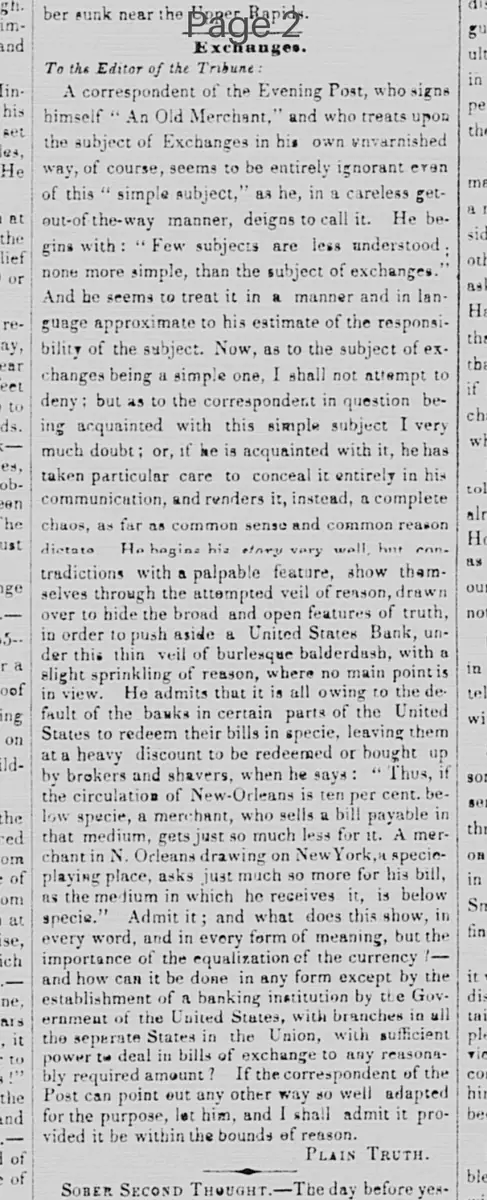
A correspondent of the Evening Post, who signs himself "An Old Merchant," and who treats upon the subject of Exchanges in his own unvarnished way, of course, seems to be entirely ignorant even of this "simple subject," as he, in a careless get-out-of-the-way manner, deigns to call it. He begins with: "Few subjects are less understood; none more simple, than the subject of exchanges." And he seems to treat it in a manner and in language approximate to his estimate of the responsibility of the subject. Now, as to the subject of exchanges being a simple one, I shall not attempt to deny: but as to the correspondent in question being acquainted with this simple subject I very much doubt; or, if he is acquainted with it, he has taken particular care to conceal it entirely in his communication, and renders it, instead, a complete chaos, as far as common sense and common reason dictate.
He begins his story very well, but contradictions with a palpable feature, show themselves through the attempted veil of reason, drawn over to hide the broad and open features of truth, in order to push aside a United States Bank, under this thin veil of burlesque balderdash, with a slight sprinkling of reason, where no main point is in view. He admits that it is all owing to the default of the banks in certain parts of the United States to redeem their bills in specie, leaving them at a heavy discount to be redeemed or bought up by brokers and shavers, when he says: "Thus, if the circulation of New-Orleans is ten per cent. below specie, a merchant, who sells a bill payable in that medium, gets just so much less for it. A merchant in N. Orleans drawing on New York, a specie-paying place, asks just so much more for his bill, as the medium in which he receives it, is below specie." Admit it; and what does this show, in every word, and in every form of meaning, but the importance of the equalization of the currency?—and how can it be done in any form except by the establishment of a banking institution by the Government of the United States, with branches in all the separate States in the Union, with sufficient power to deal in bills of exchange to any reasonably required amount? If the correspondent of the Post can point out any other way so well adapted for the purpose, let him, and I shall admit it provided it be within the bounds of reason.
PLAIN TRUTH.
To the Editor of the Tribune:
A correspondent of the Evening Post, who signs himself "An Old Merchant," and who treats upon the subject of Exchanges in his own unvarnished way, of course, seems to be entirely ignorant even of this "simple subject," as he, in a careless get-out-of-the-way manner, deigns to call it. He begins with: "Few subjects are less understood; none more simple, than the subject of exchanges." And he seems to treat it in a manner and in language approximate to his estimate of the responsibility of the subject. Now, as to the subject of exchanges being a simple one, I shall not attempt to deny: but as to the correspondent in question being acquainted with this simple subject I very much doubt; or, if he is acquainted with it, he has taken particular care to conceal it entirely in his communication, and renders it, instead, a complete chaos, as far as common sense and common reason dictate.
He begins his story very well, but contradictions with a palpable feature, show themselves through the attempted veil of reason, drawn over to hide the broad and open features of truth, in order to push aside a United States Bank, under this thin veil of burlesque balderdash, with a slight sprinkling of reason, where no main point is in view. He admits that it is all owing to the default of the banks in certain parts of the United States to redeem their bills in specie, leaving them at a heavy discount to be redeemed or bought up by brokers and shavers, when he says: "Thus, if the circulation of New-Orleans is ten per cent. below specie, a merchant, who sells a bill payable in that medium, gets just so much less for it. A merchant in N. Orleans drawing on New York, a specie-paying place, asks just so much more for his bill, as the medium in which he receives it, is below specie." Admit it; and what does this show, in every word, and in every form of meaning, but the importance of the equalization of the currency?—and how can it be done in any form except by the establishment of a banking institution by the Government of the United States, with branches in all the separate States in the Union, with sufficient power to deal in bills of exchange to any reasonably required amount? If the correspondent of the Post can point out any other way so well adapted for the purpose, let him, and I shall admit it provided it be within the bounds of reason.
PLAIN TRUTH.
What sub-type of article is it?
Persuasive
Political
What themes does it cover?
Economic Policy
Politics
What keywords are associated?
Exchanges
Currency Equalization
United States Bank
Specie Redemption
Bank Defaults
New Orleans Bills
New York Bills
What entities or persons were involved?
Plain Truth.
To The Editor Of The Tribune
Letter to Editor Details
Author
Plain Truth.
Recipient
To The Editor Of The Tribune
Main Argument
criticizes 'an old merchant' for ignorance and contradictions on exchanges; argues that regional bank failures in specie redemption necessitate a national u.s. bank with branches to equalize currency across states.
Notable Details
Quotes 'An Old Merchant' On Exchanges Simplicity
Highlights Contradictions In Opponent's Argument Against U.S. Bank
Emphasizes Importance Of Currency Equalization Via Government Banking Institution