Thank you for visiting SNEWPapers!
Sign up free
The Dawson News
Dawson, Terrell County, Georgia
What is this article about?
In the U.S. Senate, Idaho's Senator Gooding champions the McCumber-Fordney tariff bill for protecting farm products at 21.3% duty, while Georgia's Senator Watson and Alabama's Senator Underwood criticize it for unfairly burdening southern consumers and farmers with high taxes favoring privileged interests. (248 characters)
Clipping
OCR Quality
Full Text
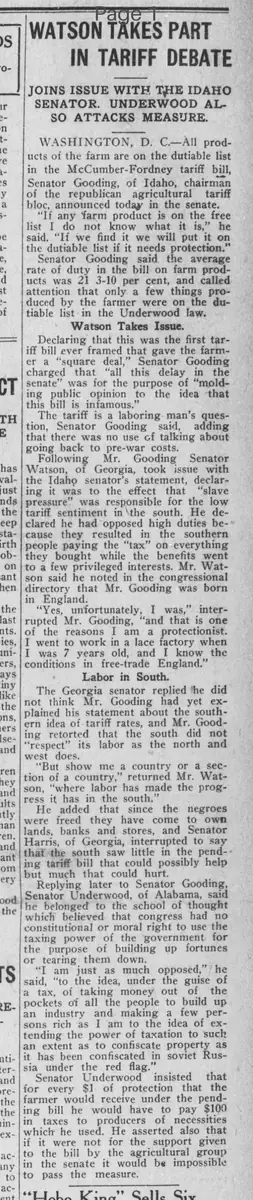
JOINS ISSUE WITH THE IDAHO SENATOR. UNDERWOOD ALSO ATTACKS MEASURE
WASHINGTON, D. C.—All products of the farm are on the dutiable list in the McCumber-Fordney tariff bill, Senator Gooding, of Idaho, chairman of the republican agricultural tariff bloc, announced today in the senate.
"If any farm product is on the free list I do not know what it is," he said. "If we find it we will put it on the dutiable list if it needs protection."
Senator Gooding said the average rate of duty in the bill on farm products was 21 3-10 per cent, and called attention that only a few things produced by the farmer were on the dutiable list in the Underwood law.
Watson Takes Issue.
Declaring that this was the first tariff bill ever framed that gave the farmer a "square deal," Senator Gooding charged "that all this delay in the senate" was for the purpose of "molding public opinion to the idea that this bill is infamous."
The tariff is a laboring man's question, Senator Gooding said, adding that there was no use of talking about going back to pre-war costs.
Following Mr. Gooding Senator Watson, of Georgia, took issue with the Idaho senator's statement, declaring it was to the effect that "slave pressure" was responsible for the low tariff sentiment in the south. He declared he had opposed high duties because they resulted in the southern people paying the "tax" on everything they bought while the benefits went to a few privileged interests. Mr. Watson said he noted in the congressional directory that Mr. Gooding was born in England.
"Yes, unfortunately, I was," interrupted Mr. Gooding, "and that is one of the reasons I am a protectionist. I went to work in a lace factory when I was 7 years old, and I know the conditions in free-trade England."
Labor in South
The Georgia senator replied he did not think Mr. Gooding had yet explained his statement about the southern idea of tariff rates, and Mr. Gooding retorted that the south did not "respect" its labor as the north and west does.
"But show me a country or a section of a country," returned Mr. Watson, "where labor has made the progress it has in the south."
He added that since the negroes were freed they have come to own lands, banks and stores, and Senator Harris, of Georgia, interrupted to say that the south saw little in the pending tariff bill that could possibly help but much that could hurt.
Replying later to Senator Gooding, Senator Underwood, of Alabama, said he belonged to the school of thought which believed that congress had no constitutional or moral right to use the taxing power of the government for the purpose of building up fortunes or tearing them down.
"I am just as much opposed," he said, to the idea, under the guise of a tax, of taking money out of the pockets of all the people to build up an industry and making a few persons rich as I am to the idea of extending the power of taxation to such an extent as to confiscate property as it has been confiscated in soviet Russia under the red flag."
Senator Underwood insisted that for every $1 of protection that the farmer would receive under the pending bill he would have to pay $100 in taxes to producers of necessities which he used. He asserted also that if it were not for the support given to the bill by the agricultural group in the senate it would be impossible to pass the measure.
What sub-type of article is it?
What themes does it cover?
What keywords are associated?
What entities or persons were involved?
Where did it happen?
Story Details
Key Persons
Location
Washington, D. C.
Story Details
Senator Gooding defends the McCumber-Fordney tariff bill, claiming it gives farmers a square deal with all farm products dutiable at 21 3-10 percent. Senator Watson challenges Gooding's views on southern tariff sentiments and labor progress. Senator Underwood opposes using taxation to favor industries, arguing farmers pay more in taxes than they gain in protection.