Thank you for visiting SNEWPapers!
Sign up free
Letter to Editor
August 28, 1793
National Gazette
Philadelphia, Philadelphia County, Pennsylvania
What is this article about?
In the first of a series, 'Hamlet' critiques potential corruption in the young U.S. federal government, urging vigilance. He dismisses rumors of a dispute between President Washington and the French minister as Tory lies, advocating gratitude and alliance with France while condemning neutrality toward England.
Clipping
OCR Quality
95%
Excellent
Full Text
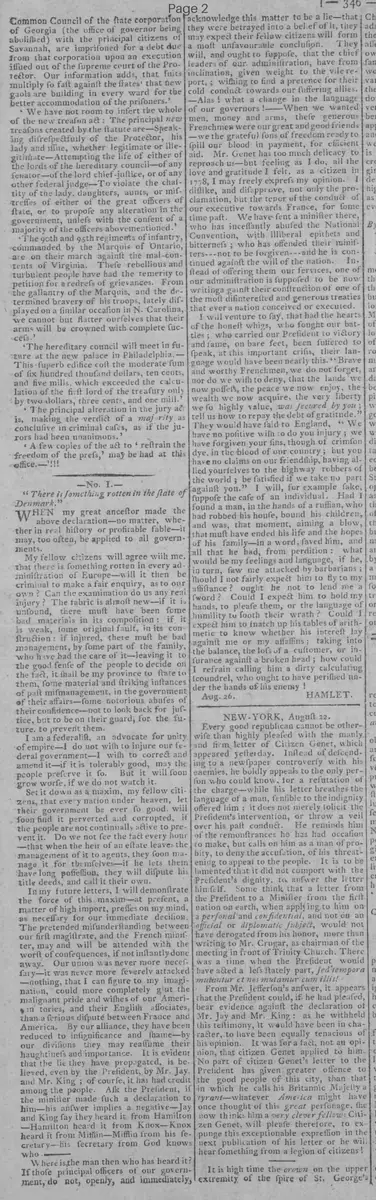
—No. I.—
There is something rotten in the state of Denmark.
WHEN my great ancestor made the above declaration—no matter, whether in real history or profitable fable—it may, too often, be applied to all governments.
My fellow citizens will agree with me, that there is something rotten in every administration of Europe—will it then be criminal to make a fair enquiry, as to our own? Can the examination do us any real injury? The fabric is almost new—if it is unsound, there must have been some bad materials in its composition: if it is weak, some original fault, in its construction: if injured, there must be bad management, by some part of the family, who have had the care of it—leaving it to the good sense of the people to decide on the fact, it shall be my province to state to them, some material and striking instances of past mismanagement, in the government of their affairs—some notorious abuses of their confidence—not to look back for justice, but to be on their guard, for the future, to prevent them.
I am a federalist, an advocate for unity of empire—I do not wish to injure our federal government—I wish to correct and amend it—if it is tolerably good, may the people preserve it so. But it will soon grow worse, if we do not watch it.
Set it down as a maxim, my fellow citizens, that every nation under heaven, let their government be ever so good, will soon find it perverted and corrupted, if the people are not continually active to prevent it. Do we not see the fact every hour—that when the heir of an estate leaves the management of it to agents, they soon manage it for themselves—if he lets them have long possession, they will dispute his title deeds, and call it their own.
In my future letters, I will demonstrate the force of this maxim—at present, a matter of high import, presses on my mind, as necessary for our immediate decision.
The pretended misunderstanding between our first magistrate, and the French minister, may and will be attended with the worst of consequences, if not instantly done away. Our union was never more necessary—it was never more severely attacked—nothing, that I can figure to my imagination, could more completely glut the malignant pride and wishes of our American tories, and their English associates, than a serious dispute between France and America. By our alliance, they have been reduced to insignificance and shame—by our divisions they may resume their haughtiness and importance. It is evident that the lie they have propagated, is believed, even by the President, by Mr. Jay, and Mr. King; of course, it has had credit among the people. Ask the President, if the minister made such a declaration to him—his answer implies a negative—Jay and King say they heard it from Hamilton—Hamilton heard it from Knox—Knox heard it from Mifflin—Mifflin from his secretary—his secretary from God knows who.
Where is the man then who has heard it: If those principal officers of our government, do not, openly, and immediately acknowledge this matter to be a lie—that they were betrayed into a belief of it, they may expect their fellow citizens will form a most unfavourable conclusion.
They will, and ought to suppose, that the chief leaders of our administration, have from inclination, given weight to the vile report; wishing to find a pretence for their cold conduct towards our suffering allies.—Alas! what a change in the language of our governors!—When we wanted men, money and arms, these generous Frenchmen were our great and good friends—we the grateful sons of freedom ready to spill our blood in payment, for efficient aid. Mr. Genet has too much delicacy to reproach us—but feeling as I do, all the love and gratitude I felt, as a citizen in 1778, I may freely express my opinion. I dislike, and disapprove, not only the proclamation, but the tenor of the conduct of our executive towards France, for some time past. We have sent a minister there, who has incessantly abused the National Convention, with illiberal epithets and bitterness; who has offended their ministers—not to be forgiven—and he is continued against the will of the nation. Instead of offering them our services, one of our administration is supposed to be now writing against their construction of one of the most disinterested and generous treaties that ever a nation conceived or executed.
I will venture to say, that had the hearts of the honest whigs, who fought our battles; who carried our President to victory and fame, on bare feet, been suffered to speak, at this important crisis, their language would have been nearly this. "Brave and worthy Frenchmen, we do not forget, nor do we wish to deny, that the lands we now possess, the peace we now enjoy, the wealth we now acquire, the very liberty we so highly value, was secured by you; tell us how to repay the debt of gratitude."
They would have said to England, "We have no positive wish to do you injury; we have forgiven your sins, though of crimson dye, in the blood of our country; but you have no claims on our friendship having allied yourselves to the highway robbers of the world; be satisfied if we take no part against you." I will, for example sake, suppose the case of an individual. Had I found a man, in the hands of a ruffian, who had robbed his house, bound his children, and was, that moment, aiming a blow, that must have ended his life and the hopes of his family—in a word, saved him, and all that he had, from perdition: what would be my feelings and language, if he, in turn, saw me attacked by barbarians; should I not fairly expect him to fly to my assistance? ought he not to lend me a hand? Could I expect him to hold my hands, to please them, or the language of humility to sooth their wrath? Could I expect him to snatch up his tables of arithmetic to know whether his interest lay against me or my affairs; taking into the balance, the loss of a customer, or insurance against a broken head; how could I refrain calling him a dirty calculating scoundrel, who ought to have perished under the hands of his enemy!
HAMLET.
There is something rotten in the state of Denmark.
WHEN my great ancestor made the above declaration—no matter, whether in real history or profitable fable—it may, too often, be applied to all governments.
My fellow citizens will agree with me, that there is something rotten in every administration of Europe—will it then be criminal to make a fair enquiry, as to our own? Can the examination do us any real injury? The fabric is almost new—if it is unsound, there must have been some bad materials in its composition: if it is weak, some original fault, in its construction: if injured, there must be bad management, by some part of the family, who have had the care of it—leaving it to the good sense of the people to decide on the fact, it shall be my province to state to them, some material and striking instances of past mismanagement, in the government of their affairs—some notorious abuses of their confidence—not to look back for justice, but to be on their guard, for the future, to prevent them.
I am a federalist, an advocate for unity of empire—I do not wish to injure our federal government—I wish to correct and amend it—if it is tolerably good, may the people preserve it so. But it will soon grow worse, if we do not watch it.
Set it down as a maxim, my fellow citizens, that every nation under heaven, let their government be ever so good, will soon find it perverted and corrupted, if the people are not continually active to prevent it. Do we not see the fact every hour—that when the heir of an estate leaves the management of it to agents, they soon manage it for themselves—if he lets them have long possession, they will dispute his title deeds, and call it their own.
In my future letters, I will demonstrate the force of this maxim—at present, a matter of high import, presses on my mind, as necessary for our immediate decision.
The pretended misunderstanding between our first magistrate, and the French minister, may and will be attended with the worst of consequences, if not instantly done away. Our union was never more necessary—it was never more severely attacked—nothing, that I can figure to my imagination, could more completely glut the malignant pride and wishes of our American tories, and their English associates, than a serious dispute between France and America. By our alliance, they have been reduced to insignificance and shame—by our divisions they may resume their haughtiness and importance. It is evident that the lie they have propagated, is believed, even by the President, by Mr. Jay, and Mr. King; of course, it has had credit among the people. Ask the President, if the minister made such a declaration to him—his answer implies a negative—Jay and King say they heard it from Hamilton—Hamilton heard it from Knox—Knox heard it from Mifflin—Mifflin from his secretary—his secretary from God knows who.
Where is the man then who has heard it: If those principal officers of our government, do not, openly, and immediately acknowledge this matter to be a lie—that they were betrayed into a belief of it, they may expect their fellow citizens will form a most unfavourable conclusion.
They will, and ought to suppose, that the chief leaders of our administration, have from inclination, given weight to the vile report; wishing to find a pretence for their cold conduct towards our suffering allies.—Alas! what a change in the language of our governors!—When we wanted men, money and arms, these generous Frenchmen were our great and good friends—we the grateful sons of freedom ready to spill our blood in payment, for efficient aid. Mr. Genet has too much delicacy to reproach us—but feeling as I do, all the love and gratitude I felt, as a citizen in 1778, I may freely express my opinion. I dislike, and disapprove, not only the proclamation, but the tenor of the conduct of our executive towards France, for some time past. We have sent a minister there, who has incessantly abused the National Convention, with illiberal epithets and bitterness; who has offended their ministers—not to be forgiven—and he is continued against the will of the nation. Instead of offering them our services, one of our administration is supposed to be now writing against their construction of one of the most disinterested and generous treaties that ever a nation conceived or executed.
I will venture to say, that had the hearts of the honest whigs, who fought our battles; who carried our President to victory and fame, on bare feet, been suffered to speak, at this important crisis, their language would have been nearly this. "Brave and worthy Frenchmen, we do not forget, nor do we wish to deny, that the lands we now possess, the peace we now enjoy, the wealth we now acquire, the very liberty we so highly value, was secured by you; tell us how to repay the debt of gratitude."
They would have said to England, "We have no positive wish to do you injury; we have forgiven your sins, though of crimson dye, in the blood of our country; but you have no claims on our friendship having allied yourselves to the highway robbers of the world; be satisfied if we take no part against you." I will, for example sake, suppose the case of an individual. Had I found a man, in the hands of a ruffian, who had robbed his house, bound his children, and was, that moment, aiming a blow, that must have ended his life and the hopes of his family—in a word, saved him, and all that he had, from perdition: what would be my feelings and language, if he, in turn, saw me attacked by barbarians; should I not fairly expect him to fly to my assistance? ought he not to lend me a hand? Could I expect him to hold my hands, to please them, or the language of humility to sooth their wrath? Could I expect him to snatch up his tables of arithmetic to know whether his interest lay against me or my affairs; taking into the balance, the loss of a customer, or insurance against a broken head; how could I refrain calling him a dirty calculating scoundrel, who ought to have perished under the hands of his enemy!
HAMLET.
What sub-type of article is it?
Persuasive
Political
Provocative
What themes does it cover?
Politics
What keywords are associated?
Federal Government
French Alliance
Tory Lies
President Washington
Mr Genet
American Gratitude
Political Vigilance
Foreign Policy
What entities or persons were involved?
Hamlet
Letter to Editor Details
Author
Hamlet
Main Argument
the u.s. government risks corruption without vigilant citizen oversight; rumors of a dispute with the french minister are tory lies that undermine the vital alliance with france, for which america owes profound gratitude, while neutrality toward england is condemned.
Notable Details
References Shakespeare: 'There Is Something Rotten In The State Of Denmark'
Critiques Chain Of Rumor From Hamilton To Knox To Mifflin
Expresses Gratitude For French Aid In 1778
Opposes U.S. Minister's Abuse Of French National Convention
Hypothetical Speech From Revolutionary War Whigs