Thank you for visiting SNEWPapers!
Sign up free
Rhode Island Republican
Newport, Newport County, Rhode Island
What is this article about?
This editorial defends the newspaper's accusation that John Rutledge forged letters criticizing President Adams, arguing based on probabilities, handwriting analysis, and timelines that Rutledge, a Federalist, authored them. It refutes defenses claiming Republican forgery or imitation, and critiques the Aegis editor's opinion supporting Rutledge.
Merged-components note: These components form a continued editorial series by the newspaper reviewing and analyzing the Rutledge forged letters case, spanning pages 2 and 3 with direct textual continuation (e.g., 'To be continued' leading into subsequent remarks). The content is opinionated and partisan, best labeled as editorial.
Clippings
1 of 2
OCR Quality
Full Text
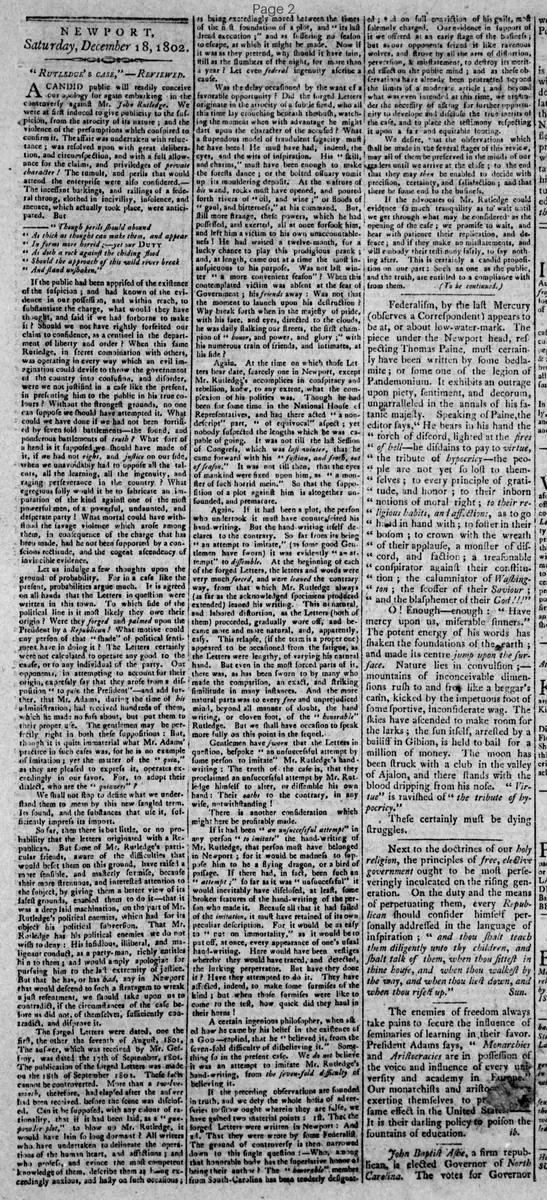
CANDID public will readily conceive our apology for again embarking in the controversy against Mr. John Rutledge. We were at first induced to give publicity to the opinion, from the atrocity of its nature; and the violence of the prepossessions which conspired to confirm it. The affair was undertaken with reluctance: was resolved upon with great deliberation, and circumspection, and with a full allowance for the claims, and privileges of private character! The tumult, and perils that would attend the enterprise were also considered.-- The incessant barkings, and railings of a federal throng, clothed in incivility, insolence, and menace, which actually took place, were anticipated. But
"Though perils should abound
As thick as thought can make them, and appear
In forms more horrid:--yet our Duty
As doth a rock against the chiding Flood
Should the approach of this wild river break,
And stand unshaken."
If the public had been apprised of the existence of the opinion; and had known of the evidence in our possession, and within reach, to substantiate the charge, what would they have thought, and said if we had forborne to make it? Should we not have rightly forfeited our claim to confidence, as a sentinel in the department of liberty and order? When this same Rutledge, in secret combination with others, was operating in every way which an evil imagination could devise to throw the government of the country into confusion, and disorder, were we not justified in a case like the present, in presenting him to the public in his true colours? Without the strongest grounds, no one can suppose we should have attempted it. What could we have done if we had not been fortified by even fold battlements--the sound, and ponderous battlements of truth? What sort of a hand is it supposed we should have made of it, if we had not right, and justice on our side, when we unavoidably had to oppose all the talents, all the learning, all the ingenuity, and raging perseverance in the country? What egregious folly would it be to fabricate an imputation of the kind against one of the most powerful men, of a powerful, undaunted, and desperate party! What mortal could have withstood the savage violence which arose among them, in consequence of the charge that has been made, had he not been supported by a conscious rectitude, and the cogent ascendency of invincible evidence.
Let us indulge a few thoughts upon the ground of probability. For in a case like the present, probabilities argue much. It is agreed on all hands that the Letters in question were written in this town. To which side of the political line is it most likely they owe their origin? Were they forged and palmed upon the President by a Republican! What motive could any person of that "shade" of political sentiment have in doing it? The Letters certainly were not calculated to operate any good to the cause, or to any individual of the party. Our opponents, in attempting to account for their origin, expressly say that they arose from a disposition "to quiz the President"--and add further, that Mr. Adams, during the time of his administration, had received hundreds of them, which he made no fuss about, but put them to their proper use. The gentlemen may be perfectly right in both these suppositions: But, though it is quite immaterial what Mr. Adams' practice in such cases was, for he is no example of imitation; yet the matter of the "quiz," as they are pleased to express it, operates exceedingly in our favor. For, to adopt their dialect, who are the "quizzers"
We shall not stop to define what we understand them to mean by this new-fangled term. Its sound, and the circumstances that use it, sufficiently imports its import.
So far, then there is but little, or no probability that the letters originated with a Republican. But some of Mr. Rutledge's particular friends, aware of the difficulties that would beset them on this ground, have raised a more sensible, and masterly cry, because their more strenuous, and interested attention to the object, by giving them a better view of its safest grounds, enabled them to do it--that it was a deep laid machination, on the part of Mr. Rutledge's political enemies, which had for its object his political subversion. That Mr. Rutledge has his political enemies we do not wish to deny: His insidious, illiberal, and malignant conduct, as a party-man, richly entitles him to them; and would amply apologize for pursuing him to the last extremity of justice. But that he has, or has had, any in Newport that would descend to such a stratagem to wreak a just resentment, we should take upon us to contradict, if the circumstances of the case before us did not, of themselves, sufficiently contradict, and disprove it.
The forged Letters were dated, one the first, the other the seventh of August, 1801. The answer, which was received by Mr. Geoffrey, was dated the 12th of September, 1801. The publication of the forged Letters was made on the 18th of September 1801. These facts cannot be controverted. More than a twelvemonth, therefore, had elapsed after the answer had been received, before the scene was disclosed. Can it be supposed, with any colour of rationality, that if it had been laid, as a "gunpowder plot," to blow up Mr. Rutledge, it would have lain so long dormant? All writers who have undertaken to delineate the operations of the human heart, and affections; and who profess, and evince the most competent knowledge of them, describe them as having exceedingly anxious, and shaky on such occasions;
being exceedingly moved between the times of the first foundation of a plot, and "its last dread execution:" and as fearing no escape, at which it might be made. Now if it was as they pretend, why should it have lain, still as the numbers of the night, for more than a year? Let even federal ingenuity ascribe a cause.
Was the delay occasioned by the want of a favorable opportunity? Did the forged Letters originate in the atrocity of a subtle fiend, who all this time lay crouching beneath the bush, watching the moment when with advantage he might dart upon the character of the accused? What a stupendous model of fraudulent sagacity must he have been! He must have had, indeed, the eyes, and the wits of inspiration. His "skill, and charms," must have been enough to make the forests dance; or the bolted quarry vomit up its mouldering deposit. At the waving of his wand, rocks must have opened, and poured forth rivers of "oil, and wine;" or floods of "gall, and bitterness," at his command. But, still more strange, these powers, which he had possessed, and exerted, all at once forsook him, and left him a victim to his own unaccountableness! He had waited a twelve-month, for a lucky chance to play this prodigious prank; and, at length, came out at a time the most inauspicious to his purpose. Was not last winter "a more convenient season"? When this contemplated victim was absent at the seat of Government; his friends away: Was not that the moment to launch upon him detraction? Why break forth when in the majesty of pride, with his eye, and eyes, directed to the clouds, he was daily treading our streets, the first champion of "honor, and power, and glory:" with his numerous train of friends, and intimates, at his side?
Again. At the time on which those Letters bear date, scarcely one in Newport, except Mr. Rutledge's accomplices in conspiracy and rebellion, knew, to any extent, what the complexion of his politics was. Though he had been for some time in the National House of Representatives, and had there acted "a non-descript" part, "of equivocal" aspect; yet nobody suspected the lengths which he was capable of going. It was not till the last Session of Congress, which was last winter, that he came forward with his seditious, and froth, out of season." It was not still then, that the eyes of mankind were fixed upon him, as "a monster of such horrid mien." So that the supposition of a plot against him is altogether unfounded, and premature.
Again. If it had been a plot, the person who undertook it must have counterfeited his hand-writing. But the hand-writing itself declares to the contrary. So far from its being "an attempt to imitate," (as some good Gentlemen have sworn) it was evidently "an attempt" to dissemble. At the beginning of each of the forged Letters, the letters and words were very much forced, and were leaned the contrary way, from that which Mr. Rutledge always (as far as the acknowledged specimens produced extended) leaned his writing. This unnatural, and labored distortion, as the Letters (both of them) proceeded, gradually wore off; and became more and more natural, and, apparently, easy. This relapse, (if the term is a proper one) appeared to be occasioned from the fatigue, as the Letters were lengthy, of varying his natural hand. But even in the most forced parts of it, there was, as has been sworn to by many who made the comparison, an exact, and striking similitude in many instances. And the more natural parts was to every free and unprejudiced mind, beyond all manner of doubt, the hand writing, or cloven foot, of the "honorable" Rutledge. But we shall have occasion to speak more fully on this point in the sequel.
Gentlemen have sworn that the Letters in question, bespoke "an unsuccessful attempt by some person to imitate" Mr. Rutledge's hand-writing: The truth of the case is, that they proclaimed an unsuccessful attempt by Mr. Rutledge himself to alter, or dissemble his own hand: Their oaths to the contrary, in any wise, notwithstanding!
There is another consideration which might here be profitably made.
If it had been "an unsuccessful attempt" in any person "to imitate" the hand-writing of Mr. Rutledge, that person must have belonged in Newport; for it would be madness to suppose him to be a flying dragon, or a bird of passage. If there had, in fact, been such an "attempt:" so far as it was "unsuccessful" it would inevitably have disclosed, at least, some broken features of the hand-writing of the person who made it. Because all that it had failed of the imitation, it must have retained of its own peculiar description. For it would be as easy to "put on immortality." as it would be to put off, at once, every appearance of one's usual hand-writing. Here would have been vestiges whereby they would have traced, and detected, the lurking perpetrator. But have they done it? Have they attempted to do it? They have affected, indeed, to make some surmises of the kind; but when those surmises were like to come to the test, how quick did they haul in their horns!
A certain ingenious philosopher, when asked how he came by his belief in the existence of a God--replied, that he "believed it, from the even-fold difficulty of disbelieving it." Something of in the present case. We do not believe it was an attempt to imitate Mr. Rutledge's hand-writing, from the seven-fold difficulty of believing it.
If the preceding observations are founded in truth, and we defy the whole host of adversaries to show ought wherein they are false, we have gained two material points: 1st. That the forged Letters were written in Newport: And 2d. That they were wrote by some Federalist.
The ground of controversy is then narrowed down to this single question:--Who, among that honorable body has the superlative honor of being their author? The "honorable" member from South-Carolina has been tenderly designated; and on full conviction of his guilt, most solemnly charged. Our evidence in support of it we offered at an early stage of the business; but as our opponents seized it like ravenous wolves, and strove by all the arts of distortion, perversion, & misstatement, to destroy its merit, and set it off on the public mind: and as these observations have already been protracted beyond the limits of a moderate article; and beyond what was even intended at this time, we are under the necessity of asking for further opportunity to develope and disclose the true merits of the case, and to place the testimony respecting it upon a fair and equitable footing.
We desire, that the observations which shall be made in the several stages of this review, may all of them be preserved in the minds of our readers until we arrive at the close: to the end that they may then be enabled to decide with precision, certainty, and satisfaction; and that there be some end to the business.
If the advocates of Mr. Rutledge could evidence so much tranquility as to wait until we get through what may be considered--as the opening of the case; we promise to wait, and hear with patience their replication, and defence; and if they make no misstatements, and will embody their testimony fairly, to say nothing after. This is certainly a candid proposition on our part: Such an one as the public, and the truth, are entitled to a compliance with from them.
(To be continued.)
Remarks upon the Aegis.
WE now fulfil our engagement repeating the opinion which has been given in the affair of the forged Letters, by the Editor of the Aegis. He has made his second entry in this interesting drama. The first was merely to volunteer 'candid opinion,' which the purveyor of the Mercury consistently transcribed into that paper, and rendered in return the tribute of compliment. We are well aware that these folks always stand ready with their compliments to exchange them for personal, or party favors :-It is their peculiar mode of procuring mantles to cover the deformities of guilt. And we are much mistaken, if the Editor of the Aegis has not, in this case, given bounds to his candor to the prejudice of his conscience. What his politics are, is nothing to the present question. Though, as an able auxiliary in the vineyard of liberty, and republicanism, we may respect and revere him ; yet, as a hasty, and officious meddler in this affair, an affair which, it seems, he knows nothing about, we shall not hesitate to oppose, as it is in our power, and incumbent on us, to confute and confound him. To his mere 'opinion' we should have replied ; but, in that case it must necessarily have been short ; for we could only have asked what avail the 'opinion' of a man a hundred miles off, who had not seen the Letters, or known any of the circumstances which attended them, but from newspapers which by accident he might have seen, and those, possibly, all of one side, could be of in the neighborhood of the transaction, where all the circumstances were notorious and familiar ? Are not the citizens of Newport competent to form their own opinions ? Are they to bow in reverence, and humble themselves before the supreme sagacity of the Editor of the Aegis? What new lights did he pretend to throw on the subject ? None at all ! He merely advanced what he called 'a candid opinion,' which, according to his own account, was formed from part of the evidence. From its newspaper dress, and appearance, it might possibly have carried some ascendency with those who will not give themselves the trouble to reflect; but with the thinking part of the community who had much better means of information, than could be obtained at Worcester, where the Aegis is printed, it could not weigh a straw. And the editor of the Mercury, however complaisant for favor, or facetious in compliment, has told a very intolerable one in attempting to palm it upon them. But we might have been spared these observations; for, as was stated, the Editor of the Aegis has since made his second entry, and, as if distrustful of the 'opinion' he had given, undertakes to exhibit the balance of facts, or preponderance of testimony upon which, he says, that opinion was predicated. It is fortunate that he has done so : because we are thereby enabled to travel on more solid ground, and to place it in his power to rectify his mistake. One of the facts he has thus stated does not happen to have any existence in the case. The others are unattended with those circumstances which are necessary to explain them. And all do not make up one eighth part of those that do really exist. He says- 'six gentlemen, out of ten, who compared them with specimens of Mr. Rutledge's hand writing, have made oath that there is a very striking similitude, and that they have no doubt the letters were written by him. The other four were of a different opinion. It is understood the six gentlemen, whose affidavits have been published are all republicans.' Now he is entirely in a mistake about a difference of opinion between the four, and six gentlemen who have deposed. Though they may have adopted different modes of expression ; and though the one may be more forcible than the other, yet they, undoubtedly co-operate to the same effect, and amount, in fact to the same opinion. The language of the six is, that they are compelled to believe that the hand-writing of the forged letters, and the hand-writing of the other letters, to wit, the specimens of Mr. Rutledge's writing, are written by the same hand. The language of the four is, that on examination of the forged letters, and comparison of them with letters and notes of John Rutledge, they perceive the greatest similitude of hand writing, and that the former are written in a constrained hand. Such as a person would write who was desirous to disguise his own. Can here be said to exist any difference of opinion ? Here, then, the opinion of the Editor of the Aegis (though 'a Democratic paper,' (as the Mercury-boy says) lumps in once. His saying, that he understands the six gentlemen to be republicans, implies that he understands the four are not. That he should be misinformed relative to the state, and merits of the case of Mr. Rutledge, is not strange; for we are very sensible that every pains has been taken, abroad as well as here, to distort it to an appearance in his favor : but how he could obtain such cramp-sided information upon a very collateral & inferior point, it is difficult to conjecture. And why he should mention it, among the reasons for his 'opinion,' is not less strange. It is, at any rate, also a mistake. But he might have informed himself. (if he wished for correct information,) from the same paper which contains the depositions of the 'six' he has mentioned, that there were Nineteen gentlemen of respectability in this town, who had certified and made oath to the similitude between the hand-writing of the forged letters and others acknowledged to have been written by Rutledge. And that about the same number in Providence gave an opinion to the same effect. Further.-He mentions the depositions of three persons-Betty Chapman, Rhody Chappell, and Polly Osborne. This last he distinguishes by denominating her 'a young girl.' Nobody has pretended that Polly Osborne lived with Mr. Rutledge, at the time of the date of
the forged letters, or that she was the person who carried the letters to the Post-Office.-- Therefore, her deposition is entirely expletive, and superfluous, and ought to be laid out of the case.-But, says he, 'Rhody Chappell testifies that at the time alluded to, she was frequently in Mr. Rutledge's family, and is positive there was no white girl or woman, and no young female domestic of any sort, in the family at that time.' to wit, 'as the time alluded to!' How cogent! How conclusive! But its cogency ought not to preclude consideration. * There was not only 'no white girl or woman' but there was also 'no young female, or domestic of any sort in the family at that time ! !' If we were disposed, we might here indulge a vein of humour, relative to the reputed gallantry of Mr. Rutledge ; but it would not be to the purpose and we forbear. Many inquisitive spirits might be inclined to ask how Rhody came to be so particular ? To satisfy which, it ought to be considered that she did not indite her deposition herself; but was under the operation, and control, of Mr. Rutledge's nimble co-adjutors. All the agency he had in it, was, if she could by any possible stretch of conscience, to give it her passive and tacit sanction.-But what does all the particularity amount to? Had Mr. Rutledge no female children ? Did no soul of petticoat description dart his door during 'the time alluded to ?' Rhody has sworn to too much : It discredits her testimony; which, if it should be admitted to be true, would argue nothing as to the main point in controversy. And it is surprising that the Editor of the Aegis would offer it as a ground for any other opinion, than that she was improperly wrought upon or that the hireling defenders of Mr. Rutledge were desperately pushed, for even a colourable defence. -Indeed, Polly Osborne never made oath to any thing : And it has been proven, by the depositions of Wm. Moore, jun. and Mrs. Osborne, that Rhody swore falsely. There is another circumstance which he offers as affording 'confirmation strong.' 'In addition to this (says he) Betty Chapman swears that she went to live in Mr. Rutledge's family, about the last of August, (which appears to be 'the time alluded to' by Miss Rhody) and that while there, she never carried letters to the post-office or any other place.' No person has been identified, as having carried the letters to the post-office. But there is at present, the strongest reasons to suppose that Betty Chapman was the person. When the suspicion was first made public against Mr. Rutledge, relative to his having forged the letters in question, he; or his friends employed their jack-a-daws to suppress, and, if possible, to wipe it away: They were many in number, and incorrigible in impudence, and effrontery. They instantly repaired to such points in the chain of circumstances, as their ingenuity taught them would most likely cut off the concatenation of proof. Betty Chapman they saw, and obtained her deposition. We have not travelled in bogs to meet their press-gangs of testimony ; we shall not, therefore, offer any conjectures relative to the manner in which they obtained it. We do not say that they colloguered, or inveigled ; that they offered rewards for perjury, or raised expectation by splendid appearances : On these points let those who have studied their characters think, and judge for themselves. But be it understood, that Betty Chapman is a young girl, of indigent circumstances, without education, and under-witted. She is, therefore, a fit instrument in their hands, and a proper subject for them to work upon. Further. -The Editor of the Aegis says. 'one witness (Mr. Kinlock, a particular friend of Mr. Rutledge) has sworn that Mr. Richardson, the Post. Master, told Mr. Rutledge. on the first enquiry, he did not know who brought the Letters.' This is misinformation. But we cannot enter into a detail of it at this time. It shall be satisfactorily explained in the course of a review of the subject, which is already undertaken. On the whole, we believe that the grounds which were offered by the Editor of the Aegis for his gigantic 'opinion' to take upon, are pretty thoroughly destroyed. It brings to mind the story of the sailor, who said he was sure of salvation-for he had been to meeting where the minister was preaching against sailors, and said they would all certainly go to perdition. And looking round for arguments to illustrate and prove it, happened to spy a fly standing quietly on the cushion :--Sailors, said he, will all go to perdition--as sure--as sure--as I catch this fly. He struck at the fly but did not take it. Mr. Blake can hit at the fly, but has missed his aim. His 'opinion,' like the fly, might have stood in tranquility, if his reasons for it had not appeared ; but they have frightened it, and it is gone. Thus much for Mr. Blake, his opinion, and the fly. We have to apologize to Mr. Blake, for the freedom we have taken in these remarks.— It was against our feelings : But in this case we are governed by the dictates of the first law of nature. Such are the desperate extremities to which it has been pushed, on the part of the accused. Not by legal means : Not with an open and liberal deportment; not by evidence, or argument ; But by subtlety, and fraud; by craft, and connivance ; by conspiracy, and machination: by declamation. scurrility, and abuse.- We embarked in it from motives of duty ; and we trust they will be strong, and lasting enough to bear us through.
Before we had determined to commence the review of " Rutledge's case," we had placed in type the piece from the (New- York) American Citizen, which appears in the first page of this day's paper,--It will be found to contain a charge, other than what we have brought against him, relative to his anonymous letter to Mr. Gerry; which, though not new to us, will doubtless be new to the public. But the Editors of the Citizen have traced him back further than our information extended.-They have shown him as an actor in this X, Y, Z, mission to France; and through the whole, we observe in him the strictest consistency of character.
What sub-type of article is it?
What keywords are associated?
What entities or persons were involved?
Editorial Details
Primary Topic
Accusation Of John Rutledge Forging Political Letters
Stance / Tone
Strongly Accusatory Against Rutledge And His Defenders
Key Figures
Key Arguments