Thank you for visiting SNEWPapers!
Sign up free
Story
December 20, 1896
The Norfolk Virginian
Norfolk, Virginia
What is this article about?
Mr. Justice Vaughan Williams speaks at Charing Cross Hospital Medical School, highlighting similarities between law and medicine but envying medicine's scientific advancement over law's unchanging principles, and warns students against becoming biased expert witnesses in court.
Clipping
OCR Quality
98%
Excellent
Full Text
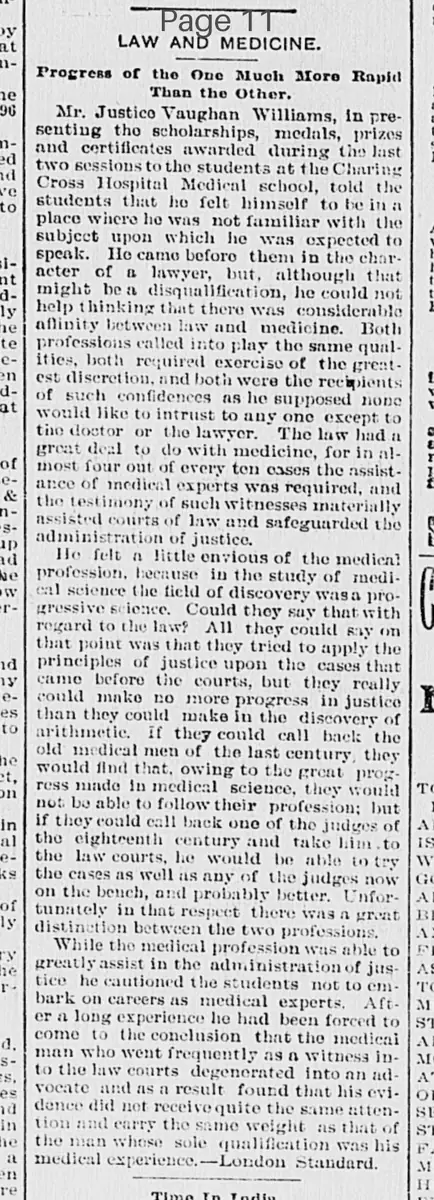
LAW AND MEDICINE.
Progress of the One Much More Rapidly Than the Other.
Mr. Justice Vaughan Williams, in presenting the scholarships, medals, prizes and certificates awarded during the last two sessions to the students at the Charing Cross Hospital Medical school, told the students that he felt himself to be in a place where he was not familiar with the subject upon which he was expected to speak. He came before them in the character of a lawyer, but, although that might be a disqualification, he could not help thinking that there was considerable affinity between law and medicine. Both professions called into play the same qualities, both required exercise of the greatest discretion, and both were the recipients of such confidences as he supposed none would like to intrust to any one except to the doctor or the lawyer. The law had a great deal to do with medicine, for in almost four out of every ten cases the assistance of medical experts was required, and the testimony of such witnesses materially assisted courts of law and safeguarded the administration of justice.
He felt a little envious of the medical profession, because in the study of medical science the field of discovery was a progressive science. Could they say that with regard to the law? All they could say on that point was that they tried to apply the principles of justice upon the cases that came before the courts, but they really could make no more progress in justice than they could make in the discovery of arithmetic. If they could call back the old medical men of the last century, they would find that, owing to the great progress made in medical science, they would not be able to follow their profession; but if they could call back one of the judges of the eighteenth century and take him to the law courts, he would be able to try the cases as well as any of the judges now on the bench, and probably better. Unfortunately in that respect there was a great distinction between the two professions. While the medical profession was able to greatly assist in the administration of justice he cautioned the students not to embark on careers as medical experts. After a long experience he had been forced to come to the conclusion that the medical man who went frequently as a witness into the law courts degenerated into an advocate and as a result found that his evidence did not receive quite the same attention and carry the same weight as that of the man whose sole qualification was his medical experience.-London Standard.
Progress of the One Much More Rapidly Than the Other.
Mr. Justice Vaughan Williams, in presenting the scholarships, medals, prizes and certificates awarded during the last two sessions to the students at the Charing Cross Hospital Medical school, told the students that he felt himself to be in a place where he was not familiar with the subject upon which he was expected to speak. He came before them in the character of a lawyer, but, although that might be a disqualification, he could not help thinking that there was considerable affinity between law and medicine. Both professions called into play the same qualities, both required exercise of the greatest discretion, and both were the recipients of such confidences as he supposed none would like to intrust to any one except to the doctor or the lawyer. The law had a great deal to do with medicine, for in almost four out of every ten cases the assistance of medical experts was required, and the testimony of such witnesses materially assisted courts of law and safeguarded the administration of justice.
He felt a little envious of the medical profession, because in the study of medical science the field of discovery was a progressive science. Could they say that with regard to the law? All they could say on that point was that they tried to apply the principles of justice upon the cases that came before the courts, but they really could make no more progress in justice than they could make in the discovery of arithmetic. If they could call back the old medical men of the last century, they would find that, owing to the great progress made in medical science, they would not be able to follow their profession; but if they could call back one of the judges of the eighteenth century and take him to the law courts, he would be able to try the cases as well as any of the judges now on the bench, and probably better. Unfortunately in that respect there was a great distinction between the two professions. While the medical profession was able to greatly assist in the administration of justice he cautioned the students not to embark on careers as medical experts. After a long experience he had been forced to come to the conclusion that the medical man who went frequently as a witness into the law courts degenerated into an advocate and as a result found that his evidence did not receive quite the same attention and carry the same weight as that of the man whose sole qualification was his medical experience.-London Standard.
What sub-type of article is it?
Historical Event
Biography
What themes does it cover?
Justice
Moral Virtue
What keywords are associated?
Law And Medicine
Professional Progress
Medical Experts
Administration Of Justice
What entities or persons were involved?
Mr. Justice Vaughan Williams
Where did it happen?
Charing Cross Hospital Medical School
Story Details
Key Persons
Mr. Justice Vaughan Williams
Location
Charing Cross Hospital Medical School
Story Details
Mr. Justice Vaughan Williams addresses medical students, comparing law and medicine professions, noting medicine's rapid progress versus law's static nature, and cautioning against frequent expert witness roles that may bias testimony.