Thank you for visiting SNEWPapers!
Sign up free
Literary
November 4, 1926
The Monmouth Inquirer
Freehold, Monmouth County, New Jersey
What is this article about?
Priscilla Dunscomb vigilantly tends her dying husband Daniel, reflecting on their 20-year unhappy marriage marked by resentment and neglect of their children. At his crisis, pity surges; she prays for his life and attempts to recapture her youthful appearance to seek redemption.
Clipping
OCR Quality
85%
Good
Full Text
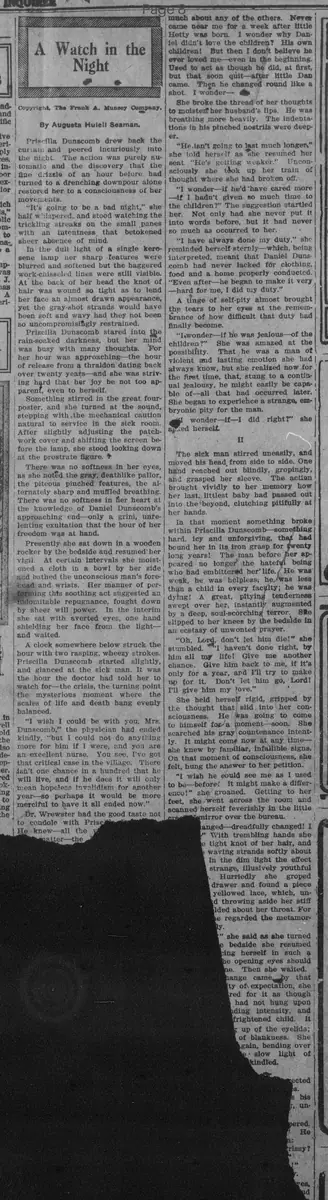
A Watch in the Night
Copyright, The Frank A. Munsey Company.
By Augusta Huell Seaman.
Priscilla Dunscomb drew back the curtain and peered incuriously into the night. The action was purely automatic and the discovery that the fine drizzle of an hour before had turned to a drenching downpour alone restored her to a consciousness of her movements.
"It's going to be a bad night," she half whispered, and stood watching the trickling streaks on the small panes with an intentness that betokened sheer absence of mind.
In the dull light of a single kerosene lamp her sharp features were blurred and softened but the haggard work-chiseled lines were still visible. At the back of her head the knot of hair was wound so tight as to lend her face an almost drawn appearance, yet the gray-shot strands would have been soft and wavy had they not been so uncompromisingly restrained.
Priscilla Dunscomb stared into the rain-soaked darkness, but her mind was busy with many thoughts. For her hour was approaching-the hour of release from a thralldom dating back over twenty years and she was striving hard that her joy be not too apparent, even to herself.
Something stirred in the great four-poster, and she turned at the sound, stepping with the mechanical caution natural to service in the sick room. After slightly adjusting the patchwork cover and shifting the screen before the lamp, she stood looking down at the prostrate figure.
There was no softness in her eyes, as she noted the gray, deathlike pallor, the piteous pinched features, the alternately sharp and muffled breathing. There was no softness in her heart at the knowledge of Daniel Dunscomb's approaching end-only a grim, unrelenting exultation that the hour of her freedom was at hand.
Presently she sat down in a wooden rocker by the bedside and resumed her vigil. At certain intervals she moistened a cloth in a bowl by her side and bathed the unconscious man's forehead and wrists. Her manner of performing this soothing act suggested an indomitable repugnance, fought down by sheer will power. In the interim she sat with averted eyes, one hand shielding her face from the light-and waited.
A clock somewhere below struck the hour with two rasping, wheezy strokes. Priscilla Dunscomb started slightly, and glanced at the sick man. It was the hour the doctor had told her to watch for-the crisis, the turning point, the mysterious moment where the scales of life and death hang evenly balanced.
"I wish I could be with you, Mrs. Dunscomb," the physician had ended kindly, "but I could not do anything more for him if I were, and you are an excellent nurse. You see, I've got that critical case in the village. There isn't one chance in a hundred that he will live, and if he does it will only mean hopeless invalidism for another year-so perhaps it would be more merciful to have it all ended now."
Dr. Brewster had the good taste not to condole with Priscilla. He knew all the years...
much about any of the others. Never came near me for a week after little Hetty was born. I wonder why Daniel didn't love the children? His own children! But then I don't believe he ever loved me even in the beginning. Used to act as though he did, at first, but that soon quit-after little Dan came. Then he changed round like a shot. I wonder-
She broke the thread of her thoughts to moisten her husband's lips. He was breathing more heavily. The indentations in his pinched nostrils were deeper.
He isn't going to last much longer, she told herself as she resumed her seat. "He's getting weaker." Unconsciously she took up her train of thought where she had broken off.
"I wonder-if he'd have cared more -if I hadn't given so much time to the children?" The suggestion startled her. Not only had she never put it into words before, but it had never so much as occurred to her.
"I have always done my duty," she reminded herself sternly-which, being interpreted, meant that Daniel Dunscomb had never lacked for clothing, food and a home properly conducted. Even after he began to make it very -hard for me, I did my duty."
A tinge of self-pity almost brought the tears to her eyes at the remembrance of how difficult that duty had finally become.
"I wonder if he was jealous of the children?" She was amazed at the possibility. That he was a man of violent and lasting emotion she had always known, but she realized now for the first time, that, stung to a continual jealousy, he might easily be capable-of all that had occurred later.
She began to experience a strange, embryonic pity for the man.
"I wonder-if I did right?" she asked herself.
The sick man stirred uneasily, and moved his head from side to side. One hand reached out blindly, gropingly, and grasped her sleeve. The action brought vividly to her memory how her last, littlest baby had passed out into the beyond, clutching pitifully at her hands.
In that moment something broke within Priscilla Dunscomb-something hard, icy and unforgiving, that had bound her in its iron grasp for twenty long years! The man before her appeared no longer the hateful being who had embittered her life. He was weak, he was helpless, he was less than a child in every faculty; he was dying! A great, pitying tenderness swept over her, instantly augmented by a deep, soul-scorching terror. She slipped to her knees by the bedside in an ecstasy of unwonted prayer.
"Oh, Lord, don't let him die!" she stumbled. "I haven't done right by him all my life! Give me another chance. Give him back to me, if it's only for a year, and I'll try to make up for it. Don't let him go, Lord! I'll give him my love."
She held herself rigid, gripped by the thought that slid into her consciousness. He was going to come to himself for a moment-soon. She searched his gray countenance intently. It might come now at any time-- she knew by familiar, infallible signs. On that moment of consciousness, she felt, hung the answer to her petition.
"I wish he could see me as I used to be-before! It might make a difference!" she groaned. Getting to her feet, she went across the room and scanned herself feverishly in the little mirror over the bureau.
Changed-dreadfully changed! I
With trembling hands she undid the tight knot of her hair, and let the waving strands softly about. In the dim light the effect was strange, illusively youthful.
Hurriedly she groped in a drawer and found a piece of yellowed lace, which, unfolded, throwing aside her stiff collar, she folded about her throat. For a moment she regarded the metamorphosis critically.
"Not bad," she said as she turned to the bedside she resumed placing herself in such a way that the opening eyes should see her. Then she waited.
The change came, by that eternity of expectation, she had prepared for it as though she had not hung upon the impending intensity, and frightened child. It was the slow up of the eyelids; of blankness. She bent over again, bending over the slow light of recognition kindled.
[Uncertain garbled text at end: reflected S hia 11n bered. triss) 7es]
Copyright, The Frank A. Munsey Company.
By Augusta Huell Seaman.
Priscilla Dunscomb drew back the curtain and peered incuriously into the night. The action was purely automatic and the discovery that the fine drizzle of an hour before had turned to a drenching downpour alone restored her to a consciousness of her movements.
"It's going to be a bad night," she half whispered, and stood watching the trickling streaks on the small panes with an intentness that betokened sheer absence of mind.
In the dull light of a single kerosene lamp her sharp features were blurred and softened but the haggard work-chiseled lines were still visible. At the back of her head the knot of hair was wound so tight as to lend her face an almost drawn appearance, yet the gray-shot strands would have been soft and wavy had they not been so uncompromisingly restrained.
Priscilla Dunscomb stared into the rain-soaked darkness, but her mind was busy with many thoughts. For her hour was approaching-the hour of release from a thralldom dating back over twenty years and she was striving hard that her joy be not too apparent, even to herself.
Something stirred in the great four-poster, and she turned at the sound, stepping with the mechanical caution natural to service in the sick room. After slightly adjusting the patchwork cover and shifting the screen before the lamp, she stood looking down at the prostrate figure.
There was no softness in her eyes, as she noted the gray, deathlike pallor, the piteous pinched features, the alternately sharp and muffled breathing. There was no softness in her heart at the knowledge of Daniel Dunscomb's approaching end-only a grim, unrelenting exultation that the hour of her freedom was at hand.
Presently she sat down in a wooden rocker by the bedside and resumed her vigil. At certain intervals she moistened a cloth in a bowl by her side and bathed the unconscious man's forehead and wrists. Her manner of performing this soothing act suggested an indomitable repugnance, fought down by sheer will power. In the interim she sat with averted eyes, one hand shielding her face from the light-and waited.
A clock somewhere below struck the hour with two rasping, wheezy strokes. Priscilla Dunscomb started slightly, and glanced at the sick man. It was the hour the doctor had told her to watch for-the crisis, the turning point, the mysterious moment where the scales of life and death hang evenly balanced.
"I wish I could be with you, Mrs. Dunscomb," the physician had ended kindly, "but I could not do anything more for him if I were, and you are an excellent nurse. You see, I've got that critical case in the village. There isn't one chance in a hundred that he will live, and if he does it will only mean hopeless invalidism for another year-so perhaps it would be more merciful to have it all ended now."
Dr. Brewster had the good taste not to condole with Priscilla. He knew all the years...
much about any of the others. Never came near me for a week after little Hetty was born. I wonder why Daniel didn't love the children? His own children! But then I don't believe he ever loved me even in the beginning. Used to act as though he did, at first, but that soon quit-after little Dan came. Then he changed round like a shot. I wonder-
She broke the thread of her thoughts to moisten her husband's lips. He was breathing more heavily. The indentations in his pinched nostrils were deeper.
He isn't going to last much longer, she told herself as she resumed her seat. "He's getting weaker." Unconsciously she took up her train of thought where she had broken off.
"I wonder-if he'd have cared more -if I hadn't given so much time to the children?" The suggestion startled her. Not only had she never put it into words before, but it had never so much as occurred to her.
"I have always done my duty," she reminded herself sternly-which, being interpreted, meant that Daniel Dunscomb had never lacked for clothing, food and a home properly conducted. Even after he began to make it very -hard for me, I did my duty."
A tinge of self-pity almost brought the tears to her eyes at the remembrance of how difficult that duty had finally become.
"I wonder if he was jealous of the children?" She was amazed at the possibility. That he was a man of violent and lasting emotion she had always known, but she realized now for the first time, that, stung to a continual jealousy, he might easily be capable-of all that had occurred later.
She began to experience a strange, embryonic pity for the man.
"I wonder-if I did right?" she asked herself.
The sick man stirred uneasily, and moved his head from side to side. One hand reached out blindly, gropingly, and grasped her sleeve. The action brought vividly to her memory how her last, littlest baby had passed out into the beyond, clutching pitifully at her hands.
In that moment something broke within Priscilla Dunscomb-something hard, icy and unforgiving, that had bound her in its iron grasp for twenty long years! The man before her appeared no longer the hateful being who had embittered her life. He was weak, he was helpless, he was less than a child in every faculty; he was dying! A great, pitying tenderness swept over her, instantly augmented by a deep, soul-scorching terror. She slipped to her knees by the bedside in an ecstasy of unwonted prayer.
"Oh, Lord, don't let him die!" she stumbled. "I haven't done right by him all my life! Give me another chance. Give him back to me, if it's only for a year, and I'll try to make up for it. Don't let him go, Lord! I'll give him my love."
She held herself rigid, gripped by the thought that slid into her consciousness. He was going to come to himself for a moment-soon. She searched his gray countenance intently. It might come now at any time-- she knew by familiar, infallible signs. On that moment of consciousness, she felt, hung the answer to her petition.
"I wish he could see me as I used to be-before! It might make a difference!" she groaned. Getting to her feet, she went across the room and scanned herself feverishly in the little mirror over the bureau.
Changed-dreadfully changed! I
With trembling hands she undid the tight knot of her hair, and let the waving strands softly about. In the dim light the effect was strange, illusively youthful.
Hurriedly she groped in a drawer and found a piece of yellowed lace, which, unfolded, throwing aside her stiff collar, she folded about her throat. For a moment she regarded the metamorphosis critically.
"Not bad," she said as she turned to the bedside she resumed placing herself in such a way that the opening eyes should see her. Then she waited.
The change came, by that eternity of expectation, she had prepared for it as though she had not hung upon the impending intensity, and frightened child. It was the slow up of the eyelids; of blankness. She bent over again, bending over the slow light of recognition kindled.
[Uncertain garbled text at end: reflected S hia 11n bered. triss) 7es]
What sub-type of article is it?
Prose Fiction
What themes does it cover?
Death Mortality
Moral Virtue
Love Romance
What keywords are associated?
Deathbed Vigil
Marital Resentment
Redemption
Pity
Duty
Regret
Nursing
Prayer
What entities or persons were involved?
By Augusta Huell Seaman.
Literary Details
Title
A Watch In The Night
Author
By Augusta Huell Seaman.
Key Lines
"Oh, Lord, Don't Let Him Die!" She Stumbled. "I Haven't Done Right By Him All My Life! Give Me Another Chance. Give Him Back To Me, If It's Only For A Year, And I'll Try To Make Up For It. Don't Let Him Go, Lord! I'll Give Him My Love."
"I Have Always Done My Duty," She Reminded Herself Sternly Which, Being Interpreted, Meant That Daniel Dunscomb Had Never Lacked For Clothing, Food And A Home Properly Conducted. Even After He Began To Make It Very Hard For Me, I Did My Duty."
In That Moment Something Broke Within Priscilla Dunscomb Something Hard, Icy And Unforgiving, That Had Bound Her In Its Iron Grasp For Twenty Long Years!