Thank you for visiting SNEWPapers!
Sign up free
The National Intelligencer And Washington Advertiser
Washington, District Of Columbia
What is this article about?
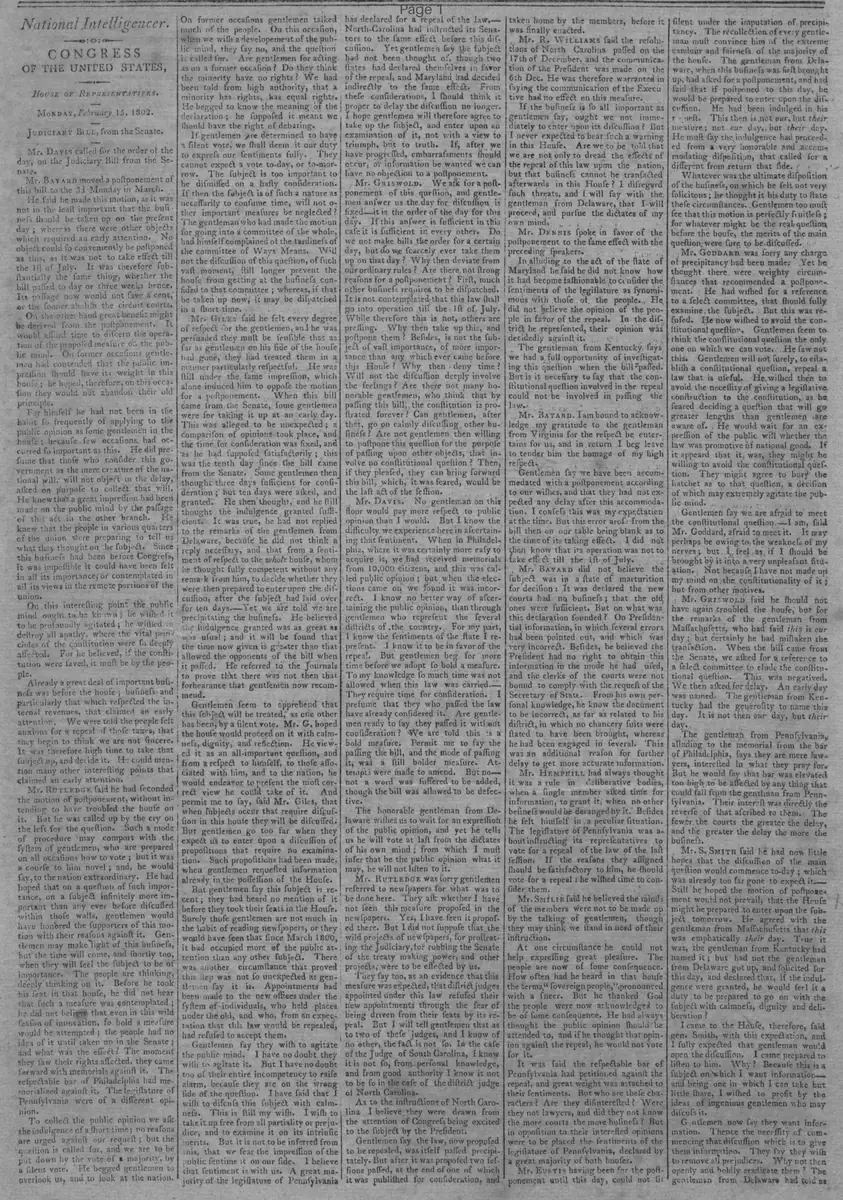
On February 15, 1802, the U.S. House of Representatives debated postponing the Senate's Judiciary Bill, which proposed repealing the Judiciary Act of 1801. Opponents like Bayard and Rutledge argued for delay to assess public opinion and constitutional implications, while supporters like Giles and Randolph urged immediate discussion, citing prior time granted and pressing business. The postponement motion failed 35-6, and a later one 34-58.
Merged-components note: This is a continuation of the congressional debate on the Judiciary Bill from page 1 to page 2, as the text flows directly from the end of the first component to the start of the second.
Clippings
1 of 2
OCR Quality
Full Text
CONGRESS
OF THE UNITED STATES.
HOUSE OF REPRESENTATIVES.
Monday, February 15, 1802.
JUDICIARY BILL, from the Senate.
Mr. Davis called for the order of the day, on the Judiciary Bill from the Senate.
Mr. Bayard moved a postponement of this bill to the 3d Monday in March.
He said he made this motion, as it was not in the least important that the business should be taken up on the present day; whereas there were other objects which required an early attention. No object could so conveniently be postponed as this, as it was not to take effect till the 1st of July. It was therefore substantially the same thing, whether the bill passed to-day or three weeks hence.
Its passage now would not save a cent, or the sooner abolish the circuit courts.
On the other hand great benefit might be derived from the postponement. It would afford time to discern the operation of the proposed measure on the public mind. On former occasions gentlemen had contended that the public impression should have its weight in this house; he hoped, therefore, on this occasion they would not abandon their old principle.
For himself he had not been in the habit of frequently applying to the public opinion as some gentlemen in the house; because few occasions had occurred so important as this. He did presume that those who consider this government as the mere creature of the national will, will not object to the delay, asked on purpose to collect that will.
He knew that a great impression had been made on the public mind by the passage of this act in the other branch. He knew that the people in various quarters of the union were preparing to tell us what they thought on the subject. Since this business had been before Congress, it was impossible it could have been felt in all its importance, or contemplated in all its views in the remote portions of the union.
On this interesting point the public mind ought to be known; he wished it to be profoundly agitated; he wished to destroy all apathy, where the vital principles of the constitution were so deeply affected. For he believed, if the constitution were saved, it must be by the people.
Already a great deal of important business was before the house; business and particularly that which respected the internal revenues, that claimed an early attention. We were told the people felt anxious for a repeal of those taxes, that they begin to think we are not sincere.
It was therefore high time to take that subject up, and decide it. He could mention many other interesting points that claimed an early attention.
Mr. Rutledge said he had seconded the motion of postponement, without intending to have troubled the house on it. But he was called up by the cry on the left for the question. Such a mode of procedure may comport with the system of gentlemen, who are prepared on all occasions how to vote; but it was a course to him novel; and, he would say, to the nation extraordinary.
He had hoped that on a question of such importance, on a subject infinitely more important than any ever before discussed within those walls, gentlemen would have honored the supporters of this motion with their reasons against it. Gentlemen may make light of this business, but the time will come, and shortly too, when they will feel the subject to be of importance. The people are thinking, deeply thinking on it.
Before he took his seat in that house, he did not hear that such a measure was contemplated; he did not believe that even in this wild season of innovation, so bold a measure would be attempted; the people had no idea of it until taken up in the Senate; and what was the effect? The moment they saw their rights affected, they came forward with memorials against it.
The respectable bar of Philadelphia had memorialized against it. The legislature of Pennsylvania were of a different opinion.
To collect the public opinion we ask the indulgence of a short time; no reasons are urged against our request; but the question is called for, and we are to be put down by the vote of a majority, by a silent vote. He begged gentlemen to overlook us, and to look at the nation.
On former occasions gentlemen talked much of the people. On this occasion, when we wish a development of the public mind, they say no, and the question is called for. Are gentlemen for acting as on a former occasion? Do they think the minority have no rights?
We had been told from high authority, that a minority has rights, has equal rights. He begged to know the meaning of the declaration; he supposed it meant we should have the right of debating.
If gentlemen are determined to have a silent vote, we shall deem it our duty to express our sentiments fully. They cannot expect a vote to-day, or to-morrow. The subject is too important to be dismissed on a hasty consideration.
If then the subject is of such a nature as necessarily to consume time, will not other important measures be neglected?
The gentleman who had made the motion for going into a committee of the whole, had himself complained of the tardiness of the committee of Ways and Means. Will not the discussion of this question, of such vast moment, still longer prevent the house from getting at the business confided to that committee; whereas, if that be taken up now, it may be dispatched in a short time.
Mr. Giles said he felt every degree of respect for the gentlemen, and he was persuaded they must be sensible that as far as gentlemen on his side of the house had gone, they had treated them in a manner particularly respectful. He was still under the same impression, which alone induced him to oppose the motion for a postponement.
When this bill came from the Senate, some gentlemen were for taking it up at an early day. This was alleged to be unexpected; a comparison of opinions took place, and the time for consideration was fixed, and as he had supposed satisfactorily; this was the tenth day since the bill came from the Senate.
Some gentlemen then thought three days sufficient for consideration; but ten days were asked, and granted. He then thought, and he still thought the indulgence granted sufficient.
It was true, he had not replied to the remarks of the gentlemen from Delaware, because he did not think a reply necessary, and that from a sentiment of respect to the whole house, whom he thought fully competent without any remark from him, to decide whether they were then prepared to enter upon the discussion, after the subject had laid over for ten days.
Yet we are told we are precipitating the business. He believed the indulgence granted was as great as usual; and it will be found that the time now given is greater than that allowed the opponents of the bill when it passed.
He referred to the Journals to prove that there was not then that forbearance that gentlemen now recommend.
Gentlemen seem to apprehend that this subject will be treated, as the other has been, by a silent vote. Mr. G. hoped the house would proceed on it with calmness, dignity, and reflection. He viewed it as an all-important question, and from a respect to himself, to those associated with him, and to the nation, he would endeavor to present the most correct view he could take of it.
And permit me to say, said Mr. Giles, that when subjects occur that require discussion in this house they will be discussed.
But gentlemen go too far when they expect us to enter upon a discussion of propositions that require no examination. Such propositions had been made, when gentlemen requested information already in the possession of the House.
But gentlemen say this subject is recent; they had heard no mention of it before they took their seats in the House. Surely those gentlemen are not much in the habit of reading newspapers, or they would have seen that since March 1800, it had occupied more of the public attention than any other subject.
There was another circumstance that proved this step was not so unexpected as gentlemen say it is. Appointments had been made to the new offices under the system of individuals, who held places under the old, and who, from an expectation that this law would be repealed, had refused to accept them.
Gentlemen say they wish to agitate the public mind. I have no doubt they wish to agitate it. But I have no doubt too of their entire incompetency to raise alarm, because they are on the wrong side of the question.
I wish to discuss this subject with calmness. This is still my wish. I wish to take it up free from all partiality or prejudice, and to examine it on its intrinsic merits. But it is not to be inferred from this, that we fear the impression of the public sentiment on our side. I believe that sentiment is with us.
A great majority of the legislature of Pennsylvania has declared for a repeal of the law.
North-Carolina had instructed its Senators to the same effect before this discussion. Yet gentlemen say the subject had not been thought of, though two states had declared themselves in favor of the repeal, and Maryland had decided indirectly to the same effect.
From these considerations, I should think it proper to delay the discussion no longer. I hope gentlemen will therefore agree to take up the subject, and enter upon an examination of it, not with a view to triumph, but to truth.
If, after we have progressed, embarrassments should occur, or information be wanted we can have no objection to a postponement.
Mr. Griswold. We ask for a postponement of this question, and gentlemen answer us the day for discussion is fixed—it is the order of the day for this day. If this answer is sufficient in this case it is sufficient in every other.
Do we not make bills the order for a certain day, but do we scarcely ever take them up on that day? Why then deviate from our ordinary rules?
Are there not strong reasons for a postponement? First, much other business requires to be dispatched. It is not contemplated that this law shall go into operation till the 1st of July. While therefore this is not, others are pressing. Why then take up this, and postpone them?
Besides, is not the subject of vast importance, of more importance than any which ever came before this House? Why then deny time?
Will not the discussion deeply involve the feelings? Are there not many honorable gentlemen, who think that by passing this bill, the constitution is prostrated forever?
Can gentlemen, after that, go on calmly discussing other business? Are not gentlemen then willing to postpone this question for the purpose of passing upon other objects, that involve no constitutional question?
Then, if they pleased, they can bring forward this bill, which, it was feared, would be the last act of the session.
Mr. Davis. No gentleman on this floor would pay more respect to public opinion than I would. But I know the difficulty we experience here in ascertaining that sentiment.
When in Philadelphia, where it was certainly more easy to acquire it, we had received memorials from 10,000 citizens, and this was called public opinion; but when the elections came on we found it was incorrect.
I know no better way of ascertaining the public opinion, than through gentlemen who represent the several districts of the country. For my part, I know the sentiments of the state I represent. I know it to be in favor of the repeal.
But gentlemen beg for more time before we adopt so bold a measure. To my knowledge so much time was not allowed when this law was carried.
They require time for consideration. I presume that they who passed the law have already considered it. Are gentlemen ready to say they passed it without consideration?
We are told this is a bold measure. Permit me to say the passing the bill, and the mode of passing it, was a still bolder measure.
Attempts were made to amend. But no, not a word was suffered to be added, though the bill was allowed to be defective.
The honorable gentleman from Delaware wishes us to wait for an expression of the public opinion, and yet he tells us he will vote at last from the dictates of his own mind; from which I must infer that be the public opinion what it may, he will not listen to it.
Mr. Rutledge was sorry gentlemen referred to newspapers for what was to be done here. They ask whether I have seen this measure proposed in the newspapers. Yes, I have seen it proposed there. But I did not suppose that the wild projects of newspapers, for protracting the Judiciary, for robbing the Senate of the treaty making power, and other projects, were to be effected by us.
They say too, as an evidence that this measure was expected, that district judges appointed under this law refused their new appointments through the fear of being driven from their seats by its repeal.
But I will tell gentlemen that as to two of these judges, and I know of no other, the fact is not so. In the case of the Judge of South Carolina, I know it is not so, from personal knowledge, and from good authority I know it not to be so in the case of the district judge of North Carolina.
As to the instructions of North Carolina I believe they were drawn from the attention of Congress being excited to the subject by the President.
Gentlemen say the law, now proposed to be repealed, was itself passed precipitately. But after it was proposed two sessions passed, at the end of one of which it was published for consideration, and taken home by the members, before it was finally enacted.
Mr. R. Williams said the resolutions of North Carolina passed on the 17th of December, and the communication of the President was made on the 6th Dec. He was therefore warranted in saying the communication of the Executive had no effect on this measure.
If the business is so all important as gentlemen say, ought we not immediately to enter upon its discussion? But I never expected to hear such a warning in this House.
Are we to be told that we are not only to dread the effects of the repeal of this law upon the nation, but that business cannot be transacted afterwards in this House? I disregard such threats, and I will say with the gentleman from Delaware, that I will proceed, and pursue the dictates of my own mind.
Mr. Dennis spoke in favor of the postponement to the same effect with the preceding speakers.
In alluding to the act of the state of Maryland he said he did not know how it had become fashionable to consider the sentiments of the legislature as synonymous with those of the people. He did not believe the opinion of the people in favor of the repeal. In the district he represented, their opinion was decidedly against it.
The gentleman from Kentucky, says we had a full opportunity of investigating this question when the bill passed. But is it necessary to say that the constitutional question involved in the repeal could not be involved in passing the law.
Mr. Bayard. I am bound to acknowledge my gratitude to the gentleman from Virginia for the respect he entertains for us, and in return I beg leave to tender him the homage of my high respect.
Gentlemen say we have been accommodated with a postponement according to our wishes, and that they had not expected any delay after this accommodation. I confess this was my expectation at the time. But this error arose from the bill then on our table being blank as to the time of its taking effect. I did not then know that its operation was not to take effect till the 1st of July.
Mr. Bayard did not believe the subject was in a state of maturation for decision: It was declared the new courts had no business; that the old ones were sufficient. But on what was this declaration founded? On Presidential information, in which several errors had been pointed out, and which was very incorrect.
Besides, he believed the President had no right to obtain this information in the mode he had used, and the clerks of the courts were not bound to comply with the request of the Secretary of State.
From his own personal knowledge, he knew the document to be incorrect, as far as related to his district, in which no chancery suits were stated to have been brought, whereas he had been engaged in several.
This was an additional reason for further delay to get more accurate information.
Mr. Hemphill had always thought it was a rule in deliberative bodies, when a single member asked time for information, to grant it, when no other business would be deranged by it. Besides he felt himself in a peculiar situation.
The legislature of Pennsylvania was about instructing its representatives to vote for a repeal of the law of the last session. If the reasons they assigned should be satisfactory to him, he should vote for a repeal: he wished time to consider them.
Mr. Smilie said he believed the minds of the members were not to be made up by the talking of gentlemen, though they may think we stand in need of their instruction.
At one circumstance he could not help expressing great pleasure. The people are now of some consequence. How often had he heard in that house the terms "sovereign people," pronounced with a sneer. But he thanked God the people were now acknowledged to be of some consequence.
He had always thought the public opinion should be attended to, and if he thought that opinion against the repeal, he would not vote for it.
It was said the respectable bar of Pennsylvania had petitioned against the repeal, and great weight was attached to their sentiments. But who are these characters? Are they disinterested? Were they not lawyers, and did they not know the more courts the more business?
But in opposition to their interested opinions were to be placed the sentiments of the legislature of Pennsylvania, declared by a great majority of both houses.
Mr. Eustis having been for the postponement until this day, could not sit silent under the imputation of precipitancy.
The recollection of every gentleman must convince him of the extreme candour and fairness of the majority of the house.
The gentleman from Delaware, when this business was first brought up, had asked for a postponement, and had said that if postponed to this day, he would be prepared to enter upon the discussion. He had been indulged in his request.
This then is not our, but their measure; not our day, but their day.
He must say the indulgence had proceeded from a very honorable and accommodating disposition, that called for a different from return than side.
Whatever was the ultimate disposition of the business, on which he felt not very solicitous: he thought it his duty to state these circumstances.
Gentlemen too must see that this motion is perfectly useless; for whatever might be the real question before the house, the merits of the main question, were sure to be discussed.
Mr. Goddard was sorry any charge of precipitancy had been made: Yet he thought there were weighty circumstances that recommended a postponement.
He had wished for a reference to a select committee, that should fully examine the subject. But this was refused.
He now wished to avoid the constitutional question. Gentlemen seem to think the constitutional question the only one on which we can vote. He saw not this.
Gentlemen will not surely, to establish a constitutional question, repeal a law that is useful.
He wished then to avoid the necessity of giving a legislative construction to the constitution, as he feared deciding a question that will go greater lengths than gentlemen are aware of.
He would wait for an expression of the public will whether the law was promotive of national good. If it appeared that it was, they might be willing to avoid the constitutional question.
They might agree to bury the hatchet as to that question, a decision of which may extremely agitate the public mind.
Gentlemen say we are afraid to meet the constitutional question. I am, said Mr. Goddard, afraid to meet it. It may perhaps be owing to the weakness of my nerves; but I feel as if I should be brought by it into a very unpleasant situation; Not because I have not made up my mind on the constitutionality of it; but from other motives.
Mr. Griswold said he should not have again troubled the house, but for the remarks of the gentleman from Massachusetts, who had said this is our day; but certainly he had mistaken the transaction.
When the bill came from the Senate, we asked for a reference to a select committee to elude the constitutional question. This was negatived.
We then asked for delay. An early day was named. The gentleman from Kentucky had the generosity to name this day. It is not then our day, but their day.
The gentleman from Pennsylvania, alluding to the memorial from the bar of Philadelphia, says they are mere lawyers, interested in what they pray for.
But he would say that bar was elevated too high to be affected by any thing that could fall from the gentleman from Pennsylvania.
Their interest was directly the reverse of that ascribed to them. The fewer the courts the greater the delay, and the greater the delay the more the business.
Mr. S. Smith said he had now little hopes that the discussion of the main question would commence to-day; which was already too far gone to expect it.
Still he hoped the motion of postponement would not prevail, that the House might be prepared to enter upon the subject tomorrow.
He agreed with the gentleman from Massachusetts that this was emphatically their day. True it was, the gentleman from Kentucky had named it; but had not the gentleman from Delaware got up, and solicited for this day, and declared that, if the indulgence were granted, he would feel it a duty to be prepared to go on with the subject with calmness, dignity and deliberation?
I came to the House, therefore, said Gen. Smith, with this expectation, and I fully expected that gentleman would open the discussion. I came prepared to listen to him. Why? Because this is a subject on which I want information—and being one in which I can take but little share, I wished to profit by the ideas of ingenious gentlemen who may discuss it.
Gentlemen now say they want information. Thence the necessity of commencing that discussion which is to give them information.
They say they wish to remove all prejudices. Why not then openly and boldly eradicate them?
The gentleman from Delaware had told us
he wished by the public will; and he adds, if the bill passed it will prostrate the constitution. Will he then, if the public will shall appear to be for a repeal, vote for it? I am inclined to think the gentleman went rather than he intended when he made this declaration.
The information gentlemen say they want can have no effect upon those who have made up their minds upon the constitutional question, for I cannot believe they would violate their oaths to conform to the public will. Is it to operate upon us. No. For we are ready to act, to say we have heard the public voice, and are prepared to obey it.
Mr. Holland spoke against the postponement. After assigning his reasons at some length, he proceeded:--
Why then wait? For the single reason offered by the gentleman from Connecticut, viz. his wanting to avoid the constitutional question --did he not mean by this to delay, to embarrass, and perhaps defeat the bill. Give me leave to say, until Mr. H. I do want to meet it, and to get rid of it, that we may proceed to other business.
Mr. Dana. The gentleman from North-Carolina need not to have told us he meant not to compliment us. We might have learned that from his conversation. But I wish to know what authorizes him to make these charges?
My colleague has said he did not wish to meet the constitutional question.-- But has he said he meant to procrastinate, to embarrass, to defeat it? Is that gentleman so much in the habit of expediting business as to be authorized to make these charges?
I acknowledge that my mind recoils at the decision of the constitutional question, because I deprecate the result, if decided in one way. My mind recoils, because it goes to shake the foundations of society; because it shakes questions that I thought were fixed, and which were not to be discussed; because if decided one way, we shall be sent back to the first principles of society.
The gentlemen cannot tell why we are for delay. The gentleman from Massachusetts is a scholar. He may appreciate my remarks, if others cannot.
We want information--that information which flows from books--he, having enriched his mind with the stores of knowledge, knows its value. Can any man show me a notary, public or private, where I can get this information. We labor here under peculiar disadvantages.
But it is probable that gentlemen, after representing their civility to us, will at last vote us down.
Mr. Goldsborough explained what he had previously said.
Mr. Bayard. It is my misfortune to be perpetually misunderstood by the gentleman from Maryland. I am at a loss to know how gentlemen on this side are more misunderstood by him than any other member. Is it that his anxiety to answer us induces him to state fallacies in order that he may refute them? He says, I stated that I would come perfectly prepared to day. I did not say so. I could not say I should be perfectly prepared. I did say we would come forward to discuss the subject.
The same gentleman charged me with having I would instruct the House.-- This is impossible. It might be compatible with the character of that gentleman, but I never could say so.
The gentleman has also charged me with saying I would vote for the repeal, if the public will was for it. I said not so. I did say the constitution was the property of the people; that the majority had a right to construe it as they pleased; and that I would obey their construction, that is. I would bow to what appeared manifestly the sense of the majority.
The gentleman from Massachusetts had said this is our day. Perhaps, it is emphatically our day--perhaps our last day. I have no doubt gentlemen would be gratified, if it were our last day.
The fact is, when an unprecedented precipitation was attempted, I agreed to this day, because I could not expect a longer day would be granted. It was, however, as much a forced day, as any other day could have been.
As to the remarks of the gentleman from Pennsylvania, it was painful for angels to be obliged to defend the friends of that gentleman from reflection. But I will say to that gentleman there was no ground of fact to justify his aspersion. He had charged his political friends with having apostatized-- with having renounced their party-- with having violated their political faith.
Mr. Smilie said he had said no such thing.
Mr. Bayard was glad the gentleman knew what he did say, which was an unusual thing. I understood him to say they acted from interested motives. I drew the inference. If governed by interest, if whether they are not apostates, whether they have not renounced their political creed? Could any thing be more base, on a question, involving constitutional grounds, than to be governed by motives the most wretched and contemptible.
The question of postponement was then taken by Yeas and Nays, which were: Yeas 35--Nays 6.
Motion to adjourn--Lost--Yeas 37.
Mr. Dennis moved a postponement till Monday next.
Mr. Randolph. I will state as briefly as possible the motives which influence me to be against the postponement moved by the gentleman from Maryland. I am sensible his motives for a postponement may be pure. I believe they are pure: But when I compare the reasons of the friends of the postponement, and find them so various and irreconcilable, I can discover no reason for gratifying their request. One gentleman says he wants information of the state of the public will. Another gentleman says it is a great constitutional question, and whatever may be the public opinion, he must vote from the dictates of his own judgment. Another gentleman wishes to understand the resolutions of the legislature of Pennsylvania, by which he may perhaps be governed. Another gentleman says the legislative vote is no indication of the public mind.
Gentlemen say their reasons are congruent; but I beg them to tell me on which of their various and contradictory reasons they mean to vote for a postponement--reasons so irreconcilable, that if one was correct the others must be false.
I should not have risen now, but from seeing the day nearly gone, and from being prepared for a reiteration of motions that will consume the whole of it.
Other reasons are urged. We are told the great constitutional question may be evaded: When I say so, I do not mean to impute to gentlemen any disposition to embarrass the discussion, but a disposition to shrink from a question which they say, will give a stab to the constitution. Believing as they do, I think the fear an honorable fear. But thinking differently myself, it becomes me to speak differently. It becomes me to declare that this is a great constitutional question that ought to be decided; and decided soon. It ought not to be let till the public mind shall be acted upon incorrectly; till some twenty or thirty years hence it shall be operated upon by war, by intrigue, or by improper excitement. When I see all the dangerous motives, such as war without, and treason within, which too frequently operate, and compare the state of the country under their influence, with its present situation, entirely free from them; I say, this is the period of decision. For decided it must be. I feel for gentlemen, whose correct disposition it is to shrink from a question whose result must be adverse to them. I have been in the same situation. I, like them, have shrunk from some questions. But did they wait or me, till their power was taken from them? According to this course, no decision can take place but that which conforms to the ears of a minority.
I recollect an eloquent member of this house from Massachusetts having deprecated indecision as the worst of all decisions. The saying was paradoxical; but the doctrine was sound. I wish the constitution settled, that it may be no longer afloat. I wish the nation to settle it, that all further discussion may be removed. I wish to know whether the judiciary is a co-ordinate or a paramount department of government.
We have heard much on the points of constitutionality and expediency. All these considerations belong in strictness to that state when the bill shall be taken up, and not to that state when the only question is, shall the bill be taken into consideration. But as gentlemen have reiterated their objections on the point of expediency, and in supporting those objections have taken only one ground, I hope I shall be indulged in stating that the very reasons of the gentlemen on that ground would govern me in making a different decision. They tell us that by this bill, we propose to repeal, justice is brought home to every man's door. But the house will please to recollect that we are not to decide whether justice shall be brought home to every man's door this is not the exclusive legislature to which this only belongs. It belongs to the states, and I will say, if they do not perform their duty, this house cannot assist the performance of it. The constitution never intended it, and this bill does not accomplish it; because while the large states, under the state governments, are subdivided into twenty districts, this law only divides them into two. Nor is it necessary under our law that there should be this subdivision, because the federal authority of the courts does not extend to cases between man and man, or to those ordinary cases, that require that justice should be brought to the door of every citizen. So long as federal courts exist, to which there may be an appeal or removal; so long as the states are prevented from emitting paper currencies; so long as one part of the Union is prohibited from cheating its neighbours; so long as the foreigner has an impartial tribunal to appeal to, the constitution is satisfied.
This it is for which the constitution was made, and that which makes the gentleman from Connecticut vote against the repeal of this act, makes me for it. I mean in connection with other motives. These are my reasons for opposing the motion. The question of repeal is a great constitutional question, and we must settle it. until it shall be decided, and this is the only tribunal before which it can be decided.
Mr. Dennis and Mr. Nicholson followed, the latter of whom denied that there was any ground of saying the citizens of Maryland were against the repealing act.
The question was then taken by yeas and nays, and the motion of postponement lost--Yeas 34--Nays 58.
What sub-type of article is it?
What themes does it cover?
What keywords are associated?
What entities or persons were involved?
Where did it happen?
Story Details
Key Persons
Location
House Of Representatives, United States Congress
Event Date
Monday, February 15, 1802
Story Details
Debate on motion to postpone Judiciary Bill from Senate to March 3 for public opinion on repeal of 1801 Act; opponents cite constitutional concerns and need for information, supporters argue sufficient time already given and urgency for other business; motions fail by votes of 35-6 and 34-58.