Thank you for visiting SNEWPapers!
Sign up free
Plain Speaker
Providence, Providence County, Rhode Island
What is this article about?
Philosophical letter reflecting on personal stance toward reforms and abolition, asserting the divinity inherent in all humans, critiquing sin as insanity from self-doubt, and advocating recognition of one's divine nature to end suffering and promote universal freedom and joy.
Merged-components note: Continuation of philosophical letter/essay (signed Christopher A. Greene) across pages
Clippings
1 of 2
OCR Quality
Full Text
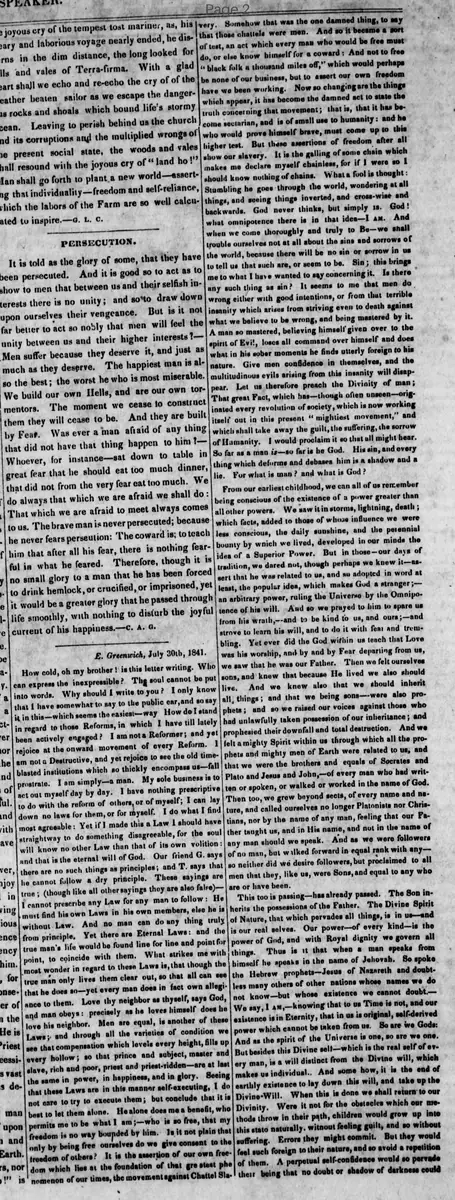
Somehow that was the one damned thing, to say that those chattels were men. And so it became a sort of test, an act which every man who would be free must do, or else know himself for a coward: And not to free "black folk a thousand miles off," which would perhaps be none of our business, but to assert our own freedom have we been working. Now so changing are the things which appear, it has become the damned act to state the truth concerning that movement; that is, that it has become sectarian, and is of small use to humanity: and he who would prove himself brave, must come up to this higher test. But these assertions of freedom after all show our slavery. It is the galling of some chain which makes me declare myself chainless, for if I were so I should know nothing of chains. What a fool is thought: Stumbling he goes through the world, wondering at all things, and seeing things inverted, and cross-wise and backwards. God never thinks, but simply is. God! what omnipotence there is in that idea—I AM. And when we come thoroughly and truly to Be—we shall trouble ourselves not at all about the sins and sorrows of the world, because there will be no sin or sorrow in us to tell us that such are, or seem to be. Sin; this brings me to what I have wanted to say concerning it. Is there any such thing as sin? It seems to me that men do wrong either with good intentions, or from that terrible insanity which arises from striving even to death against what we believe to be wrong, and being mastered by it. A man so mastered, believing himself given over to the spirit of Evil, loses all command over himself and does what in his sober moments he finds utterly foreign to his nature. Give men confidence in themselves, and the multitudinous evils arising from this insanity will disappear. Let us therefore preach the Divinity of man; That great Fact, which has—though often unseen—originated every revolution of society, which is now working itself out in this present "mightiest movement," and which shall take away the guilt, the suffering, the sorrow of Humanity. I would proclaim it so that all might hear So far as a man is so far is he God. His sin, and every thing which deforms and debases him is a shadow and lie. For what is man? and what is God?
From our earliest childhood, we can all of us remember being conscious of the existence of a power greater than all other powers. We saw it in storms, lightning, death; which acts, added to those of whose influence we were less conscious, the daily sunshine, and the perennial bounty by which we lived, developed in our minds the idea of a Superior Power. But in those—our days of tradition, we dared not, though perhaps we knew it—assert that he was related to us, and so adopted in word at least, the popular idea, which makes God a stranger;—an arbitrary power, ruling the Universe by the Omnipotence of his will. And so we prayed to him to spare us from his wrath,—and to be kind to us, and ours;—and strove to learn his will, and to do it with fear and trembling. Yet ever did the God within us teach that Love was his worship, and by and by Fear departing from us, we saw that he was our Father. Then we felt ourselves sons, and knew that because He lived we also should live. And we knew also that we should inherit all things; and that we being sons—were also prophets; and so we raised our voices against those who had unlawfully taken possession of our inheritance; and prophesied their downfall and total destruction. And we felt a mighty Spirit within us through which all the prophets and mighty men of Earth were related to us, and that we were the brothers and equals of Socrates and Plato and Jesus and John,—of every man who had written or spoken, or walked or worked in the name of God. Then too, we grew beyond sects, of every name and nature, and called ourselves no longer Platonists nor Christians, nor by the name of any man, feeling that our Father taught us, and in His name, and not in the name of any man should we speak. And as we were followers of no man, but walked forward in equal rank with any—so neither did we desire followers, but proclaimed to all men that they, like us, were Sons, and equal to any who are or have been.
This too is passing—has already passed. The Son inherits the possessions of the Father. The Divine Spirit of Nature, that which pervades all things, is in us—and is our real selves. Our power—of every kind—is the power of God, and with Royal dignity we govern all things. Thus is it that when a man speaks from himself he speaks in the name of Jehovah. So spoke the Hebrew prophets—Jesus of Nazareth and doubtless many others of other nations whose names we do not know—but whose existence we cannot doubt.—We say, I am,—knowing that to us Time is not, and our existence is in Eternity, that in us is original, self-derived power which cannot be taken from us. So are we Gods: And as the spirit of the Universe is one, so are we one. But besides this Divine self—which is the real self of every man, is a will distinct from the Divine will, which makes us individual. And some how, it is the end of earthly existence to lay down this will, and take up the Divine-Will. When this is done we shall return to our Divinity. Were it not for the obstacles which our methods throw in their path, children would grow up into this state naturally. without feeling guilt, and so without suffering. Errors they might commit. But they would feel such foreign to their nature, and so avoid a repetition of them. A perpetual self-confidence would so pervade their being that no doubt or shadow of darkness could
come to disturb their peace. Let us try with man a new method. Let us permit him to be the Divinity he is. Not till a man has learned the truth of that which he is doing, and seen that he is right in doing it, can he really leave it or something better. Let us then, when we speak to men, speak of the truth of their methods, of the good which they do, of the Divinity which is in them. This and to develop in them that consciousness of Divinity will be doing what we can to take away their suffering, which is the source of Light, and Liberty, and Joy.
From the depths of Hell every Soul shall be raised: And this sweet consciousness shall be ours and theirs. Those fires of agony shall be quenched; and God and Heaven become, as of right they are, the inheritance of all men.
Christopher A. Greene.
To Wm. M. Chase.
What sub-type of article is it?
What themes does it cover?
What keywords are associated?
What entities or persons were involved?
Letter to Editor Details
Author
Christopher A. Greene
Recipient
Wm. M. Chase
Main Argument
the letter argues that humans are inherently divine, sin arises from self-doubt and insanity, reforms like abolition stem from asserting personal freedom, and recognizing one's divinity eliminates suffering, promoting universal equality and joy without prescriptive laws.
Notable Details