Thank you for visiting SNEWPapers!
Sign up free
Story
September 14, 1841
The Madisonian
Washington, District Of Columbia
What is this article about?
Biographical sketch of Abel P. Upshur, Virginia judge and statesman, nominated by President Tyler for Secretary of the Navy. Highlights his legal career, role in 1829 Virginia Constitutional Convention, judicial integrity, and praise from figures like Madison, Monroe, and Randolph.
Clipping
OCR Quality
95%
Excellent
Full Text
FOR THE MADISONIAN
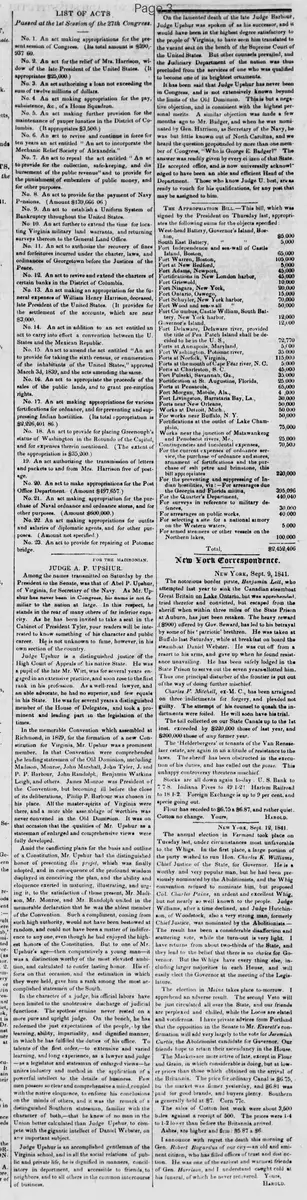
JUDGE A. P. UPSHUR.
Among the names transmitted on Saturday by the President to the Senate, was that of Abel P. Upshur, of Virginia, for Secretary of the Navy. As Mr. Upshur has never been in Congress, his name is not familiar to the nation at large. In this respect, he stands in the rear of many others of far inferior capacity. As he has been invited to take a seat in the Cabinet of President Tyler, your readers will be interested to know something of his character and public career. He is not unknown to fame, however, in his own section of the country.
Judge Upshur is a distinguished justice of the High Court of Appeals of his native State. He was a pupil of the late Mr. Wirt, was for several years engaged in an extensive practice, and soon rose to the first rank in his profession. As a well-read lawyer, and an able advocate, he had no superior, and few equals in his State. He was for several years a distinguished member of the House of Delegates, and took a prominent and leading part in the legislation of the times.
In the memorable Convention which assembled at Richmond, in 1829, for the formation of a new Constitution for Virginia, Mr. Upshur was a prominent member. In that Convention were comprehended the leading statesmen of the Old Dominion, including Madison, Monroe, John Marshall, John Tyler, J. and P. P. Barbour, John Randolph, Benjamin Watkins Leigh, and others. James Monroe was President of the Convention, but becoming ill before the close of its deliberations, Philip P. Barbour was chosen in his place. All the master-spirits of Virginia were there, and a more able assemblage of worthies was never convened in the Old Dominion. It was on that occasion that the qualities of Mr. Upshur as a statesman of enlarged and comprehensive views were fully developed.
Amid the conflicting plans for the basis and outline of a Constitution, Mr. Upshur had the distinguished honor of presenting the projet, which was finally adopted, and in consequence of the profound wisdom displayed in conceiving the plan, and the ability and eloquence exerted in maturing, illustrating, and urging it, to the satisfaction of those present, Mr. Madison, Mr. Monroe, and Mr. Randolph united in the memorable declaration that he was the ablest member of the Convention. Such a compliment, coming from such high authority, would not have been bestowed at random, and could not have been a matter of indifference to any one, even though he had enjoyed the highest honors of the Constitution. But to one of Mr. Upshur's age—then comparatively a young man—it was a distinction worthy of the most elevated ambition, and calculated to confer lasting honor. His efforts on that occasion, and the estimation in which they were held, gave him a rank among the most accomplished statesmen of the South.
In the character of a judge, his official labors have been limited to the unobtrusive discharge of judicial functions. The spotless ermine never rested on a more pure and upright judge. On the bench, he has redeemed the just expectations of the people, by the learning, ability, impartiality, and dignified manner, in which he has fulfilled the duties of his office. To talents of the first order,—to extensive and varied learning, and long experience, as a lawyer and judge —as a legislator and statesman of enlarged views—he unites industry and method in the application of a powerful intellect to the details of business. Few men possess so clear and comprehensive a mind, coupled with the native eloquence, to enforce his conclusions on the minds of others, and it was the remark of a distinguished Southern statesman, familiar with the character of both,—that he knew of no man in the Union better calculated than Judge Upshur, to compete with the gigantic intellect of Daniel Webster, on any important subject.
Judge Upshur is an accomplished gentleman of the Virginia school, and in all the social relations of public and private life, he is dignified in manners, conciliatory in deportment, and accessible to friends, to neighbors, and to all others in the common intercourse of business.
On the lamented death of the late Judge Barbour Judge Upshur was spoken of as his successor, and it would have been in the highest degree satisfactory to the people of Virginia, to have seen him translated to the vacant seat on the bench of the Supreme Court of the United States. But other counsels prevailed, and the Judiciary Department of the nation was thus precluded from the services of one who was qualified to become one of its brightest ornaments.
It has been said that Judge Upshur has never been in Congress, and is not extensively known beyond the limits of the Old Dominion. This is but a negative objection, and is consistent with the highest personal merits. A similar objection was made a few months ago to Mr. Badger, and when he was nominated by Gen. Harrison, as Secretary of the Navy, he was but little known out of North Carolina, and we heard the question propounded by more than one member of Congress, "Who is George E. Badger?" The answer was readily given by every citizen of that State. He accepted office, and is now universally acknowledged to have been an able and efficient Head of the Department. Those who know Judge U. best, are as ready to vouch for his qualifications, for any post that may be assigned to him.
JUDGE A. P. UPSHUR.
Among the names transmitted on Saturday by the President to the Senate, was that of Abel P. Upshur, of Virginia, for Secretary of the Navy. As Mr. Upshur has never been in Congress, his name is not familiar to the nation at large. In this respect, he stands in the rear of many others of far inferior capacity. As he has been invited to take a seat in the Cabinet of President Tyler, your readers will be interested to know something of his character and public career. He is not unknown to fame, however, in his own section of the country.
Judge Upshur is a distinguished justice of the High Court of Appeals of his native State. He was a pupil of the late Mr. Wirt, was for several years engaged in an extensive practice, and soon rose to the first rank in his profession. As a well-read lawyer, and an able advocate, he had no superior, and few equals in his State. He was for several years a distinguished member of the House of Delegates, and took a prominent and leading part in the legislation of the times.
In the memorable Convention which assembled at Richmond, in 1829, for the formation of a new Constitution for Virginia, Mr. Upshur was a prominent member. In that Convention were comprehended the leading statesmen of the Old Dominion, including Madison, Monroe, John Marshall, John Tyler, J. and P. P. Barbour, John Randolph, Benjamin Watkins Leigh, and others. James Monroe was President of the Convention, but becoming ill before the close of its deliberations, Philip P. Barbour was chosen in his place. All the master-spirits of Virginia were there, and a more able assemblage of worthies was never convened in the Old Dominion. It was on that occasion that the qualities of Mr. Upshur as a statesman of enlarged and comprehensive views were fully developed.
Amid the conflicting plans for the basis and outline of a Constitution, Mr. Upshur had the distinguished honor of presenting the projet, which was finally adopted, and in consequence of the profound wisdom displayed in conceiving the plan, and the ability and eloquence exerted in maturing, illustrating, and urging it, to the satisfaction of those present, Mr. Madison, Mr. Monroe, and Mr. Randolph united in the memorable declaration that he was the ablest member of the Convention. Such a compliment, coming from such high authority, would not have been bestowed at random, and could not have been a matter of indifference to any one, even though he had enjoyed the highest honors of the Constitution. But to one of Mr. Upshur's age—then comparatively a young man—it was a distinction worthy of the most elevated ambition, and calculated to confer lasting honor. His efforts on that occasion, and the estimation in which they were held, gave him a rank among the most accomplished statesmen of the South.
In the character of a judge, his official labors have been limited to the unobtrusive discharge of judicial functions. The spotless ermine never rested on a more pure and upright judge. On the bench, he has redeemed the just expectations of the people, by the learning, ability, impartiality, and dignified manner, in which he has fulfilled the duties of his office. To talents of the first order,—to extensive and varied learning, and long experience, as a lawyer and judge —as a legislator and statesman of enlarged views—he unites industry and method in the application of a powerful intellect to the details of business. Few men possess so clear and comprehensive a mind, coupled with the native eloquence, to enforce his conclusions on the minds of others, and it was the remark of a distinguished Southern statesman, familiar with the character of both,—that he knew of no man in the Union better calculated than Judge Upshur, to compete with the gigantic intellect of Daniel Webster, on any important subject.
Judge Upshur is an accomplished gentleman of the Virginia school, and in all the social relations of public and private life, he is dignified in manners, conciliatory in deportment, and accessible to friends, to neighbors, and to all others in the common intercourse of business.
On the lamented death of the late Judge Barbour Judge Upshur was spoken of as his successor, and it would have been in the highest degree satisfactory to the people of Virginia, to have seen him translated to the vacant seat on the bench of the Supreme Court of the United States. But other counsels prevailed, and the Judiciary Department of the nation was thus precluded from the services of one who was qualified to become one of its brightest ornaments.
It has been said that Judge Upshur has never been in Congress, and is not extensively known beyond the limits of the Old Dominion. This is but a negative objection, and is consistent with the highest personal merits. A similar objection was made a few months ago to Mr. Badger, and when he was nominated by Gen. Harrison, as Secretary of the Navy, he was but little known out of North Carolina, and we heard the question propounded by more than one member of Congress, "Who is George E. Badger?" The answer was readily given by every citizen of that State. He accepted office, and is now universally acknowledged to have been an able and efficient Head of the Department. Those who know Judge U. best, are as ready to vouch for his qualifications, for any post that may be assigned to him.
What sub-type of article is it?
Biography
Historical Event
What themes does it cover?
Moral Virtue
Triumph
Justice
What keywords are associated?
Abel Upshur
Virginia Convention
Secretary Navy
Constitutional Convention
Judicial Career
Statesman Praise
What entities or persons were involved?
Abel P. Upshur
President Tyler
James Madison
James Monroe
John Marshall
John Tyler
Philip P. Barbour
John Randolph
Benjamin Watkins Leigh
Daniel Webster
George E. Badger
Where did it happen?
Virginia, Richmond
Story Details
Key Persons
Abel P. Upshur
President Tyler
James Madison
James Monroe
John Marshall
John Tyler
Philip P. Barbour
John Randolph
Benjamin Watkins Leigh
Daniel Webster
George E. Badger
Location
Virginia, Richmond
Event Date
1829
Story Details
Biographical account of Abel P. Upshur's career as lawyer, legislator, convention delegate where he presented adopted constitutional plan praised by Madison, Monroe, and Randolph, and judge; nominated for Secretary of the Navy despite limited national fame.