Thank you for visiting SNEWPapers!
Sign up free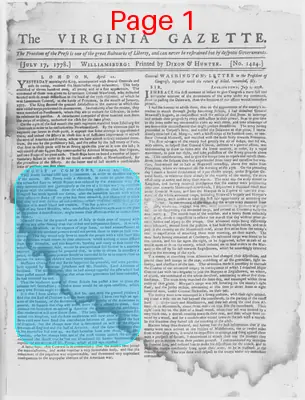
The Virginia Gazette
Richmond, Williamsburg, Richmond County, Virginia
What is this article about?
On April 21, 1778, in the British House of Commons, Mr. Powis proposed extending commissioners' powers to recognize American independence for peace, supported by Fox and Burke but opposed by Johnstone and Dundas; the motion was rejected.
Clipping
OCR Quality
Full Text
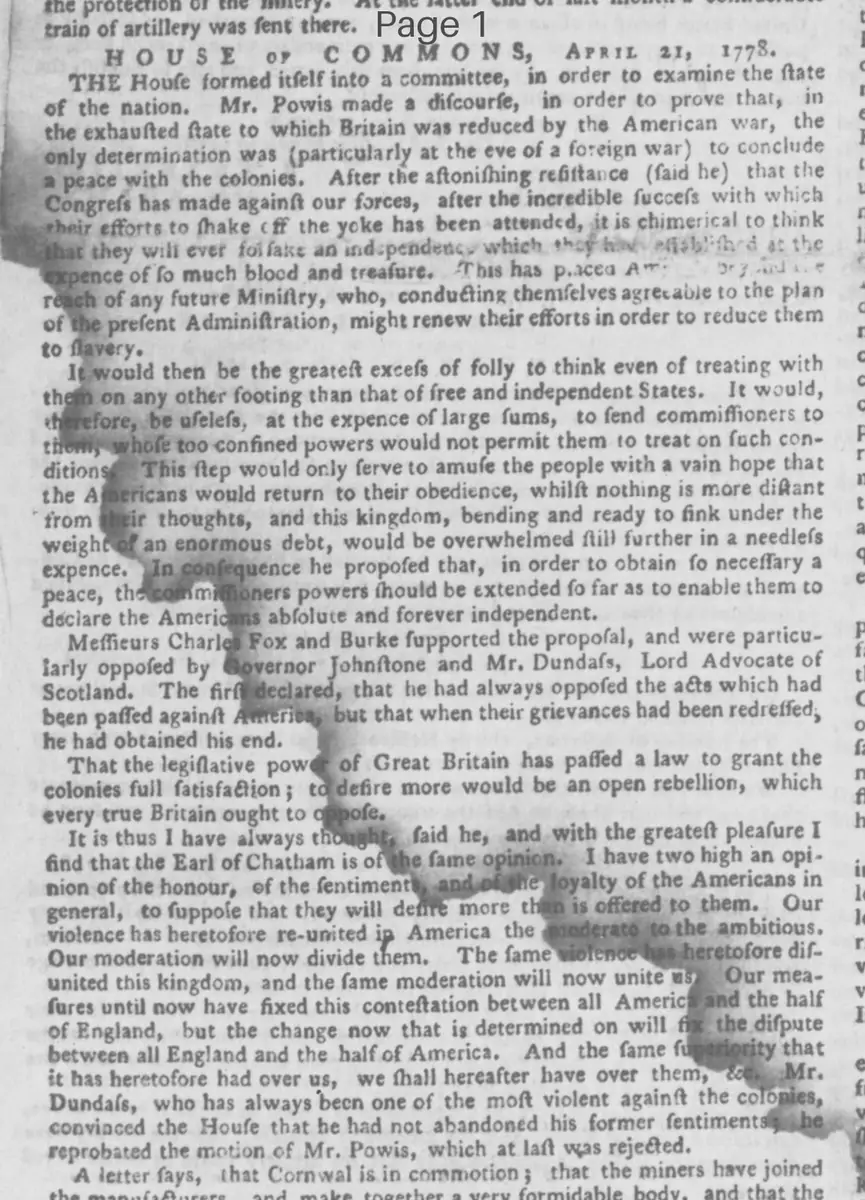
THE House formed itself into a committee, in order to examine the state of the nation. Mr. Powis made a discourse, in order to prove that, in the exhausted state to which Britain was reduced by the American war, the only determination was (particularly at the eve of a foreign war) to conclude a peace with the colonies. After the astonishing resistance (said he) that the Congress has made against our forces, after the incredible success with which their efforts to shake off the yoke has been attended, it is chimerical to think that they will ever forsake an independence which they have established at the expense of so much blood and treasure. This has placed America beyond the reach of any future Ministry, who, conducting themselves agreeable to the plan of the present Administration, might renew their efforts in order to reduce them to Slavery. It would then be the greatest excess of folly to think even of treating with them on any other footing than that of free and independent States. It would, therefore, be useless, at the expense of large sums, to send commissioners to them, whose too confined powers would not permit them to treat on such conditions. This step would only serve to amuse the people with a vain hope that the Americans would return to their obedience, whilst nothing is more distant from their thoughts, and this kingdom, bending and ready to sink under the weight of an enormous debt, would be overwhelmed still further in a needless expense. In consequence he proposed that, in order to obtain so necessary a peace, the commissioners powers should be extended so far as to enable them to declare the Americans absolute and forever independent. Messieurs Charles Fox and Burke supported the proposal, and were particularly opposed by Governor Johnstone and Mr. Dundas, Lord Advocate of Scotland. The first declared, that he had always opposed the acts which had been passed against America but that when their grievances had been redressed, he had obtained his end. That the legislative power of Great Britain has passed a law to grant the colonies full satisfaction; to desire more would be an open rebellion, which every true Briton ought to oppose. It is thus I have always thought, said he, and with the greatest pleasure I find that the Earl of Chatham is of the same opinion. I have too high an opinion of the honour, of the sentiment and of the loyalty of the Americans in general, to suppose that they will desire more than is offered to them. Our violence has heretofore re-united in America the moderate to the ambitious. Our moderation will now divide them. The same violence he heretofore dis-united this kingdom, and the same moderation will now unite it. Our measures until now have fixed this contestation between all America and the half of England, but the change now that is determined on will fix the dispute between all England and the half of America. And the same superiority that it has heretofore had over us, we shall hereafter have over them. Mr. Dundas, who has always been one of the most violent against the colonies, convinced the House that he had not abandoned his former sentiments: he reprobated the motion of Mr. Powis, which at last was rejected.
What sub-type of article is it?
What keywords are associated?
What entities or persons were involved?
Where did it happen?
Foreign News Details
Primary Location
America
Event Date
April 21, 1778.
Key Persons
Outcome
the motion of mr. powis was rejected.
Event Details
In a committee examining the state of the nation, Mr. Powis argued for recognizing American independence due to Britain's exhaustion from the war and America's successful resistance, proposing to extend commissioners' powers accordingly. Charles Fox and Burke supported this, while Governor Johnstone and Mr. Dundas opposed, with Johnstone emphasizing redressed grievances and expecting American loyalty, and Dundas maintaining his anti-colonial stance.