Thank you for visiting SNEWPapers!
Sign up free
The Key West Citizen
Key West, Monroe County, Florida
What is this article about?
US officials cautiously prepare for possible intervention in Laos civil war as Communist forces from North Vietnam reportedly invade to support Pathet Lao against pro-Western government; diplomatic efforts via SEATO and allies emphasized amid Eisenhower-Kennedy transition. (248 characters)
Clipping
OCR Quality
Full Text
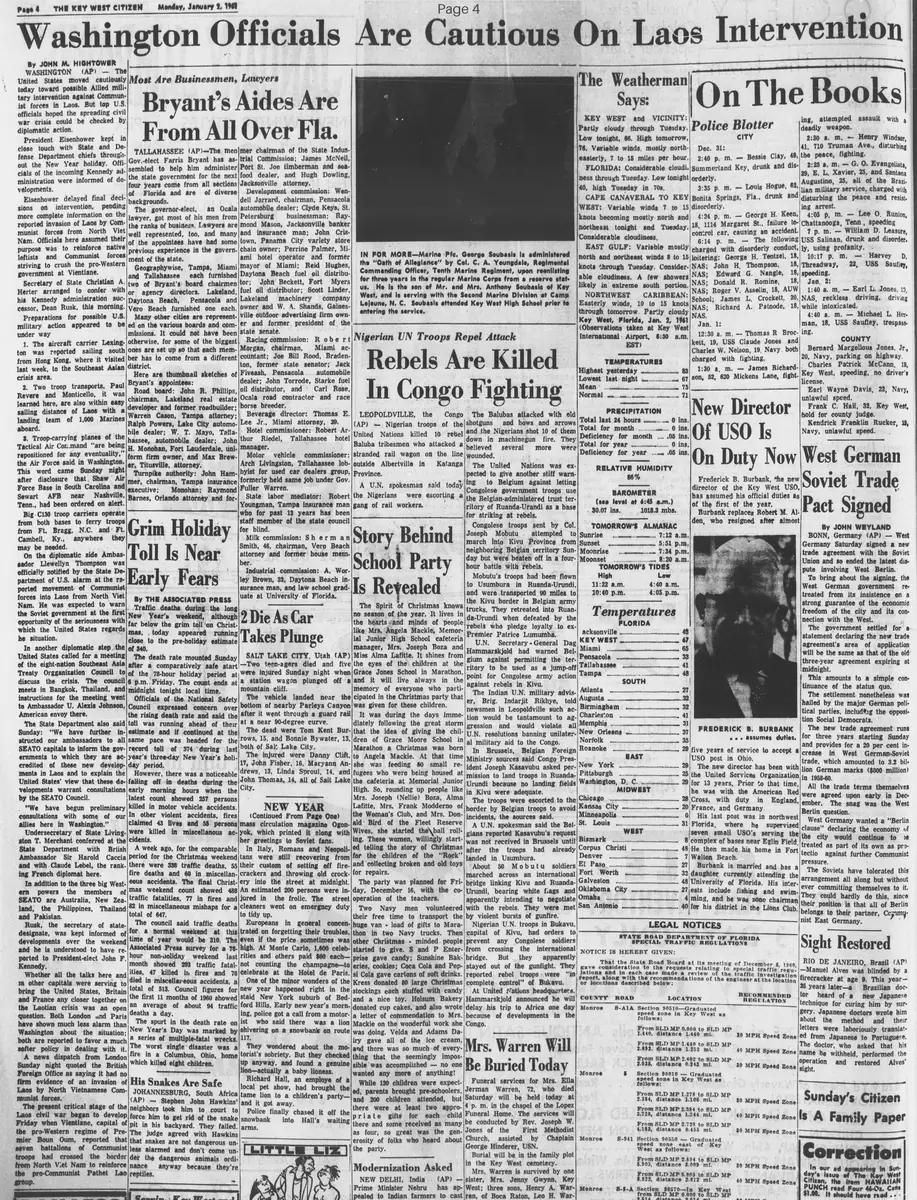
By John M. Hightower
WASHINGTON (AP) - The United States moved cautiously today toward possible Allied military intervention against Communist forces in Laos. But top U.S. officials hoped the spreading civil war crisis could be checked by diplomatic action.
President Eisenhower kept in close touch with State and Defense Department chiefs throughout the New Year holiday. Officials of the incoming Kennedy administration were informed of developments.
Eisenhower delayed final decisions on intervention, pending more complete information on the reported invasion of Laos by Communist forces from North Viet Nam. Officials here assumed their purpose was to reinforce native leftists and Communist forces striving to crush the pro-Western government at Vientiane.
Secretary of State Christian A. Herter arranged to confer with his Kennedy administration successor, Dean Rusk, this morning.
Preparations for possible U.S. military action appeared to be under way.
1. The aircraft carrier Lexington was reported sailing south from Hong Kong, where it visited last week, to the Southeast Asian crisis area.
2. Two troop transports, Paul Revere and Monticello, it was learned here, are also within easy sailing distance of Laos with a landing team of 1,000 Marines aboard.
3. Troop-carrying planes of the Tactical Air Command "are being repositioned for any eventuality," the Air Force said in Washington.
This word came Sunday night after disclosure that Shaw Air Force Base in South Carolina and Sewart AFB near Nashville, Tenn., had been ordered on alert. Big C-130 troop carriers operate from both bases to ferry troops from Ft. Bragg, N.C. and Ft. Campbell, Ky., anywhere they may be needed.
On the diplomatic side Ambassador Llewellyn Thompson was officially notified by the State Department of U.S. alarm at the reported movement of Communist forces into Laos from North Viet Nam. He was expected to warn the Soviet government at the first opportunity of the seriousness with which the United States regards the situation.
In another diplomatic step the United States called for a meeting of the eight-nation Southeast Asia Treaty Organization Council to discuss the crisis. The council meets in Bangkok, Thailand, and instructions for the meeting went to Ambassador U. Alexis Johnson, American envoy there.
The State Department also said Sunday: "We have further instructed our ambassadors to all SEATO capitals to inform the governments to which they are accredited of these new developments in Laos and to explain the United States' view that these developments warrant consultations by the SEATO Council."
"We have begun preliminary consultations with some of our allies here in Washington."
Undersecretary of State Livingston T. Merchant conferred at the State Department with British Ambassador Sir Harold Caccia and with Claude Lebel, the ranking French diplomat here.
In addition to the three big Western powers the members of SEATO are Australia, New Zealand, the Philippines, Thailand and Pakistan.
Rusk, the secretary of state-designate, was kept informed of developments over the weekend and he is understood to have reported to President-elect John F. Kennedy.
Whether all the talks here and in other capitals were serving to bring the United States, Britain and France any closer together on the Laotian crisis was an open question. Both London and Paris have shown much less alarm than Washington about the situation; both are reported to favor a much softer policy in dealing with it.
A news dispatch from London Sunday night quoted the British Foreign Office as saying it had no firm evidence of an invasion of Laos by North Vietnamese Communist forces.
The present critical stage of the Laos civil war began to develop Friday when Vientiane, capital of the pro-Western regime of Premier Boun Oum, reported that seven battalions of Communist troops had crossed the border from North Viet Nam to reinforce the pro-Communist Pathet Lao group.
What sub-type of article is it?
What keywords are associated?
What entities or persons were involved?
Where did it happen?
Foreign News Details
Primary Location
Laos
Event Date
Began To Develop Friday
Key Persons
Outcome
spreading civil war crisis with reported invasion by communist forces from north viet nam to reinforce pathet lao; u.s. military preparations under way but decisions delayed pending more information; diplomatic consultations initiated with allies and seato call for meeting
Event Details
The United States moved cautiously toward possible Allied military intervention against Communist forces in Laos amid a spreading civil war crisis, hoping to check it through diplomatic action. President Eisenhower consulted with officials and informed the incoming Kennedy administration. Preparations included repositioning the aircraft carrier Lexington, troop transports Paul Revere and Monticello with 1,000 Marines, and Tactical Air Command planes. Diplomatically, Ambassador Thompson was to warn the Soviet government; the U.S. called for a SEATO Council meeting in Bangkok and began consultations with allies including Britain and France, who showed less alarm. The crisis developed Friday when Vientiane reported seven battalions of Communist troops crossing from North Viet Nam to aid the pro-Communist Pathet Lao against the pro-Western government.