Thank you for visiting SNEWPapers!
Sign up free
Atlanta Daily World
Atlanta, Fulton County, Georgia
What is this article about?
CIO's Anti-Discrimination Committee releases handbook on civil rights laws in 20 states prohibiting race discrimination in public places like restaurants and theaters, and in employment in some states, with penalties and advice for victims to file complaints.
Merged-components note: Continuation of civil rights laws article from page 1 (ro21) to page 5.
Clippings
1 of 2
OCR Quality
Full Text
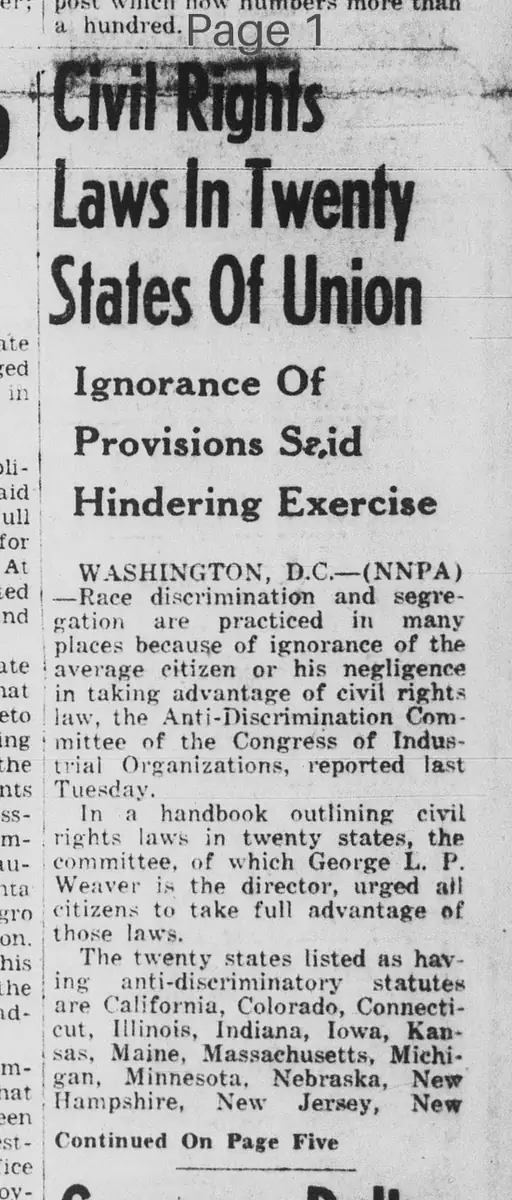
Ignorance Of Provisions Said Hindering Exercise
WASHINGTON. D.C.-(NNPA) -Race discrimination and segregation are practiced in many places because of ignorance of the average citizen or his negligence in taking advantage of civil rights law. the Anti-Discrimination Committee of the Congress of Industrial Organizations, reported last Tuesday.
In a handbook outlining civil rights laws in twenty states. the committee. of which George L. P. Weaver is the director, urged all citizens to take full advantage of those laws.
The twenty states listed as having anti-discriminatory statutes are California, Colorado, Connecticut, Illinois, Indiana, Iowa, Kansas, Maine, Massachusetts, Michigan, Minnesota, Nebraska, New Hampshire, New Jersey,
New Continued On Page Five
Civil Rights
(Continued from Page One)
York, Ohio, Pennsylvania, Rhode Island, Washington and Wisconsin.
Prohibitions
The CIO research department found that eighteen of these twenty states prohibit race discriminations in restaurant and other eating places, most of them prohibit it in public conveyances, over half of them include theatres and barber shops, seven of them prohibit discriminatory advertising, and others provide for equal rights in places ranging from hotels to cemeteries and including hospitals, rest rooms, stores, elevators, poolrooms, race tracks and saloons.
Most of the statutes include a comprehensive prohibition, making the statute applicable to "all other places of public accommodation or amusement," the pamphlet said.
Penalties for violation of these statutes range from fines of $10 to $1,000 or jail sentences of from 30 days to one year, or both, and in some states suits for civil damages are authorized.
License Suspensions
In addition to these penalties, some states provide for suspension or revocation of the license of places which practice discrimination.
The pamphlet points out that there are five states which have laws against discrimination in private employment. These states are Indiana and Wisconsin-which have laws containing no penalties and providing only for investigation and study and Massachusetts, New York and New Jersey which penalize violators.
In Indiana and Wisconsin, the committee said, victims of discrimination should make whatever use they can of the legal machinery set up. It advises the filing of complaints with appropriate state agencies and exposure of the case to the public.
Complaints
Any victim of race or religious discrimination in employment in Massachusetts, New York and New Jersey can file a complaint with the state agency by filling in a standard form provided for that purpose, the pamphlet points out.
The pamphlet also points out that the courts and other agencies have made rulings on racial or religious discrimination in employment. These rulings include a decision by the United States Supreme Court that a labor union as the exclusive bargaining agent for a class or craft must represent all members of the class or craft without discrimination. It also points out that the California Supreme Court has decided that a labor union which bars colored workers from membership cannot enforce a closed shop agreement against a colored worker who refuses to accept membership in an auxiliary.
What sub-type of article is it?
What themes does it cover?
What keywords are associated?
What entities or persons were involved?
Where did it happen?
Story Details
Key Persons
Location
Washington D.C.
Event Date
Last Tuesday
Story Details
The Anti-Discrimination Committee of the CIO reports on civil rights laws in twenty states prohibiting race discrimination in public places and some employment, urging citizens to use these laws, with penalties including fines, jail, and license suspensions.