Thank you for visiting SNEWPapers!
Sign up free
Daily Richmond Whig
Richmond, Virginia
What is this article about?
Joseph J. Knapp, Jr., son-in-law of Capt. White's housekeeper, confesses to orchestrating the April 1830 murder of Capt. White in Salem for inheritance by hiring assassins, destroying the will, and paying them partially; his anonymous letters and failed plans are detailed, shocking the community.
Merged-components note: The table of committee names is spatially within and part of the story about the invitation to Hon. Daniel Webster.
Clipping
OCR Quality
Full Text
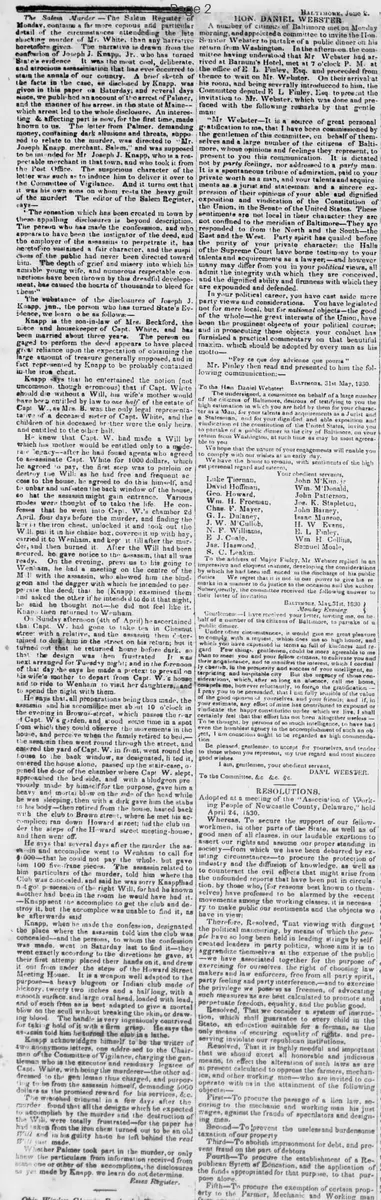
The Salem Register of Monday contains a far more copious and particular detail of the circumstances attending the late shocking murder of Mr. White, than any narrative heretofore given. The narrative is drawn from the confession of Joseph J. Knapp, Jr., who has turned State's evidence. It was the most cool, deliberate, and atrocious assassination that has ever occurred to stain the annals of our country. A brief sketch of the facts in the case, as disclosed by Knapp, was given in this paper on Saturday; and several days since, we published an account of the arrest of Palmer, and the manner of his arrest, in the state of Maine—which arrest led to the whole disclosure. An interesting & affecting part is now, for the first time, made known to us. The letter from Palmer, demanding money, containing dark allusions and threats, supposed to relate to the murder, was directed to 'Mr. Joseph Knapp, merchant, Salem.' and was supposed to be intended for Mr. Joseph J. Knapp, who is a respectable merchant in that town, and who took it from the Post Office. The suspicious character of the letter was such as to induce him to deliver it over to the Committee of Vigilance. And it turns out that it was his own son on whom rests the heavy guilt of the murder! The editor of the Salem Register, says—
The sensation which has been created in town by these appalling disclosures is beyond description. The person who has made the confession, and who appears to have been the instigator of the deed, and the employer of the assassins to perpetrate it, has heretofore sustained a fair character, and the suspicions of the public had never been directed toward him. The depth of grief and misery into which his amiable young wife, and numerous respectable connections have been thrown by this dreadful development, has caused the hearts of thousands to bleed for them.
The substance of the disclosures of Joseph J. Knapp, Jr., the person who has turned State's Evidence, we learn to be as follows:—
Knapp is the son-in-law of Mrs. Beckford, the niece and housekeeper of Capt. White, and has been married about three years.
The person engaged to perform the deed appears to have placed great reliance upon the expectation of obtaining the large amount of treasure generally supposed, and in fact represented by Knapp to be probably contained in the iron chest.
Knapp says that he entertained the notion (not uncommon, though erroneous) that if Capt. White should die without a Will, his wife's mother would have been entitled by law to one half of the estate of Capt. W., as Mrs. B. was the only legal representative of a deceased sister of Capt. White, and the children of his deceased brother were the only heirs, and entitled to the other half.
He knew that Capt. W. had made a Will by which his mother would be entitled only to a moderate legacy—after he had found agents who agreed to assassinate Capt. White for 1000 dollars, which he agreed to pay, the first step was to purloin or destroy the Will: as he had free and frequent access to the house, he agreed to do this himself, and to unbar and unfasten the back window of the house, so that the assassin might gain entrance. Various modes were thought of to take the life. He confesses that he went into Capt. W.'s chamber 2d April, four days before the murder, and finding the key of the iron chest, unlocked it and took out the Will, put it in his chaise box, covered it up with hay, carried it to Wenham, and kept it till after the murder, and then burned it. After the Will had been secured, he gave notice to the assassin, that all was ready. On the evening, previous to his going to Wenham, he had a meeting on the centre of the road with the assassin, who showed him the bludgeon and the dagger with which he intended to perpetrate the deed; that he (Knapp) examined them and asked the other if he intended to do it that night, he said he thought not—he did not feel like it. Knapp then returned to Wenham.
On Sunday afternoon (4th of April) he ascertained that Capt. W. had gone to take tea in Chestnut street with a relative, and the assassin then determined to dirk him in the street on his return; but it turned out that he returned home before dark, so that the design was then frustrated. It was next arranged for Tuesday night; and in the forenoon of that day, he says he made a pretext to prevail on his wife's mother to depart from Capt. W.'s house and to ride to Wenham to visit her daughters, and to spend the night with them.
He says that, all preparations being thus made, the assassin and his accomplice met about 10 o'clock in the evening in Brown's-street, which passes the rear of Capt. W.'s garden, and stood some time in a spot from which they could observe the movements in the house, and perceive when the family retired to bed—the assassin then went round through the street, and entered the yard of Capt. W. in front, went round the house to the back window, as designated, lifted it, entered the house alone, passed up the stair-case, opened the door of the chamber where Capt. W. slept, approached the bed side, and with a bludgeon previously made by himself for the purpose, gave him a heavy and mortal blow on the side of the head while he was sleeping, then with a dirk gave him the stabs in his body—then retired from the house, hasted back with the club to Brown street, where he met his accomplice; ran down Howard street; hid the club under the steps of the Howard street meeting-house, and then went off.
He says that several days after the murder the assassin and accomplice went to Wenham to call for $1000—that he could not pay the whole, but gave him 100 five-franc pieces. The assassin related to him particulars of the murder, told him where the club was concealed, and said he was sorry Knapp had not got possession of the right Will, for had he known another had been in the room he would have had it.—Knapp sent the accomplice to get the club and destroy it, but the accomplice was unable to find it, as he afterwards said.
Knapp, when he made the confession, designated the place where the assassin told him the club was concealed—and the persons, to whom the confession was made, went on Saturday last to find it—they went exactly according to the directions he gave, at their first attempt placed their hands on it, and drew it out from under the steps of the Howard Street Meeting House. It is a weapon well adapted to the purpose—a heavy bludgeon or Indian club made of hickory, twenty two inches and a half long, with a smooth surface, and large oval head, loaded with lead, and of such form as is best adapted to give a mortal blow on the skull without breaking the skin, or drawing blood. The handle is very ingeniously contrived for taking hold of it with a firm grasp. He says the assassin told him he turned the club in a lathe.
Knapp acknowledges himself to be the writer of two anonymous letters, one addressed to the Chairman of the Committee of Vigilance, charging the gentleman who is the executor and residuary legatee of Capt. White, with being the murderer—the other addressed to the gentleman thus charged, and purporting to be from the assassin himself, demanding $5000 dollars as the promised reward for his services, &c.
The wretched criminal in a few days after the murder found that all the designs which he expected to accomplish by the murder and the destruction of the Will, were totally frustrated—for the paper he had taken from the iron chest turned out to be an old Bill and in his guilty haste he left behind the real Will just made.
Whether Palmer took part in the murder, or only knew the particulars from information received from some one or other of the accomplices, the disclosures aver made by Knapp, we learn do not determine.
Essex Register.
| Luke Tiernan, David Hoffman, Geo. Howard, Wm. H. Froeman, Chas. F. Mayer, G. I. Dulaney, J. W. M'Cullob, N. F. Williams, E. J. Coale, Jas. Haswood, S. C. Leakin | John M'Kim, Jr. Wm. M'Donald, John Patterson, Joe. K. Stapleton, John Barney, Isaac Munroe, H. W. Evans, E. L. Finley, Wm. H. Collins, Samuel Moale, |
What sub-type of article is it?
What themes does it cover?
What keywords are associated?
What entities or persons were involved?
Where did it happen?
Story Details
Key Persons
Location
Salem
Event Date
April 1830
Story Details
Joseph J. Knapp, Jr. confesses to plotting Capt. White's murder for inheritance, hiring assassins for $1000, destroying what he thought was the will, facilitating entry, and writing anonymous letters; the murder occurred on Tuesday night after failed attempts, using bludgeon and dirk; plans failed as he destroyed the wrong document.