Thank you for visiting SNEWPapers!
Sign up free
Editorial
November 27, 1828
Rhode Island American And Providence Gazette
Providence, Providence County, Rhode Island
What is this article about?
A correspondent praises John Quincy Adams' character and principles after his electoral defeat to Andrew Jackson in 1828, viewing the outcome as a mysterious providence. Includes a poem, biblical quotes, and excerpts from Adams' farewell lecture at Harvard emphasizing moral resilience through letters, science, and religion.
Merged-components note: Continuous editorial on Mr. Adams; merged into single editorial.
Clipping
OCR Quality
95%
Excellent
Full Text
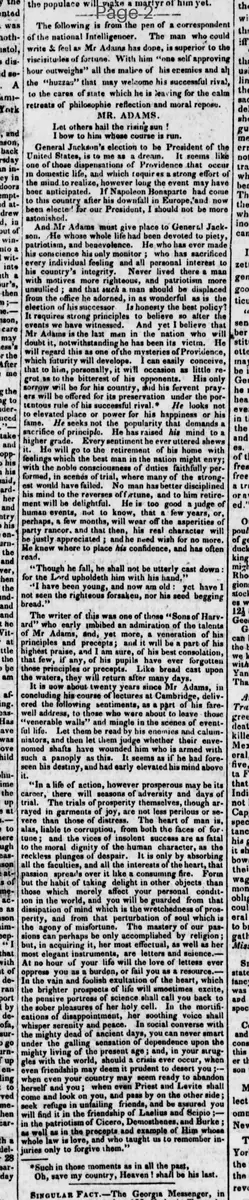
The following is from the pen of a correspondent of the National Intelligencer. The man who could write & feel as Mr Adams has done, is superior to the vicissitudes of fortune. With him "one self approving hour outweighs" all the malice of his enemies and all the "huzzas" that may welcome his successful rival, to the cares of state which he is leaving for the calm retreats of philosophic reflection and moral repose.
MR. ADAMS.
Let others hail the rising sun !
I bow to him whose course is run.
General Jackson's election to be President of the United States, is to me as a dream. It seems like one of those dispensations of Providence that occur in domestic life, and which requires a strong effort of the mind. to realize, however long the event may have been anticipated. If Napoleon Bonaparte had come to this country after his downfall in Europe, 'and now been elected for our President, I should not be more astonished.
And Mr Adams must give place to General Jackson. He whose whole life had been devoted to piety, patriotism, and benevolence. He who has ever made his conscience his only monitor : who has sacrificed every individual feeling and all personal interest to his country's integrity. Never lived there a man with motives more righteous, and patriotism more unsullied ; and that such a man should be displaced from the office he adorned, in as wonderful as is the election of his successor Is honesty the best policy? It requires strong principles to believe so after the events we have witnessed. And yet I believe that Mr Adams is the last man in the nation who will doubt it, notwithstanding he has been its victim. He will regard this as one of the mysteries of Providence, which futurity will develope. I can easily conceive, that to him, personally, it will occasion as little regret as to the bitterest of his opponents. His only sorrow will be for his country, and his fervent prayers will be offered for its preservation under the portentous rule of his successful rival.* He looks not to elevated place or power for his happiness or his fame. He seeks not the popularity that demands a sacrifice of principle. He has raised his mind to a higher grade. Every sentiment he ever uttered shews it. He will go to the retirement of his home with feelings which the best man in the nation might envy; with the noble consciousness of duties faithfully performed, in scenes of trial, where many of the strongest would have failed. No man has better disciplined his mind to the reverses of fortune, and to him retirement will be delightful. He is too good a judge of human events, not to know, that a few years, or, perhaps, a few months, will wear off the asperities of party rancor. and that then, his real character will be justly-appreciated; and he need wish for no more. He knew where to place his confidence, and has often read.
"Though he fall, he shall not be utterly cast down : for the Lord upholdeth him with his hand."
"I have been young, and now am old: yet have I not seen the righteous forsaken, nor his seed begging bread."
The writer of this was one of those "Sons of Harvard" who early imbibed an admiration of the talents of Mr Adams, and, yet more, a veneration of his principles and precepts; and it will be a part of his highest praise, and I am sure, of his best consolation, that few, if any, of his pupils have ever forgotten those principles or precepts. Like bread cast upon the waters, they will return after many days.
It is now about twenty years since Mr Adams, in concluding his course of lectures at Cambridge, delivered the following sentiments, as a part of his farewell address, to those who were about to leave "those venerable walls" and mingle in the scenes of eventful life. Let them be read by his enemies and calumniators, and then let them judge whether their envenomed shafts have wounded him who is armed with such a panoply as this. It seems as if he had foreseen his destiny, and had early elevated his mind above it.
"In a life of action, however prosperous may be its career, there will seasons of adversity and days of trial. The trials of prosperity themselves, though arrayed in garments of joy, are not less perilous or severe than those of distress. The heart of man is, alas, liable to corruption, from both the faces of fortune; and the vices of insolent success are as fatal to the moral dignity of the human character, as the reckless plunges of despair. It is only by absorbing all the faculties, and all the interests of the heart, that passion spreads over it like a consuming fire. Form but the habit of taking delight in other objects than those which merely affect your personal condition in the world, and you will be guarded from that dissipation of mind which is the wretchedness of prosperity, and from that perturbation of soul which is the agony of misfortune. The mastery of our passions can perhaps be only accomplished by religion; but, in acquiring it, her most effectual, as well as her most elegant instruments, are letters and science.— At no hour of your life will the love of letters ever oppress you as a burden, or fail you as a resource.— In the vain and foolish exultation of the heart, which the brighter prospects of life will sometimes excite, the pensive portress of science shall call you back to the sober pleasures of her holy cell. In the mortifications of disappointment, her soothing voice shall whisper serenity and peace. In social converse with the mighty dead of ancient days, you can never smart under the galling sensation of dependence upon the mighty living of the present age; and, in your struggles with the world, should a crisis ever occur, when even friendship may deem it prudent to desert you ;— when even your country may seem ready to abandon herself and you; when even Priest and Levite shall come and look on you, and pass by on the other side; seek refuge in unfailing friends, and be assured you will find it in the friendship of Laelius and Scipio ;— in the patriotism of Cicero, Demosthenes, and Burke; as well as in the precepts and example of Him whose whole law is love, and who taught us to remember injuries only to forgive them."
*Such in those moments as in all the past,
Oh, save my country, Heaven! shall be his last.
MR. ADAMS.
Let others hail the rising sun !
I bow to him whose course is run.
General Jackson's election to be President of the United States, is to me as a dream. It seems like one of those dispensations of Providence that occur in domestic life, and which requires a strong effort of the mind. to realize, however long the event may have been anticipated. If Napoleon Bonaparte had come to this country after his downfall in Europe, 'and now been elected for our President, I should not be more astonished.
And Mr Adams must give place to General Jackson. He whose whole life had been devoted to piety, patriotism, and benevolence. He who has ever made his conscience his only monitor : who has sacrificed every individual feeling and all personal interest to his country's integrity. Never lived there a man with motives more righteous, and patriotism more unsullied ; and that such a man should be displaced from the office he adorned, in as wonderful as is the election of his successor Is honesty the best policy? It requires strong principles to believe so after the events we have witnessed. And yet I believe that Mr Adams is the last man in the nation who will doubt it, notwithstanding he has been its victim. He will regard this as one of the mysteries of Providence, which futurity will develope. I can easily conceive, that to him, personally, it will occasion as little regret as to the bitterest of his opponents. His only sorrow will be for his country, and his fervent prayers will be offered for its preservation under the portentous rule of his successful rival.* He looks not to elevated place or power for his happiness or his fame. He seeks not the popularity that demands a sacrifice of principle. He has raised his mind to a higher grade. Every sentiment he ever uttered shews it. He will go to the retirement of his home with feelings which the best man in the nation might envy; with the noble consciousness of duties faithfully performed, in scenes of trial, where many of the strongest would have failed. No man has better disciplined his mind to the reverses of fortune, and to him retirement will be delightful. He is too good a judge of human events, not to know, that a few years, or, perhaps, a few months, will wear off the asperities of party rancor. and that then, his real character will be justly-appreciated; and he need wish for no more. He knew where to place his confidence, and has often read.
"Though he fall, he shall not be utterly cast down : for the Lord upholdeth him with his hand."
"I have been young, and now am old: yet have I not seen the righteous forsaken, nor his seed begging bread."
The writer of this was one of those "Sons of Harvard" who early imbibed an admiration of the talents of Mr Adams, and, yet more, a veneration of his principles and precepts; and it will be a part of his highest praise, and I am sure, of his best consolation, that few, if any, of his pupils have ever forgotten those principles or precepts. Like bread cast upon the waters, they will return after many days.
It is now about twenty years since Mr Adams, in concluding his course of lectures at Cambridge, delivered the following sentiments, as a part of his farewell address, to those who were about to leave "those venerable walls" and mingle in the scenes of eventful life. Let them be read by his enemies and calumniators, and then let them judge whether their envenomed shafts have wounded him who is armed with such a panoply as this. It seems as if he had foreseen his destiny, and had early elevated his mind above it.
"In a life of action, however prosperous may be its career, there will seasons of adversity and days of trial. The trials of prosperity themselves, though arrayed in garments of joy, are not less perilous or severe than those of distress. The heart of man is, alas, liable to corruption, from both the faces of fortune; and the vices of insolent success are as fatal to the moral dignity of the human character, as the reckless plunges of despair. It is only by absorbing all the faculties, and all the interests of the heart, that passion spreads over it like a consuming fire. Form but the habit of taking delight in other objects than those which merely affect your personal condition in the world, and you will be guarded from that dissipation of mind which is the wretchedness of prosperity, and from that perturbation of soul which is the agony of misfortune. The mastery of our passions can perhaps be only accomplished by religion; but, in acquiring it, her most effectual, as well as her most elegant instruments, are letters and science.— At no hour of your life will the love of letters ever oppress you as a burden, or fail you as a resource.— In the vain and foolish exultation of the heart, which the brighter prospects of life will sometimes excite, the pensive portress of science shall call you back to the sober pleasures of her holy cell. In the mortifications of disappointment, her soothing voice shall whisper serenity and peace. In social converse with the mighty dead of ancient days, you can never smart under the galling sensation of dependence upon the mighty living of the present age; and, in your struggles with the world, should a crisis ever occur, when even friendship may deem it prudent to desert you ;— when even your country may seem ready to abandon herself and you; when even Priest and Levite shall come and look on you, and pass by on the other side; seek refuge in unfailing friends, and be assured you will find it in the friendship of Laelius and Scipio ;— in the patriotism of Cicero, Demosthenes, and Burke; as well as in the precepts and example of Him whose whole law is love, and who taught us to remember injuries only to forgive them."
*Such in those moments as in all the past,
Oh, save my country, Heaven! shall be his last.
What sub-type of article is it?
Partisan Politics
Moral Or Religious
What keywords are associated?
Adams
Jackson
Election
Patriotism
Providence
Retirement
Morality
Harvard
What entities or persons were involved?
Mr. Adams
General Jackson
Napoleon Bonaparte
Sons Of Harvard
Editorial Details
Primary Topic
Praise For John Quincy Adams Following His Defeat In The 1828 Presidential Election
Stance / Tone
Strongly Supportive Of Adams, Astonished And Critical Of Jackson's Victory
Key Figures
Mr. Adams
General Jackson
Napoleon Bonaparte
Sons Of Harvard
Key Arguments
Adams' Life Devoted To Piety, Patriotism, And Benevolence
Election Of Jackson Is Astonishing And Dream Like
Honesty Is The Best Policy Despite Adams' Defeat
Adams Views Outcome As Mystery Of Providence
Adams Finds Peace In Retirement And Principled Life
Biblical Assurances Of Divine Support For The Righteous
Adams' Lectures Emphasize Resilience Through Religion, Letters, And Science