Thank you for visiting SNEWPapers!
Sign up free
Kentucky Gazette
Lexington, Fayette County, Kentucky
What is this article about?
In Balasore, India, on September 6, 1814, missionary John Peter reports failing to prevent a 45-50-year-old widow from committing sati by burning herself alive on her husband Ochob's funeral pyre, despite quoting scripture and pleading with her and the crowd.
Clipping
OCR Quality
Full Text
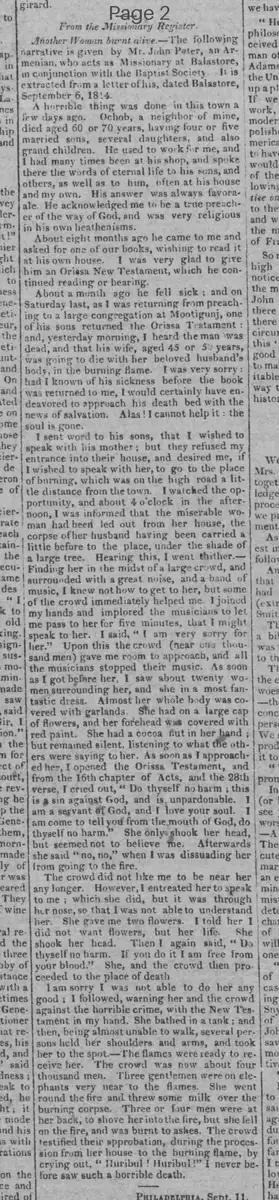
Another Woman burnt alive. The following narrative is given by Mr. John Peter, an Armenian, who acts as Missionary at Balasore, in Conjunction with the Baptist Society. It is extracted from a letter of his, dated Balasore, September 6, 1814.
A horrible thing was done in this town a few days ago, Ochob, a neighbor of mine, died aged 60 or 70 years, having four or five married sons, several daughters, and also grand children. He used to work for me, and I had many times been at his shop, and spoke there the words of eternal life to his sons, and others, as well as to him, often at his house and my own. His answer was always favorable. He acknowledged me to be a true preacher of the way of God, and was very religious in his own heathenisms.
About eight months ago he came to me and asked for one of our books, wishing to read it at his own house. I was very glad to give him an Oria New Testament, which he continued reading or hearing.
About a month ago he fell sick: and on Saturday last, as I was returning from preaching to a large congregation at Mootigunj, one of his sons returned the Oria Testament: and, yesterday morning, I heard the man was dead, and that his wife, aged 45 or 50 years, was going to die with her beloved husband's body, in the burning flame. I was very sorry: had I known of his sickness before the book was returned to me, I would certainly have endeavored to approach his death bed with the news of salvation. Alas! I cannot help it: the soul is gone.
I sent word to his sons, that I wished to speak with his mother; but they refused my entrance into their house, and desired me, if I wished to speak with her, to go to the place of burning, which was on the high road a little distance from the town. I watched the opportunity, and about 4 o'clock in the afternoon, I was informed that the miserable woman had been led out from her house, the corpse of her husband having been carried a little before to the place, under the shade of a large tree. Hearing this, I went thither. Finding her in the midst of a large crowd, and surrounded with a great noise, and a band of music, I knew not how to get to her, but some of the crowd immediately helped me. I joined my hands and implored the musicians to let me pass to her for five minutes, that I might speak to her. I said, "I am very sorry for her." Upon this the crowd (near one thousand men) gave me room to approach, and all the musicians stopped their music. As soon as I got before her, I saw about twenty women surrounding her, and she in a most fantastic dress. Almost her whole body was covered with garlands. She had on a large cap of flowers, and her forehead was covered with red paint. She had a cocoa nut in her hand; but remained silent, listening to what the others were saying to her. As soon as I approached her, I opened the Oria Testament, and from the 16th chapter of Acts, and the 28th verse, I cried out, "Do thyself no harm; this is a sin against God, and is, unpardonable. I am a servant of God, and I love your soul. I am come to tell you from the mouth of God, do thyself no harm." She only shook her head, but seemed not to believe me. Afterwards she said "no, no," when I was dissuading her from going to the fire.
The crowd did not like me to be near her any longer. However, I entreated her to speak to me; which she did, but it was through her nose, so that I was not able to understand her. She gave me two flowers. I told her I did not want flowers, but her life. She shook her head. Then I again said, "Do thyself no harm. If you do it I am free from your blood." She, and the crowd then proceeded to the place of death.
I am sorry I was not able to do her any good: I followed, warning her and the crowd against the horrible crime, with the New Testament in my hand. She bathed in a tank; and then, being almost unable to walk, several persons held her shoulders and arms, and took her to the spot. The flames were ready to receive her. The crowd was now about four thousand men. Three gentlemen were on elephants very near to the flames. She went round the fire and threw some milk over the burning corpse. Three or four men were at her back, to shove her into the fire, but she fell on the fire, and was burnt to ashes. The crowd testified their approbation, during the procession from her house to the burning flame, by crying out, "Huribul! Huribul!" I never before saw such a horrible death.
What sub-type of article is it?
What keywords are associated?
What entities or persons were involved?
Where did it happen?
Foreign News Details
Primary Location
Balasore
Event Date
A Few Days Ago From September 6, 1814
Key Persons
Outcome
the wife, aged 45 or 50 years, was burnt alive on her husband's funeral pyre.
Event Details
Ochob, aged 60 or 70, died about a month after falling sick. His widow prepared for sati. Missionary John Peter attempted to intervene by quoting Acts 16:28 from the Oria Testament, pleading with her and the crowd of up to four thousand, but she proceeded and was burnt to ashes amid cries of 'Huribul! Huribul!'