Thank you for visiting SNEWPapers!
Sign up free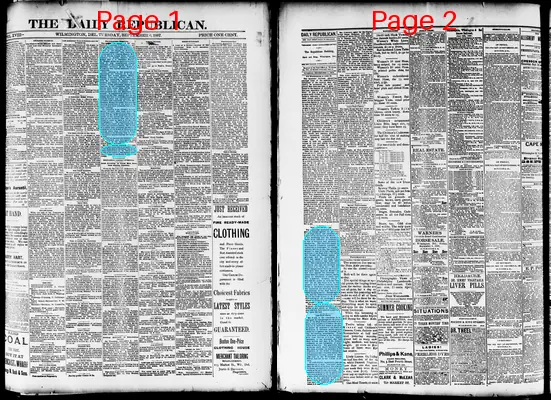
Daily Republican
Wilmington, New Castle County, Delaware
What is this article about?
A committee of the Board of Education in Wilmington organized to investigate charges against High School Principal Graham, electing officers, hiring a stenographer and notary, and scheduling hearings for Tuesday evening. They focused on direct charges by Misses Hare and Pyle, criticized public influence attempts, and opted for broad evidence latitude.
Merged-components note: Continuation across pages of the article detailing the committee's investigation into charges against the High School principal.
Clippings
1 of 2
OCR Quality
Full Text
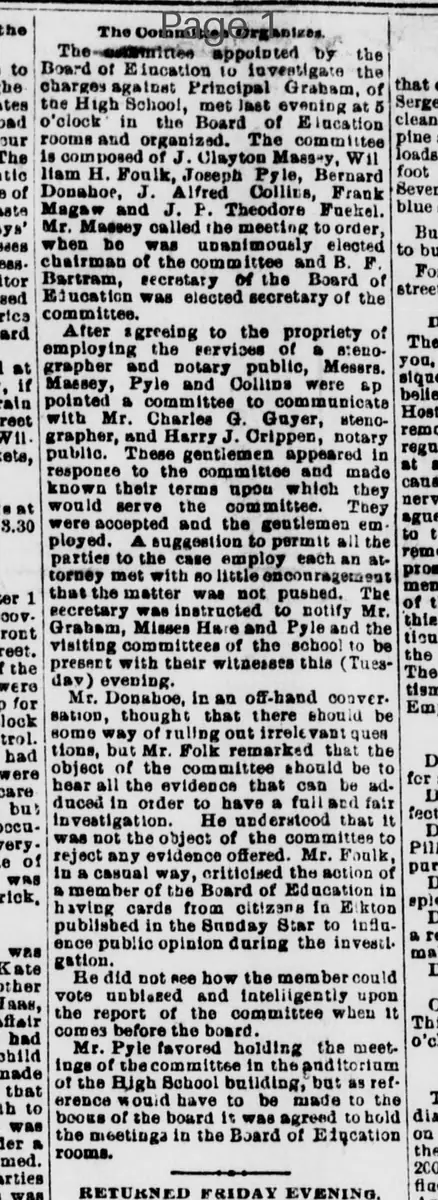
Mr. Massey called the meeting to order, when he was unanimously elected chairman of the committee and B. F. Bartram, secretary of the Board of Education was elected secretary of the committee.
After agreeing to the propriety of employing the services of a stenographer and notary public, Messrs. Massey, Pyle and Collins were appointed a committee to communicate with Mr. Charles J. Guyer, stenographer, and Harry J. Crippen, notary public. These gentlemen appeared in response to the committee and made known their terms upon which they would serve the committee. They were accepted and the gentlemen employed. A suggestion to permit all the parties to the case employ each an attorney met with so little encouragement that the matter was not pushed. The secretary was instructed to notify Mr. Graham, Misses Hare and Pyle and the visiting committees of the school to be present with their witnesses this (Tuesday) evening
Mr. Donahoe, in an off-hand conversation, thought that there should be some way of ruling out irrelevant questions, but Mr. Foulk remarked that the object of the committee should be to hear all the evidence that can be adduced in order to have a full and fair investigation. He understood that it was not the object of the committee to reject any evidence offered. Mr. Foulk, in a casual way, criticised the action of a member of the Board of Education in having cards from citizens in Elkton published in the Sunday Star to influence public opinion during the investigation. He did not see how the member could vote unbiased and intelligently upon the report of the committee when it comes before the board.
Mr. Pyle favored holding the meetings of the committee in the auditorium of the High School building, but as reference would have to be made to the books of the board it was agreed to hold the meetings in the Board of Education rooms.
Sticking to the Charges.
The committee appointed to investigate the charges against the principal of the High School met yesterday and organized by the election of officers. It is not surprising that the committee found some difficulty in formulating a line of direction and guidance for themselves. The resolution passed by the Board of Education requested the committee to investigate "all charges," whether written or oral, that have been brought or may be brought against the principal of the High School, the ladies who brought the charges against the principal, and the committees who have had charge of the High School during the troubles that have taken place. The experience of the committee evidently was that the resolution was too much of a "drag net." The only direct charges found upon the committee's table were those by Misses Hare and Pyle against the principal. All others were but casual hearsay, having really no foundation to stand upon. The committee, therefore, though it still has the power to work the "drag net" for all that there is in it, very properly and wisely confined themselves to the direct charges, and sensibly instructed the secretary to notify the principal of the High School, the ladies bringing specific charges against him, and the respective school committees of the High School to be present this evening at the investigation with whatever evidence in the case they may see proper to bring.
The committee is evidently disposed to permit the broadest latitude in giving evidence, and shows no disposition to suppress any facts relative to and bearing upon the case.
Last Hour Cards.
Mr. Foulk, in the committee to investigate the charges against the principal of the High School, yesterday afternoon, very properly objected to the publication of cards and letters in the public papers by members of the Board of Education to influence public opinion either for or against the principal during the pending investigation. Three cards were published in last Sunday's Star from citizens of Elkton, highly favorable to the principal, that had been written and sent to Mr. Palmer evidently at the instigation of somebody in this city. The gentlemen who wrote the cards would naturally have sent them to either the secretary or the President of the Board of Education had they not been otherwise posted. The investigation entirely relates to what was done in the Wilmington High School, and not in the Elkton Academy.
Of such evident impropriety was the publication of these "last hour" cards, that the editor of the Star, who was not to blame, apologized for them in an editorial so far as he was concerned. The question arises, how can the gentleman, who is a member of the Board of Education, after betraying such unusual interest in the principal of the High School vote, intelligently and without bias upon the report of the committee when it is made?
What sub-type of article is it?
What keywords are associated?
What entities or persons were involved?
Where did it happen?
Domestic News Details
Primary Location
Wilmington
Event Date
Last Evening (Monday) And This (Tuesday) Evening
Key Persons
Outcome
committee organized with massey as chairman and bartram as secretary; hired stenographer guyer and notary crippen; decided to focus on direct charges by misses hare and pyle; scheduled hearing for tuesday evening; criticized publication of influencing cards.
Event Details
The Board of Education committee met to organize for investigating charges against High School Principal Graham, including those from Misses Hare and Pyle. They elected officers, hired support staff, rejected attorneys for parties, and planned to allow broad evidence. Discussions included handling irrelevant questions, meeting location, and objection to public opinion influence via published cards from Elkton citizens.