Thank you for visiting SNEWPapers!
Sign up free
The Hillsborough Recorder
Hillsboro, Orange County, North Carolina
What is this article about?
Armistice signed November 20, 1820, between Spain and Colombia suspends hostilities for six months to enable peace negotiations. Details include territorial positions, guerrilla disbandment, and free trade. Generals Morillo and Bolivar met November 28 at Santa Ana, embracing, dining, toasting peace, and starting a reconciliation monument.
Merged-components note: These components continue the report on the armistice between Spain and Colombia, including related letters, with sequential reading orders.
Clipping
OCR Quality
Full Text
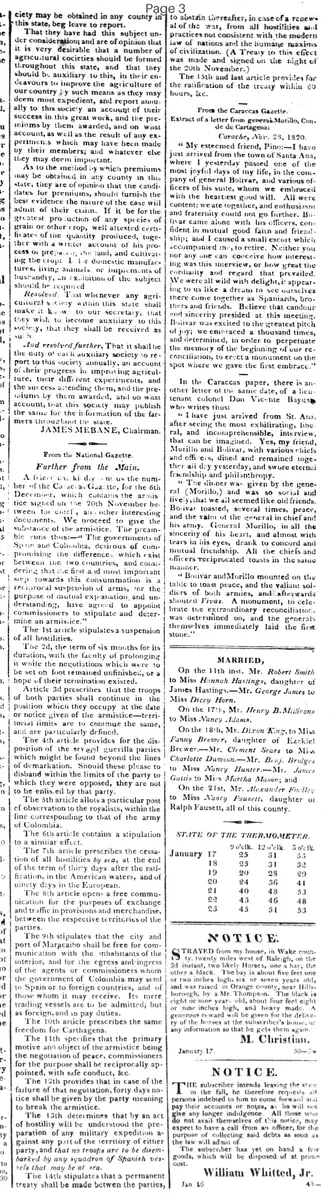
Further from the Main.
A friend kindly sent us the number of the Caracas Gazette, for the 6th December, which contains the armistice signed on the 20th November between the chief, and other interesting documents. We proceed to give the substance of the armistice. The preamble runs thus:—“The governments of Spain and Colombia, desirous of compromising the difference, which exist between the two countries, and considering that the first and most important step towards this consummation is a reciprocal suspension of arms, for the purpose of mutual explanation and understanding, have agreed to appoint commissioners to stipulate and determine an armistice.”
The 1st article stipulates a suspension of all hostilities.
The 2d, the term of six months for its duration, with the faculty of prolonging it while the negotiations which were to be set on foot remained unfinished, or a hope of their termination existed.
Article 3d prescribes that the troops of both parties shall continue in the position which they occupy at the date or notice given of the armistice—territorial limits are to continue the same, and are particularly defined.
The 4th article provides for the disposition of the several guerilla parties which might be found beyond the lines of demarkation. Should these please to disband within the limits of the party to which they were opposed, they are not to be enlisted by that party.
The 5th article allots a particular post of observation to the royalists, within the line corresponding to that of the army of Colombia.
The 6th article contains a stipulation to a similar effect.
The 7th article prescribes the cessation of all hostilities by sea, at the end of the term of thirty days after the ratification, in the American waters, and of ninety days in the European.
The 8th article opens a free communication for the purposes of exchange and traffic in provisions and merchandise, between the respective territories of the parties.
The 9th stipulates that the city and port of Maracaibo shall be free for communication with the inhabitants of the interior, and for the egress and ingress of the agents or commissioners whom the government of Colombia may send to Spain or to foreign countries, and of those whom it may receive. Its mere trading vessels are to be admitted: but as foreign, and to pay duties.
The 10th article prescribes the same freedom for Carthagena.
The 11th specifies that the primary motive and object of the armistice being the negotiation of peace, commissioners for the purpose shall be reciprocally appointed, with safe conduct, &c.
The 12th provides that in case of the failure of that negotiation, forty days notice shall be given by the party meaning to break the armistice.
The 13th determines that by an act of hostility will be understood the preparation of any military expedition against any part of the territory of either party, and that no troops are to be disembarked by any squadron of Spanish vessels that may be at sea.
The 14th stipulates that a permanent treaty shall be made between the parties to abstain thereafter, in case of a renewal of the war, from all hostilities and practices not consistent with the modern law of nations and the humane maxims of civilization. (A Treaty to this effect was made and signed on the night of the 20th November.)
The 15th and last article provides for the ratification of the treaty within 60 days, &c.
From the Caracas Gazette.
Extract of a letter from general Morillo, Com. de de Cartagena:
Curache, Nov. 28, 1820.
"My esteemed friend, Pino:—I have just arrived from the town of Santa Ana, where I yesterday passed one of the most joyful days of my life, in the company of general Bolivar, and various officers of his suite, whom we embraced with the heartiest good will. All were content: we ate together, and enthusiasm and fraternity could not go further. Bolivar came alone with his officers, confident in mutual good faith and friendship; and I caused a small escort which accompanied him, to retire. Neither you nor any one can conceive how interesting was this interview, or how great the cordiality and regard that prevailed. We were all wild with delight, it appearing to us like a dream to see ourselves there come together as Spaniards, brothers and friends. Believe that candour and sincerity presided at this meeting. Bolivar was excited to the greatest pitch of joy; we embraced a thousand times, and determined, in order to perpetuate the memory of the beginning of our reconciliation, to erect a monument on the spot where we gave the first embrace."
In the Caracas paper, there is another letter of the same date, of a lieutenant colonel Don Vicente Bayus who writes thus:
"I have just arrived from St. Ana, after seeing the most exhilirating, liberal, and incomprehensible, interview, that can be imagined. Yes, my friend, Morillo and Bolivar, with various chiefs and officers, dined and remained together all day yesterday, and swore eternal friendship and philanthropy.
"The dinner was given by the general (Morillo,) and was so social and lively, that we all seemed like old friends. Bolivar toasted, several times, peace, and the valor of the general in chief and his army. General Morillo, in all the sincerity of his heart, and almost with tears in his eyes, drank to concord and mutual friendship. All the chiefs and officers reciprocated toasts in the same manner.
"Bolivar and Morillo mounted on the table to toast peace, and the valiant soldiers of both armies, and afterwards shouted Vivas. A monument, to celebrate the extraordinary reconciliation, was determined on, and the generals themselves immediately laid the first stone."
What sub-type of article is it?
What keywords are associated?
What entities or persons were involved?
Where did it happen?
Foreign News Details
Primary Location
Caracas
Event Date
20th November 1820
Key Persons
Outcome
armistice suspends hostilities for six months; enables peace negotiations; generals morillo and bolivar meet amicably, toast peace, and lay foundation for reconciliation monument.
Event Details
Governments of Spain and Colombia sign armistice on November 20, 1820, suspending hostilities, maintaining positions, allowing trade, and appointing commissioners for peace talks. On November 28, Generals Morillo and Bolivar meet at Santa Ana, embrace, dine together, toast friendship and peace, and initiate a monument to commemorate reconciliation.