Thank you for visiting SNEWPapers!
Sign up free
Portland Gazette, And Maine Advertiser
Portland, Cumberland County, Maine
What is this article about?
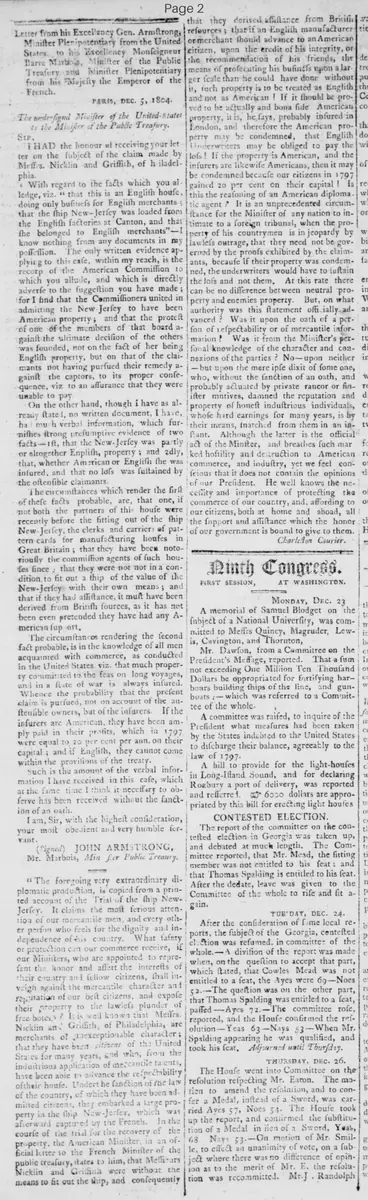
In a 1804 letter from Paris, US Minister John Armstrong questions the American ownership of the captured ship New-Jersey, claimed by Philadelphia merchants Nicklin and Griffith, suggesting English ties and insurance coverage. A Charleston Courier commentary condemns this as damaging to US commerce and dignity.
Clipping
OCR Quality
Full Text
Minister Plenipotentiary from the United
States, to his Excellency Monseigneur
Barbé Marbois, Minister of the Public
Treasury and Minister Plenipotentiary
from his Majesty the Emperor of the
French.
PARIS, DEC. 5, 1804.
The undersigned Minister of the United States
to the Minister of the Public Treasury.
SIR,
I had the honour of receiving your letter on the subject of the claim made by
Messrs. Nicklin and Griffith, of Philadelphia.
With regard to the facts which you allege, viz. "that this is an English house,
doing only business for English merchants,
that the ship New-Jersey was loaded from
the English factories at Canton, and that
she belonged to English merchants"—I
know nothing from any documents in my
possession. The only written evidence applying to this case, within my reach, is the
report of the American Commission to
which you allude, and which is directly
adverse to the suggestion you have made;
for I find that the Commissioners united in
admitting the New-Jersey to have been
American property; and that the protest
of one of the members of that board against the ultimate decision of the others
was founded, not on the fact of her being
English property, but on that of the claimants not having pursued their remedy against the captors, to its proper consequence, viz to an assurance that they were
unable to pay
On the other hand, though I have, as already stated, no written document, I have,
much verbal information, which furnishes strong presumptive evidence of two
facts—1st, that the New-Jersey was partly
or altogether English property; and 2dly,
that, whether American or English she was
insured, and that no loss was sustained by
the ostensible claimants.
The circumstances which render the first
of these facts probable, are, that one, if
not both the partners of this house were
recently before the fitting out of the ship
New-Jersey, the clerks and carriers of pattern cards for manufacturing houses in
Great Britain; that they have been notoriously the commission agents of such houses since; that they were not in a condition, to fit out a ship of the value of the
New-Jersey with their own means; and
that if they had assistance, it must have been derived from British sources, as it has not been even pretended they have had any American support.
The circumstances rendering the second
fact probable, is in the knowledge of all men acquainted with commerce, as conducted in the United States viz. that much property committed to the seas on long voyages,
and in a state of war is always insured.
Whence the probability that the present
claim is pursued, not on account of the ostensible owners, but of the insurers. If the
insurers are American, they have been amply paid in their profits, which in 1797
were equal to 20 per cent per ann. on their
capital; and if English, they cannot come
within the provisions of the treaty.
Such is the amount of the verbal information I have received in this case, which
at the same time I think it necessary to observe has been received without the sanction of an oath.
I am, Sir, with the highest consideration,
your most obedient and very humble servant.
(Signed) JOHN ARMSTRONG.
Mr. Marbois, Minister of Public Treasury.
The foregoing very extraordinary diplomatic production, is copied from a printed account of the Trial of the ship New-
Jersey. It claims the most serious attention of our mercantile men, and every other person who feels for the dignity and independence of his country. What safety
or protection can our commerce receive, if
our Ministers, who are appointed to represent the honor and assert the interests of
their country and fellow citizens, shall inveigh against the mercantile character and
reputation of our best citizens, and expose
their property to the lawless plunder of
freebooters? It is well known that Messrs.
Nicklin and Griffith, of Philadelphia, are
merchants of unexceptionable character;
that they have been citizens of the United
States for many years, and who, from the
industrious application of mercantile talents, have been able to advance the respectability of their house. Under the sanction of the laws of the country, of which they have been admitted citizens, they embarked a large property in the ship New-Jersey, which was afterward captured by the French. In the course of the trial for the recovery of the property, the American Minister, in an official letter to the French Minister of the public treasury, states to him, that Messrs. Nicklin and Griffith were without the
means to fit out the ship, and consequently
that they derived assistance from British
resources; that if an English manufacturer
or merchant house should advance to an American citizen, upon the credit of his integrity, or the recommendation of his friends, the means of prosecuting his business upon a larger scale than he could have done without it, such property is to be treated as English and not as American! If it should be proved to be actually and bona fide American property, it is, he says, probably insured in London, and therefore the American property may be condemned, that English Underwriters may be obliged to pay the loss! If the property is American, and the insurers are likewise Americans, then it may be condemned because our citizens in 1797 gained 20 per cent on their capital! Is this the reasoning of an American diplomatic agent? It is an unprecedented circumstance for the Minister of any nation to intimate to a foreign tribunal, when the property of his countrymen is in jeopardy by lawless outrage, that they need not be governed by the proofs exhibited by the claimants, because if their property was condemned, the underwriters would have to sustain the loss and not them. At this rate there can be no difference between neutral property and enemies property. But, on what authority was this statement officially advanced? Was it upon the oath of a person of respectability or of mercantile information? Was it from the Minister's personal knowledge of the character and connexions of the parties? No—upon neither—but upon the mere ipse dixit of some one who, without the sanction of an oath, and probably actuated by private rancor or sinister motives, damned the reputation and property of honest industrious individuals, whose hard earnings for many years, is by their means, snatched from them in an instant. Although the latter is the official act of the Minister, and breathes such marked hostility and destruction to American commerce, and industry, yet we feel conscious that it does not contain the opinions of our President. He well knows the necessity and importance of protecting the commerce of our country, and, affording to our citizens, both at home and abroad, all the support and assistance which the honor of our government is bound to give to them.
Charleton Courier.
What sub-type of article is it?
What keywords are associated?
What entities or persons were involved?
Where did it happen?
Foreign News Details
Primary Location
Paris
Event Date
1804 12 05
Key Persons
Outcome
ship new-jersey captured by french; claim disputed based on alleged english ownership and insurance
Event Details
US Minister Armstrong writes to French Minister Marbois questioning the American ownership of the ship New-Jersey claimed by Philadelphia merchants Nicklin and Griffith, citing verbal information suggesting English ties and insurance, contrary to commission report. Commentary in Charleston Courier criticizes the letter as undermining US merchants and commerce.