Thank you for visiting SNEWPapers!
Sign up free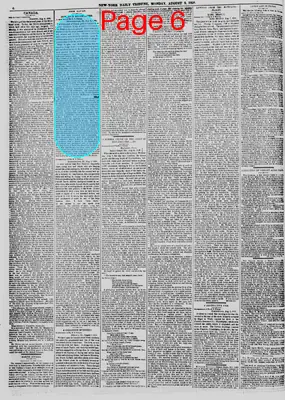
Domestic News
August 9, 1858
New York Daily Tribune
New York, New York County, New York
What is this article about?
On Aug. 2, 1858, Senator Stephen Douglas spoke to about 5,000-6,000 people in Hillsborough, Illinois, reiterating anti-negro equality arguments and criticizing Lincoln and Republicans. The speech drew mixed, mostly disappointed reactions.
Clipping
OCR Quality
95%
Excellent
Full Text
DOUGLAS IN HILLSBOROUGH.
Correspondence of The N. Y. Tribune.
Hillsborough, Ill., Aug. 2, 1858.
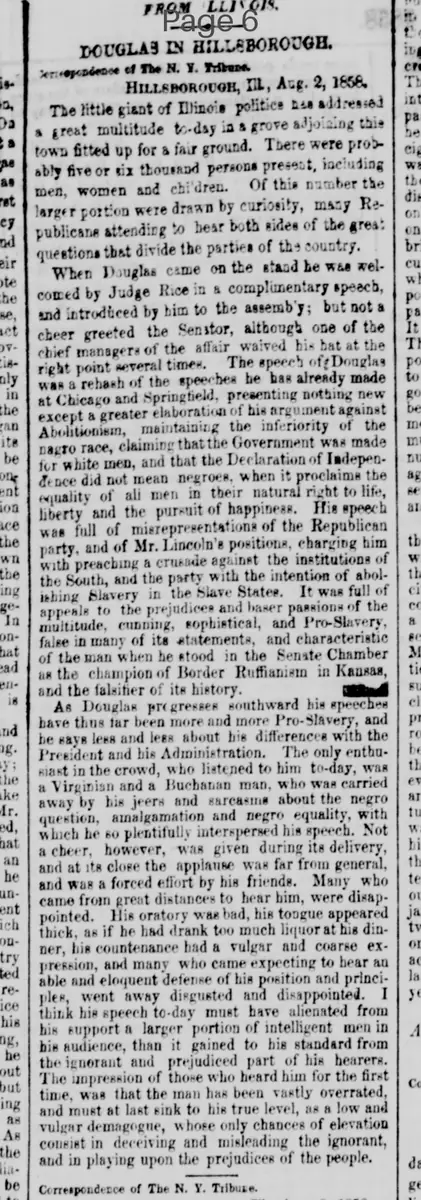
The little giant of Illinois politics addressed a great multitude to-day in a grove adjoining this town fitted up for a fair ground. There were probably five or six thousand persons present, including men, women and children. Of this number the larger portion were drawn by curiosity, many Republicans attending to hear both sides of the great questions that divide the parties of the country.
When Douglas came on the stand he was welcomed by Judge Rice in a complimentary speech, and introduced by him to the assembly; but not a cheer greeted the Senator, although one of the chief managers of the affair waved his hat at the right point several times. The speech of Douglas was a rehash of the speeches he has already made at Chicago and Springfield, presenting nothing new except a greater elaboration of his argument against negro equality, claiming that the Government was made for white men, and that the Declaration of Independence did not mean negroes, when it proclaims the equality of all men in their natural right to life, liberty and the pursuit of happiness. His speech was full of misrepresentations of the Republican party, and of Mr. Lincoln's positions, charging him with preaching a crusade against the institutions of the South, and the party with the intention of abolishing Slavery in the Slave States. It was full of appeals to the prejudices and baser passions of the multitude, cunning, sophistical, and Pro-Slavery, false in many of its statements, and characteristic of the man when he stood in the Senate Chamber as the champion of Border Ruffianism in Kansas, and the falsifier of its history.
As Douglas progresses southward his speeches have thus far been more and more Pro-Slavery, and he says less and less about his differences with the President and his Administration. The only enthusiast in the crowd, who listened to him to-day, was a Virginian and a Buchanan man, who was carried away by his jeers and sarcasms about the negro question, amalgamation and negro equality, with which he so plentifully interspersed his speech. Not a cheer, however, was given during its delivery, and at its close the applause was far from general, and was a forced effort by his friends. Many who came from great distances to hear him, were disappointed. His oratory was bad, his tongue appeared thick, as if he had drank too much liquor at his dinner, his countenance had a vulgar and coarse expression, and many who came expecting to hear an able and eloquent defense of his position and principles, went away disgusted and disappointed. I think his speech to-day must have alienated from his support a larger portion of intelligent men in his audience, than it gained to his standard from the ignorant and prejudiced part of his hearers. The impression of those who heard him for the first time, was that the man has been vastly overrated, and must at last sink to his true level, as a low and vulgar demagogue, whose only chances of elevation consist in deceiving and misleading the ignorant, and in playing upon the prejudices of the people.
Correspondence of The N. Y. Tribune.
Hillsborough, Ill., Aug. 2, 1858.
The little giant of Illinois politics addressed a great multitude to-day in a grove adjoining this town fitted up for a fair ground. There were probably five or six thousand persons present, including men, women and children. Of this number the larger portion were drawn by curiosity, many Republicans attending to hear both sides of the great questions that divide the parties of the country.
When Douglas came on the stand he was welcomed by Judge Rice in a complimentary speech, and introduced by him to the assembly; but not a cheer greeted the Senator, although one of the chief managers of the affair waved his hat at the right point several times. The speech of Douglas was a rehash of the speeches he has already made at Chicago and Springfield, presenting nothing new except a greater elaboration of his argument against negro equality, claiming that the Government was made for white men, and that the Declaration of Independence did not mean negroes, when it proclaims the equality of all men in their natural right to life, liberty and the pursuit of happiness. His speech was full of misrepresentations of the Republican party, and of Mr. Lincoln's positions, charging him with preaching a crusade against the institutions of the South, and the party with the intention of abolishing Slavery in the Slave States. It was full of appeals to the prejudices and baser passions of the multitude, cunning, sophistical, and Pro-Slavery, false in many of its statements, and characteristic of the man when he stood in the Senate Chamber as the champion of Border Ruffianism in Kansas, and the falsifier of its history.
As Douglas progresses southward his speeches have thus far been more and more Pro-Slavery, and he says less and less about his differences with the President and his Administration. The only enthusiast in the crowd, who listened to him to-day, was a Virginian and a Buchanan man, who was carried away by his jeers and sarcasms about the negro question, amalgamation and negro equality, with which he so plentifully interspersed his speech. Not a cheer, however, was given during its delivery, and at its close the applause was far from general, and was a forced effort by his friends. Many who came from great distances to hear him, were disappointed. His oratory was bad, his tongue appeared thick, as if he had drank too much liquor at his dinner, his countenance had a vulgar and coarse expression, and many who came expecting to hear an able and eloquent defense of his position and principles, went away disgusted and disappointed. I think his speech to-day must have alienated from his support a larger portion of intelligent men in his audience, than it gained to his standard from the ignorant and prejudiced part of his hearers. The impression of those who heard him for the first time, was that the man has been vastly overrated, and must at last sink to his true level, as a low and vulgar demagogue, whose only chances of elevation consist in deceiving and misleading the ignorant, and in playing upon the prejudices of the people.
What sub-type of article is it?
Politics
What keywords are associated?
Douglas Speech
Hillsborough
Illinois Politics
Slavery Debate
Republican Party
What entities or persons were involved?
Douglas
Judge Rice
Mr. Lincoln
Where did it happen?
Hillsborough, Ill.
Domestic News Details
Primary Location
Hillsborough, Ill.
Event Date
Aug. 2, 1858
Key Persons
Douglas
Judge Rice
Mr. Lincoln
Event Details
Stephen Douglas addressed a crowd of five or six thousand in a grove near Hillsborough, introduced by Judge Rice. His speech rehashed previous arguments against negro equality, misrepresented Republican positions and Lincoln's views, and appealed to prejudices. The audience response was muted, with disappointment among many listeners.