Thank you for visiting SNEWPapers!
Sign up free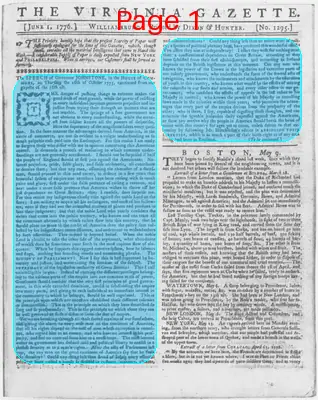
The Virginia Gazette
Richmond, Williamsburg, Richmond County, Virginia
What is this article about?
Governor Johnstone's speech in the House of Commons on October 26, 1775, criticizes British coercive policies toward America, arguing for constitutional dependence and warning against destroying the empire's system over false pretenses of revenue and independence.
Merged-components note: Image overlaps spatially with the speech text (bbox overlap in y and x coordinates), indicating it is part of the same component, likely an illustration or masthead related to the content. Relabeled from 'story' to 'foreign_news' as this is a report of a speech in the British House of Commons regarding the American colonies, fitting international reports.
Clipping
OCR Quality
Full Text
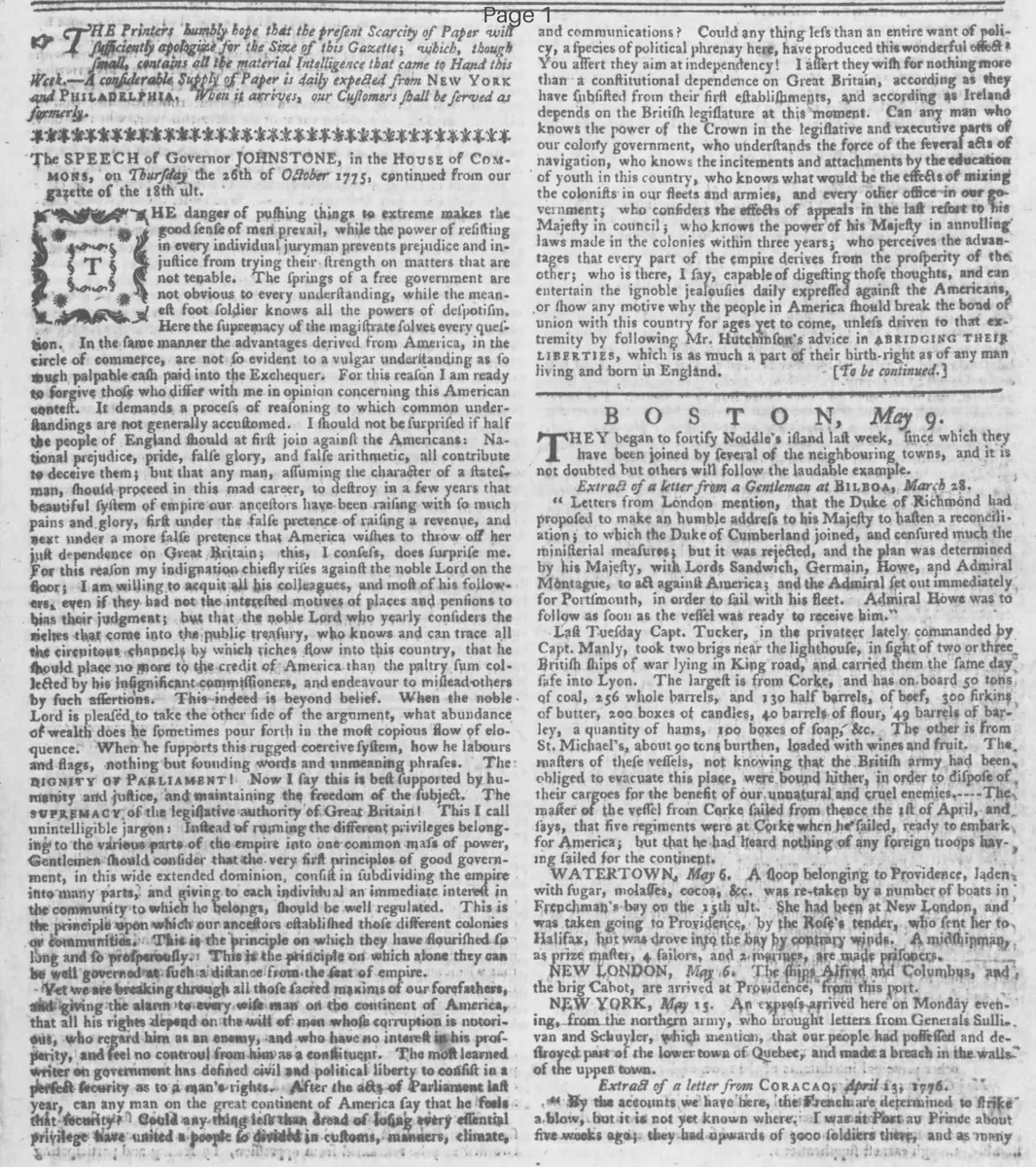
The danger of pushing things to extreme makes the good sense of men prevail, while the power of resisting in every individual juryman prevents prejudice and injustice from trying their strength on matters that are not tenable. The springs of a free government are not obvious to every understanding, while the meanest foot soldier knows all the powers of despotism.
Here the supremacy of the magistrate solves every question. In the same manner the advantages derived from America, in the circle of commerce, are not so evident to a vulgar understanding as so much palpable cash paid into the Exchequer. For this reason I am ready to forgive those who differ with me in opinion concerning this American contest. It demands a process of reasoning to which common understandings are not generally accustomed. I should not be surprised if half the people of England should at first join against the Americans: National prejudice, pride, false glory, and false arithmetic, all contribute to deceive them; but that any man, assuming the character of a statesman, should proceed in this mad career, to destroy in a few years that beautiful system of empire our ancestors have been raising with so much pains and glory, first under the false pretence of raising a revenue, and next under a more false pretence that America wishes to throw off her just dependence on Great Britain; this, I confess, does surprise me.
For this reason my indignation chiefly rises against the noble Lord on the floor; I am willing to acquit all his colleagues, and most of his followers, even if they had not the interested motives of places and pensions to bias their judgment; but that the noble Lord who yearly considers the revenues that come into the public treasury, who knows and can trace all the circuitous channels by which riches flow into this country, that he should place no more to the credit of America than the paltry sum collected by his insignificant commissioners, and endeavour to mislead others by such assertions. This indeed is beyond belief. When the noble Lord is pleased to take the other side of the argument, what abundance of wealth does he sometimes pour forth in the most copious flow of eloquence. When he supports this rugged coercive system, how he labours and flags, nothing but sounding words and unmeaning phrases. The DIGNITY OF PARLIAMENT! Now I say this is best supported by humanity and justice, and maintaining the freedom of the subject. The SUPREMACY of the legislative authority of Great Britain! This I call unintelligible jargon: Instead of running the different privileges belonging to the various parts of the empire into one common mass of power, Gentlemen should consider that the very first principles of good government, in this wide extended dominion, consist in subdividing the empire into many parts, and giving to each individual an immediate interest in the community to which he belongs, should be well regulated. This is the principle upon which our ancestors established those different colonies or communities. This is the principle on which they have flourished so long and so prosperously. This is the principle on which alone they can be well governed at such a distance from the seat of empire.
Yet we are breaking through all those sacred maxims of our forefathers, and giving the alarm to every wise man on the continent of America, that all his rights depend on the will of men whose corruption is notorious, who regard him as an enemy, and who have no interest in his prosperity, and feel no controul from him as a constituent. The most learned writer on government has defined civil and political liberty to consist in a perfect security as to a man's rights. After the acts of Parliament last year, can any man on the great continent of America say that he feels that security? Could any thing less than dread of losing every essential privilege have united a people so divided in customs, manners, climate, and communications? Could any thing less than an entire want of policy, a species of political phrenzy here, have produced this wonderful effect?
You assert they aim at independency! I assert they wish for nothing more than a constitutional dependence on Great Britain, according as they have subsisted from their first establishments, and according as Ireland depends on the British legislature at this moment. Can any man who knows the power of the Crown in the legislative and executive parts of our colony government, who understands the force of the several acts of navigation, who knows the incitements and attachments by the education of youth in this country, who knows what would be the effects of mixing the colonists in our fleets and armies, and every other office in our government; who considers the effects of appeals in the last resort to his Majesty in council; who knows the power of his Majesty in annulling laws made in the colonies within three years; who perceives the advantages that every part of the empire derives from the prosperity of the other; who is there, I say, capable of digesting those thoughts, and can entertain the ignoble jealousies daily expressed against the Americans, or show any motive why the people in America should break the bond of union with this country for ages yet to come, unless driven to that extremity by following Mr. Hutchinson's advice in ABRIDGING THEIR LIBERTIES, which is as much a part of their birth-right as of any man living and born in England.
—[To be continued.]
What sub-type of article is it?
What keywords are associated?
What entities or persons were involved?
Where did it happen?
Foreign News Details
Primary Location
America
Event Date
1775 10 26
Key Persons
Event Details
Governor Johnstone delivers a speech in the House of Commons criticizing British coercive policies toward America, arguing that the colonies seek only constitutional dependence, not independence, and warning that current measures threaten the empire's structure and the colonists' liberties.