Thank you for visiting SNEWPapers!
Sign up free
Lincoln County Leader
Toledo, Lincoln County, Oregon
What is this article about?
Historical overview of Lincoln County, Oregon, created in 1854, detailing its geography, resources like bays, rivers, fertile lands, timber, coal, and towns such as Toledo and Newport. Promotes settlement opportunities, dairying, and future development including the Siletz Reservation.
Clipping
OCR Quality
Full Text
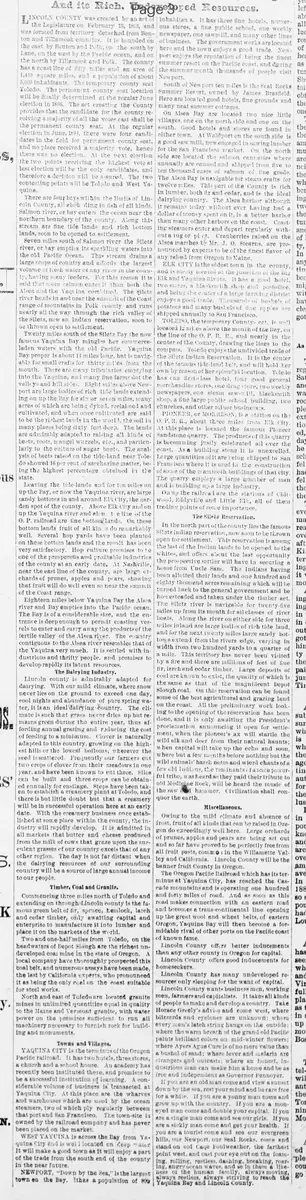
There are four bays within the limits of Lincoln County, all abounding in fish of all kinds. Salmon river, or bay enters the ocean near the northern boundary of the county. Along this stream are fine tide lands and rich bottom lands, soon to be opened to settlement.
Seven miles south of Salmon river the Siletz river, or bay empties its sparkling waters into the old Pacific Ocean. This stream drains a large scope of country and affords the largest volume of fresh water of any river in the county, having many feeders. For this reason it is said that more salmon enter it than both the Alsea and the Yaquina combined. The Siletz river heads in and near the summit of the Coast range of mountains in Polk County and runs nearly all the way through the rich valley of the Siletz, now an Indian reservation, soon to be thrown open to settlement.
Twenty miles south of the Siletz Bay the now famous Yaquina Bay mingles her commerce-laden waters with the old Pacific. Yaquina Bay proper is about 4 miles long, but is navigable for small crafts for thirty miles from the mouth. There are many tributaries emptying into the Yaquina, and many fine farms dot the valleys and hill sides. Eight miles above Newport are large bodies of rich tide lands extending on up the Bay for six or seven miles, many acres of which are being dyked, reclaimed and cultivated, and when once cultivated are said to be the richest lands in the world, the soil in many places being sixty feet deep. The lands are admirably adapted to raising all kinds of beets, roots, mangel wurzels, etc., and particularly to the culture of sugar beet. The analysis of beets raised on the tide-land near Toledo showed 16 per cent of saccharine matter, being the highest percentage obtained in the state.
Leaving the tide-lands and for ten miles on up the Bay, or now the Yaquina river, are large sandy bottoms in and around Elk City, the garden spot of the county. Above Elk City and on up the Yaquina river and along the line of the O. P. railroad are fine bottom lands. On these bottom lands fruit of all kinds do remarkably well. Several hop yards have been planted on these bottom lands and the result has been very satisfactory. Hop culture promises to be one of the prosperous and profitable industries of the county at an early date. At Nashville, near the east line of the county, are large orchards of prunes, apples and pears, showing that fruit will do well even so near the summit of the Coast range.
Eighteen miles below Yaquina Bay the Alsea river and Bay empties into the Pacific ocean. The Bay is of a considerable size, and the entrance is deep enough to permit coasting vessels to enter and carry away the products of the fertile valley of the Alsea river. The country contiguous to the Alsea river resembles that of the Yaquina very much. It is settled with industrious and thrifty people, and promises to develop rapidly its latent resources.
Lincoln county is admirably adapted for the Dairying Industry. With our mild climate, where snow never lies on the ground to exceed one day, cool nights and abundance of pure spring water, it is an ideal dairying Country. The climate is such that grass never dries up but remains green during the entire year, thus affording annual grazing and reducing the cost of feeding to a minimum. Clover is naturally adapted to this country, growing on the highest hills or the lowest bottoms, wherever the seed is scattered. Frequently our farmers cut two crops of clover from their meadows in one year, and have been known to cut three. Silos can be built and three crops can be obtained annually for ensilage. Steps have been taken to establish a creamery plant at Toledo, and there is but little doubt but that a creamery will be in successful operation here at an early date. With the creamery business once established at some place within the county, the industry will rapidly develop. It is admitted in all markets that butter and cheese produced from the milk of cows that graze upon the succulent grasses of our country excels that of any other region. The day is not far distant when the dairying resources of our surrounding country will be a source of large annual income to our people.
Commencing three miles north of Toledo and extending on through Lincoln county is the famous green belt of fir, spruce, hemlock, larch and cedar timber, only awaiting capital and enterprise to manufacture it into lumber and place it on the markets of the world.
Two and one-half miles from Toledo, on the headwaters of Depot Slough are the richest undeveloped coal mine in the state of Oregon. A local company have thoroughly prospected this coal belt, and numerous assays have been made the last by California experts, who pronounced it as being the only coal on the coast suitable for steel works.
North and east of Toledo are located granite mines in unlimited quantities equal in quality to the Maine and Vermont granite, with water power on the premises sufficient to run all machinery necessary to furnish rock for building and monuments.
YAQUINA CITY is the terminus of the Oregon Pacific railroad. It has two hotels, three stores, a church and a school house. An academy has recently been instituted there, and promises to be a successful institution of learning. A considerable volume of business is transacted at Yaquina City. At this place are the wharves and warehouses which are used by the ocean steamers, two of which ply regularly between that port and San Francisco. The town-site is owned by the railroad company and has never been placed on the market.
WEST YAQUINA is across the Bay from Yaquina City and is well located on deep water. It will make a good town as it will enjoy a part of the trade from the south end of the county in the near future.
NEWPORT, "Down by the Sea," is the largest town on the Bay. It has a population of 800 inhabitants. It has three fine hotels, numerous stores, a fine public school, one weekly newspaper, one sawmill, and many other lines of business. The government works are located here and the town enjoys a good trade. Newport enjoys the reputation of being the finest summer resort on the Pacific coast, and during the summer months thousands of people visit Newport.
South of Newport ten miles is the Seal Rocks Summer Resort, owned by James Brasfield. Here are located good hotels, fine grounds and many neat summer cottages.
On Alsea Bay are located two nice little villages, one on the north side and one on the south. Good hotels and stores are found in either town. At Waldport on the south side is a good saw mill, now engaged in sawing lumber for the San Francisco market. On the north side are located the salmon canneries where annually are canned and shipped from five to ten thousand cases of salmon of fine grade. The Alsea Bay is navigable for steam crafts for twelve miles. This part of the County is rich in lumber, both fir and cedar, and is the ideal dairying country. The Alsea harbor although it remains today without ever having had a dollar of money spent on it, is a better harbor than many other harbors on the coast. Coasting steamers enter and depart regularly without a tug or pilot. Cranberries raised on the Alsea marshes by Mr. J. O. Stearns, are pronounced by experts to be of the finest flavor of any raised from Oregon to Maine.
ELK CITY is the oldest town in the county, and is nicely located at the junction of the big Elk and Yaquina Rivers. It has a good hotel, two stores, a blacksmith shop and postoffice, and being the center of a large farming district enjoys a good trade. Thousands of bushels of potatoes and many bushels of fine apples are shipped annually to San Francisco.
TOLEDO, the temporary County seat, is well located 12 miles above the mouth of the Bay, on the line of the O. P. R. R., and nearly in the center of the County, drawing the lines to the compass. Toledo enjoys the undivided trade of the Siletz Indian Reservation. It is the center of the famous tide-land belt, and will hold her own by reason of her splendid location. Toledo has one first-class hotel, four good general merchandise stores, one drug store, two weekly newspapers, one steam saw-mill, blacksmith shop, a fine large public school building, two churches, and other minor businesses.
PIONEER, or MORRISON, is a station on the O. P. R. R., about three miles from Elk City. At this place is located the famous Pioneer Sandstone quarry. The products of this quarry is becoming justly celebrated all over the coast. As a building stone it is unexcelled. Large quantities of it are being shipped to San Francisco where it is used in the construction of some of the mammoth buildings of that city. The quarry employs a large number of men and is building up a large industry.
On up the railroad are the stations of Chitwood, Eddyville and Little Elk, all of them trading points of some importance.
The Siletz Reservation.
In the north part of the county lies the famous Siletz Indian reservation, now soon to be thrown open for settlement. This reservation is among the last of the Indian lands to be opened to the whites, and offers about the last opportunity the prospective settler will have in securing a home from Uncle Sam. The Indians having been allotted their lands and one hundred and eighty thousand acres remaining which will be turned back to the general government and be homesteaded and taken under the timber act. The Siletz river is navigable for twenty-five miles up from its mouth for all classes of river boats. Along the river on either side for three miles inland are large bodies of rich tide land, and for the next twenty miles large sandy bottoms extend from the rivers edge, varying in width from two hundred yards to a quarter of a mile. This territory has never been visited by a fire and there are millions of feet of fine fir, larch and cedar timber. Large deposits of coal are known to exist, the quality of which is the same as that of the magnificent Depot Slough coal. On this reservation can be found some of the best agricultural and grazing land on the coast. All the preliminary work looking to the opening of the reservation has been done, and it is only awaiting the President's proclamation announcing it open for settlement, when the pioneer's ax will startle the wild elk and deer from their natural haunts; when capital will take up the echo and soon, where but a few months before nothing but the wild animals' harsh notes and weird chants of a few old Indians, the remnants of a once powerful tribe, was heard as they paid their tribute to old Medicine Rock, will be heard the music of the saw and hammer. Civilization shall conquer the earth.
Miscellaneous.
Owing to the mild climate and absence of frost, fruit of all kinds that can be raised in Oregon do exceedingly well here. Large orchards of prunes, apples and pears are being set out and so far have proved to be perfectly free from all fruit pests, common in the Willamette Valley and California. Lincoln County will be the banner fruit County in Oregon.
The Oregon Pacific Railroad which has its terminus at Yaquina City, has reached the Cascade mountains and is operating one hundred and forty miles of road. And as soon as this road makes connection with an eastern road and becomes a trans-continental line opening up the great wool and wheat belts of eastern Oregon, Yaquina Bay will then become a formidable rival of other ports on the Pacific coast of known fame.
Lincoln County offers better inducements than any other county in Oregon for capital. Lincoln County offers good inducements for homeseckers. Lincoln County has many undeveloped resources only sleeping for the want of capital. Lincoln County wants business men, working men, farmers and capitalists. It takes all kinds of people to make and develop a country. Take Horace Greeley's advice and come west, where blizzards and cyclones are unknown; where every man's latch string hangs on the outside; where the warm breath of the grand old Pacific paints brilliant colors on mid-winter flowers; where Ayer's Ague Cure is of no more value than a bushel of sand; where fever and malaria are strangers and outcasts; where an honest, industrious man can make him a home and be as free and independent as Governor Pennoyer.
If you are an old man come and view a sunset down by the sea, rest your mind and be care free for a while. If you are a young man come and grow up with the country. If you are a moneyed man come and double your capital. If you are a single man come and see our girls. If you are a sickly man come and get your health. If you are a tourist come and see our evergreen hills, our Newport, our Seal Rocks, come and stand on old Cape Foulweather, the farthest point west, and cast your eye out on the foaming, rolling, restless, dashing, breaking, roaring, angry ocean waves, and see in them a likeness of the human family, always moving, always restless, always striving to reach the Yaquina Bay and Lincoln County.
What sub-type of article is it?
What themes does it cover?
What keywords are associated?
Where did it happen?
Story Details
Location
Lincoln County, Oregon
Event Date
February 13, 1854
Story Details
Lincoln County was created in 1854 from Benton and Tillamook counties, with boundaries including the Pacific Ocean. It features bays, rivers, fertile lands, timber, coal, and dairying potential. Towns like Toledo, Newport, and Yaquina City are described, along with the Siletz Indian Reservation soon to open for settlement. The text promotes the county's resources and invites settlers.