Thank you for visiting SNEWPapers!
Sign up free
Literary
March 3, 1842
Lincoln Telegraph
Bath, Sagadahoc County, Maine
What is this article about?
This essay describes the stages of pulmonary consumption (tuberculosis): crudity of tubercles, softening, and ulceration. It details symptoms like cough, expectoration, fever, emaciation, and variations in progression, emphasizing physical signs and patient experiences.
Merged-components note: Continuation of medical essay on consumption across pages; labeled as literary essay
Clippings
1 of 2
OCR Quality
95%
Excellent
Full Text
FOR THE TELEGRAPH.
CONSUMPTION.
NO. TWO.
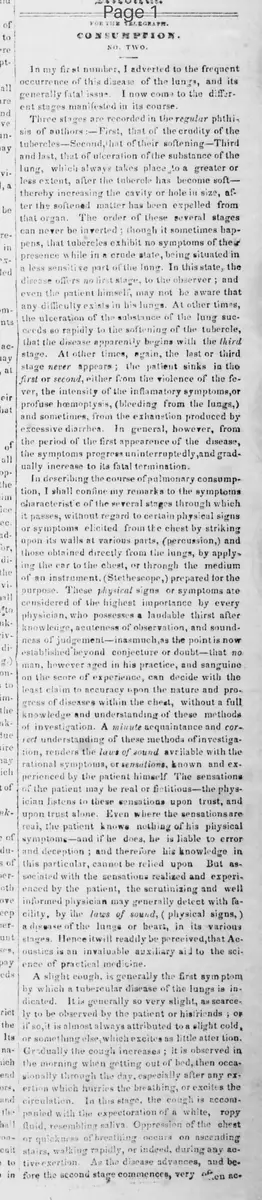
In my first number, I adverted to the frequent occurrence of this disease of the lungs, and its generally fatal issue. I now come to the different stages manifested in its course.
Three stages are recorded in the regular phthisis of authors:—First, that of the crudity of the tubercles—Second, that of their softening—Third and last, that of ulceration of the substance of the lung, which always takes place to a greater or less extent, after the tubercle has become soft—thereby increasing the cavity or hole in size, after the softened matter has been expelled from that organ. The order of these several stages can never be inverted; though it sometimes happens, that tubercles exhibit no symptoms of their presence while in a crude state, being situated in a less sensitive part of the lung. In this state, the disease offers no first stage, to the observer; and even the patient himself, may not be aware that any difficulty exists in his lungs. At other times, the ulceration of the substance of the lung succeeds so rapidly to the softening of the tubercle, that the disease apparently begins with the third stage. At other times, again, the last or third stage never appears; the patient sinks in the first or second, either from the violence of the fever, the intensity of the inflammatory symptoms, or profuse hæmoptysis, (bleeding from the lungs,) and sometimes, from the exhaustion produced by excessive diarrhœa. In general, however, from the period of the first appearance of the disease, the symptoms progress uninterruptedly, and gradually increase to its fatal termination.
In describing the course of pulmonary consumption, I shall confine my remarks to the symptoms characteristic of the several stages through which it passes, without regard to certain physical signs or symptoms elicited from the chest by striking upon its walls at various parts, (percussion,) and those obtained directly from the lungs, by applying the ear to the chest, or through the medium of an instrument (Stethoscope,) prepared for the purpose. These physical signs or symptoms are considered of the highest importance by every physician, who possesses a laudable thirst after knowledge, acuteness of observation, and soundness of judgement—inasmuch, as the point is now established beyond conjecture or doubt—that no man, however aged in his practice, and sanguine on the score of experience, can decide with the least claim to accuracy upon the nature and progress of diseases within the chest, without a full knowledge and understanding of these methods of investigation. A minute acquaintance and correct understanding of these methods of investigation, renders the laws of sound available with the rational symptoms, or sensations, known and experienced by the patient himself. The sensations of the patient may be real or fictitious—the physician listens to these sensations upon trust, and upon trust alone. Even where the sensations are real, the patient knows nothing of his physical symptoms—and if he does, he is liable to error and deception; and therefore his knowledge in this particular, cannot be relied upon. But associated with the sensations realized and experienced by the patient, the scrutinizing and well informed physician may generally detect with facility, by the laws of sound, (physical signs,) a disease of the lungs or heart, in its various stages. Hence it will readily be perceived, that Acoustics is an invaluable auxiliary aid to the science of practical medicine.
A slight cough, is generally the first symptom by which a tubercular disease of the lungs is indicated. It is generally so very slight, as scarcely to be observed by the patient or his friends; or if so, it is almost always attributed to a slight cold, or something else, which excites as little attention. Gradually the cough increases; it is observed in the morning when getting out of bed, then occasionally through the day, especially after any exertion which hurries the breathing, or excites the circulation. In this stage, the cough is accompanied with the expectoration of a white, ropy fluid, resembling saliva. Oppression of the chest or quickness of breathing occurs on ascending stairs, walking rapidly, or indeed, during any active exertion. As the disease advances, and before the second stage commences, very often ac—
When active bleeding from the lungs takes place, acute pains are felt between the shoulders, under the right or left shoulder blade, or in one, or both sides. To these symptoms are added more or less derangement of the general system. The pulse becomes accelerated, and an alteration in the temperature of the body is noticed, particularly the hands and feet. Towards evening, and sometimes in the early part of the day, there is often experienced a slight chillness, followed by some heat of the skin—more especially the palms of the hands, and the soles of the feet. A clammy, greasy perspiration, confined principally to the chest, often takes place in the latter part of the night, or towards morning. The appetite is generally somewhat diminished, the countenance is paler than usual, and subject to frequent changes. The patient is languid; often complains of laziness, and feels little inclined to bodily or mental exertion. The skin loses its natural elastic feel, and emaciation commences slowly, but progressively. The sleep is unsound, being often disturbed by unpleasant dreams, and the morning brings with it little refreshment and vigor.
Such, then, are the most important symptoms presented to the observer, in the first stage of consumption—subject, however, to many changes and modifications. These symptoms may continue for a considerable length of time, varying in intensity, according to various circumstances. Emerging from a cold and cheerless winter, the soft and invigorating influence of a Spring and Summer atmosphere, will often impart new energy to the system, and an amendment of the general health of the patient will ensue frequently to such an extent, as to lead him and his friends to think the danger is past. But the change of the season, generally arouses the sleeping hydra to redoubled activity; all the former symptoms return with increased intensity, and the second stage of the disease is soon made apparent.
This stage is indicated by a remarkable change in the character of the expectoration. The curdles, before in a crude or hard state, are now softened, and the matter begins to be expectorated, leaving a cavity in the lung, proportionate to the size of the softened tubercle. In this stage, the symptoms characteristic of the first, are increased in degree. The cough is more frequent and harassing, the morning and evening paroxysms are longer, the sleep is disturbed, and sometimes even a change of posture in bed, will excite a fit of coughing, almost to suffocation. The expectoration is confined, more generally to the morning paroxysms of coughing. The before colorless, ropy or frothy fluid raised from the lungs, now assumes a yellowish green, and sometimes greyish color—often streaked with blood, with more or less of a fluid resembling in appearance and color, the white of an egg. The commencement of this expectoration most always affords considerable relief to the patient, from the ease with which he is enabled to free his lungs from the oppressive weight, characteristic of the first stage. After a continuance of this purulent expectoration for a few days, it not unfrequently happens that a subsidence takes place in many of the most prominent symptoms, particularly the expectoration, owing to the ejection of most of the softened tuberculous matter—giving fresh hopes to the patient, and a phase in the course of the malady illustrative of the popular notion, that 'consumption is a flattering disease.'
This state of things, however, does not last long; other tubercles become softened and an increase of expectoration is the result. The symptoms again augment—the cough becomes more frequent, the oppression and difficulty of breathing are increased; the pains about the chest, which before seemed to be rheumatic, are now more acute, amounting almost, at times, to pleuritic suffering. The chills are more severe,—the succeeding heat of the skin greater, followed by a more general and abundant perspiration. The pulse is, at all times, accelerated—a circumscribed flush may be observed upon one or both cheeks in the latter part of the day, and the respiration is hurried, even when the patient is at rest.
In this stage, the condition of the bowels is variable; sometimes obstinate costiveness prevails, at others, costiveness alternates with diarrhea, while in the majority of cases, diarrhea more or less profuse and continuous, prostrates more rapidly the flagging powers of the system. Shooting pains are felt in the bowels, and oftentimes a degree of jarring and soreness are felt when stepping. The soreness is felt more especially, in one or both sides of the abdomen (generally in the right) when pressed upon. In females, the monthly periods are almost always deranged but more generally wholly suspended. Emaciation goes on progressively; but occasionally an amelioration takes place in many of the most prominent symptoms, as if a relaxation of the disease had taken place, that it might gather new strength for the conflict.
The length of time during which a patient may continue in this state, varies greatly; a few weeks in some cases, will prostrate the most vigorous frame, while in others, many months, or even years, may pass without much increase or diminution of the symptoms; and in a small proportion of cases, a curative process takes place, and proceeds to a partial or entire restoration of the patient.
The third and last stage of the disease is generally, of short duration, from which a patient seldom, and perhaps never recovers. This stage seems to be nothing more than an augmentation of all the symptoms characteristic of the second; the perspiration is more copious: the diarrheic discharges more frequent and liquid; the expectoration is more abundant; the breathing more hurried and oppressed, and the cough becomes more distressing during the night. The emaciation and debility generally, keep pace with above symptoms; and with the loss of strength, the faculties of the mind generally, undergo a corresponding diminution. The feet and ankles become swollen, and lastly a cankered or aphthous state of the mouth takes place, which is a sure precursor of speedy dissolution.
Although conscious of the fatal nature of his disease, the patient seldom abandons all hope of recovery; but generally until his last hours, or until delirium has bereft him of a consciousness of his condition, the consumptive clings to life with all the ardor of a condemned criminal who hopes for reprieve, until the last moment of his earthly existence.
This, however, is not always the case. In some instances the patient's anxiety of mind, gives way to a state of tranquility and ease, and he sinks gradually without a struggle.
Such is the more common progress of consumption, and such are the phenomena by which it is characterised.
There are, however, a great many varieties some of which, I shall attempt to describe in a future number.
CONSUMPTION.
NO. TWO.
In my first number, I adverted to the frequent occurrence of this disease of the lungs, and its generally fatal issue. I now come to the different stages manifested in its course.
Three stages are recorded in the regular phthisis of authors:—First, that of the crudity of the tubercles—Second, that of their softening—Third and last, that of ulceration of the substance of the lung, which always takes place to a greater or less extent, after the tubercle has become soft—thereby increasing the cavity or hole in size, after the softened matter has been expelled from that organ. The order of these several stages can never be inverted; though it sometimes happens, that tubercles exhibit no symptoms of their presence while in a crude state, being situated in a less sensitive part of the lung. In this state, the disease offers no first stage, to the observer; and even the patient himself, may not be aware that any difficulty exists in his lungs. At other times, the ulceration of the substance of the lung succeeds so rapidly to the softening of the tubercle, that the disease apparently begins with the third stage. At other times, again, the last or third stage never appears; the patient sinks in the first or second, either from the violence of the fever, the intensity of the inflammatory symptoms, or profuse hæmoptysis, (bleeding from the lungs,) and sometimes, from the exhaustion produced by excessive diarrhœa. In general, however, from the period of the first appearance of the disease, the symptoms progress uninterruptedly, and gradually increase to its fatal termination.
In describing the course of pulmonary consumption, I shall confine my remarks to the symptoms characteristic of the several stages through which it passes, without regard to certain physical signs or symptoms elicited from the chest by striking upon its walls at various parts, (percussion,) and those obtained directly from the lungs, by applying the ear to the chest, or through the medium of an instrument (Stethoscope,) prepared for the purpose. These physical signs or symptoms are considered of the highest importance by every physician, who possesses a laudable thirst after knowledge, acuteness of observation, and soundness of judgement—inasmuch, as the point is now established beyond conjecture or doubt—that no man, however aged in his practice, and sanguine on the score of experience, can decide with the least claim to accuracy upon the nature and progress of diseases within the chest, without a full knowledge and understanding of these methods of investigation. A minute acquaintance and correct understanding of these methods of investigation, renders the laws of sound available with the rational symptoms, or sensations, known and experienced by the patient himself. The sensations of the patient may be real or fictitious—the physician listens to these sensations upon trust, and upon trust alone. Even where the sensations are real, the patient knows nothing of his physical symptoms—and if he does, he is liable to error and deception; and therefore his knowledge in this particular, cannot be relied upon. But associated with the sensations realized and experienced by the patient, the scrutinizing and well informed physician may generally detect with facility, by the laws of sound, (physical signs,) a disease of the lungs or heart, in its various stages. Hence it will readily be perceived, that Acoustics is an invaluable auxiliary aid to the science of practical medicine.
A slight cough, is generally the first symptom by which a tubercular disease of the lungs is indicated. It is generally so very slight, as scarcely to be observed by the patient or his friends; or if so, it is almost always attributed to a slight cold, or something else, which excites as little attention. Gradually the cough increases; it is observed in the morning when getting out of bed, then occasionally through the day, especially after any exertion which hurries the breathing, or excites the circulation. In this stage, the cough is accompanied with the expectoration of a white, ropy fluid, resembling saliva. Oppression of the chest or quickness of breathing occurs on ascending stairs, walking rapidly, or indeed, during any active exertion. As the disease advances, and before the second stage commences, very often ac—
When active bleeding from the lungs takes place, acute pains are felt between the shoulders, under the right or left shoulder blade, or in one, or both sides. To these symptoms are added more or less derangement of the general system. The pulse becomes accelerated, and an alteration in the temperature of the body is noticed, particularly the hands and feet. Towards evening, and sometimes in the early part of the day, there is often experienced a slight chillness, followed by some heat of the skin—more especially the palms of the hands, and the soles of the feet. A clammy, greasy perspiration, confined principally to the chest, often takes place in the latter part of the night, or towards morning. The appetite is generally somewhat diminished, the countenance is paler than usual, and subject to frequent changes. The patient is languid; often complains of laziness, and feels little inclined to bodily or mental exertion. The skin loses its natural elastic feel, and emaciation commences slowly, but progressively. The sleep is unsound, being often disturbed by unpleasant dreams, and the morning brings with it little refreshment and vigor.
Such, then, are the most important symptoms presented to the observer, in the first stage of consumption—subject, however, to many changes and modifications. These symptoms may continue for a considerable length of time, varying in intensity, according to various circumstances. Emerging from a cold and cheerless winter, the soft and invigorating influence of a Spring and Summer atmosphere, will often impart new energy to the system, and an amendment of the general health of the patient will ensue frequently to such an extent, as to lead him and his friends to think the danger is past. But the change of the season, generally arouses the sleeping hydra to redoubled activity; all the former symptoms return with increased intensity, and the second stage of the disease is soon made apparent.
This stage is indicated by a remarkable change in the character of the expectoration. The curdles, before in a crude or hard state, are now softened, and the matter begins to be expectorated, leaving a cavity in the lung, proportionate to the size of the softened tubercle. In this stage, the symptoms characteristic of the first, are increased in degree. The cough is more frequent and harassing, the morning and evening paroxysms are longer, the sleep is disturbed, and sometimes even a change of posture in bed, will excite a fit of coughing, almost to suffocation. The expectoration is confined, more generally to the morning paroxysms of coughing. The before colorless, ropy or frothy fluid raised from the lungs, now assumes a yellowish green, and sometimes greyish color—often streaked with blood, with more or less of a fluid resembling in appearance and color, the white of an egg. The commencement of this expectoration most always affords considerable relief to the patient, from the ease with which he is enabled to free his lungs from the oppressive weight, characteristic of the first stage. After a continuance of this purulent expectoration for a few days, it not unfrequently happens that a subsidence takes place in many of the most prominent symptoms, particularly the expectoration, owing to the ejection of most of the softened tuberculous matter—giving fresh hopes to the patient, and a phase in the course of the malady illustrative of the popular notion, that 'consumption is a flattering disease.'
This state of things, however, does not last long; other tubercles become softened and an increase of expectoration is the result. The symptoms again augment—the cough becomes more frequent, the oppression and difficulty of breathing are increased; the pains about the chest, which before seemed to be rheumatic, are now more acute, amounting almost, at times, to pleuritic suffering. The chills are more severe,—the succeeding heat of the skin greater, followed by a more general and abundant perspiration. The pulse is, at all times, accelerated—a circumscribed flush may be observed upon one or both cheeks in the latter part of the day, and the respiration is hurried, even when the patient is at rest.
In this stage, the condition of the bowels is variable; sometimes obstinate costiveness prevails, at others, costiveness alternates with diarrhea, while in the majority of cases, diarrhea more or less profuse and continuous, prostrates more rapidly the flagging powers of the system. Shooting pains are felt in the bowels, and oftentimes a degree of jarring and soreness are felt when stepping. The soreness is felt more especially, in one or both sides of the abdomen (generally in the right) when pressed upon. In females, the monthly periods are almost always deranged but more generally wholly suspended. Emaciation goes on progressively; but occasionally an amelioration takes place in many of the most prominent symptoms, as if a relaxation of the disease had taken place, that it might gather new strength for the conflict.
The length of time during which a patient may continue in this state, varies greatly; a few weeks in some cases, will prostrate the most vigorous frame, while in others, many months, or even years, may pass without much increase or diminution of the symptoms; and in a small proportion of cases, a curative process takes place, and proceeds to a partial or entire restoration of the patient.
The third and last stage of the disease is generally, of short duration, from which a patient seldom, and perhaps never recovers. This stage seems to be nothing more than an augmentation of all the symptoms characteristic of the second; the perspiration is more copious: the diarrheic discharges more frequent and liquid; the expectoration is more abundant; the breathing more hurried and oppressed, and the cough becomes more distressing during the night. The emaciation and debility generally, keep pace with above symptoms; and with the loss of strength, the faculties of the mind generally, undergo a corresponding diminution. The feet and ankles become swollen, and lastly a cankered or aphthous state of the mouth takes place, which is a sure precursor of speedy dissolution.
Although conscious of the fatal nature of his disease, the patient seldom abandons all hope of recovery; but generally until his last hours, or until delirium has bereft him of a consciousness of his condition, the consumptive clings to life with all the ardor of a condemned criminal who hopes for reprieve, until the last moment of his earthly existence.
This, however, is not always the case. In some instances the patient's anxiety of mind, gives way to a state of tranquility and ease, and he sinks gradually without a struggle.
Such is the more common progress of consumption, and such are the phenomena by which it is characterised.
There are, however, a great many varieties some of which, I shall attempt to describe in a future number.
What sub-type of article is it?
Essay
What themes does it cover?
Death Mortality
What keywords are associated?
Consumption
Pulmonary
Tubercles
Stages
Symptoms
Cough
Expectoration
Emaciation
Hæmoptysis
Diarrhœa
What entities or persons were involved?
For The Telegraph.
Literary Details
Title
Consumption. No. Two.
Author
For The Telegraph.
Key Lines
Three Stages Are Recorded In The Regular Phthisis Of Authors:—First, That Of The Crudity Of The Tubercles—Second, That Of Their Softening—Third And Last, That Of Ulceration Of The Substance Of The Lung...
A Slight Cough, Is Generally The First Symptom By Which A Tubercular Disease Of The Lungs Is Indicated.
This Stage Is Indicated By A Remarkable Change In The Character Of The Expectoration.
The Third And Last Stage Of The Disease Is Generally, Of Short Duration, From Which A Patient Seldom, And Perhaps Never Recovers.
The Consumptive Clings To Life With All The Ardor Of A Condemned Criminal Who Hopes For Reprieve, Until The Last Moment Of His Earthly Existence.