Thank you for visiting SNEWPapers!
Sign up free
Literary
November 23, 1820
The Alexandrian: A Commercial, Agricultural And Literary Journal
Alexandria, District Of Columbia
What is this article about?
Lord Chancellor Talbot demonstrates generosity by awarding a church living to a deserving curate with a large family, after the intended recipient had already engaged another curate, thus overriding the prior claim.
Clipping
OCR Quality
100%
Excellent
Full Text
LORD CHANCELLOR TALBOT
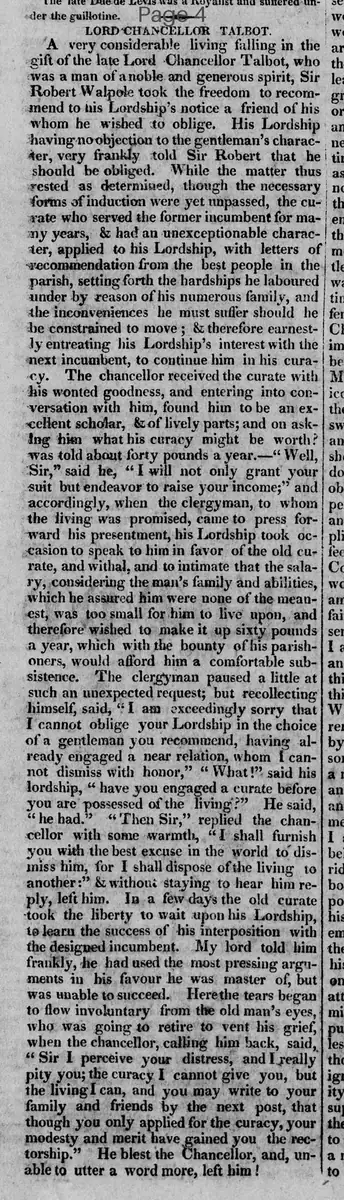
A very considerable living falling in the gift of the late Lord Chancellor Talbot, who was a man of a noble and generous spirit, Sir Robert Walpole took the freedom to recommend to his Lordship's notice a friend of his whom he wished to oblige. His Lordship having no objection to the gentleman's character, very frankly told Sir Robert that he should be obliged. While the matter thus rested as determined, though the necessary forms of induction were yet unpassed, the curate who served the former incumbent for many years, & had an unexceptionable character, applied to his Lordship, with letters of recommendation from the best people in the parish, setting forth the hardships he laboured under by reason of his numerous family, and the inconveniences he must suffer should he be constrained to move; & therefore earnestly entreating his Lordship's interest with the next incumbent, to continue him in his curacy. The chancellor received the curate with his wonted goodness, and entering into conversation with him, found him to be an excellent scholar, & of lively parts; and on asking him what his curacy might be worth? was told about forty pounds a year.- "Well, Sir," said he, "I will not only grant your suit but endeavor to raise your income;" and accordingly, when the clergyman, to whom the living was promised, came to press forward his presentment, his Lordship took occasion to speak to him in favor of the old curate, and withal, to intimate that the salary, considering the man's family and abilities, which he assured him were none of the meanest, was too small for him to live upon, and therefore wished to make it up sixty pounds a year, which with the bounty of his parishioners, would afford him a comfortable subsistence. The clergyman paused a little at such an unexpected request; but recollecting himself, said, "I am exceedingly sorry that I cannot oblige your Lordship in the choice of a gentleman you recommend, having already engaged a near relation, whom I cannot dismiss with honor," "What!" said his lordship, "have you engaged a curate before you are possessed of the living?" He said, "he had." "Then Sir," replied the chancellor with some warmth, "I shall furnish you with the best excuse in the world to dismiss him, for I shall dispose of the living to another:" & without staying to hear him reply, left him. In a few days the old curate took the liberty to wait upon his Lordship to learn the success of his interposition with the designed incumbent. My lord told him frankly, he had used the most pressing arguments in his favour he was master of, but was unable to succeed. Here the tears began to flow involuntary from the old man's eyes, who was going to retire to vent his grief, when the chancellor, calling him back, said, "Sir I perceive your distress, and I really pity you; the curacy I cannot give you, but the living I can, and you may write to your family and friends by the next post, that though you only applied for the curacy, your modesty and merit have gained you the rectorship." He blest the Chancellor, and, unable to utter a word more, left him!
A very considerable living falling in the gift of the late Lord Chancellor Talbot, who was a man of a noble and generous spirit, Sir Robert Walpole took the freedom to recommend to his Lordship's notice a friend of his whom he wished to oblige. His Lordship having no objection to the gentleman's character, very frankly told Sir Robert that he should be obliged. While the matter thus rested as determined, though the necessary forms of induction were yet unpassed, the curate who served the former incumbent for many years, & had an unexceptionable character, applied to his Lordship, with letters of recommendation from the best people in the parish, setting forth the hardships he laboured under by reason of his numerous family, and the inconveniences he must suffer should he be constrained to move; & therefore earnestly entreating his Lordship's interest with the next incumbent, to continue him in his curacy. The chancellor received the curate with his wonted goodness, and entering into conversation with him, found him to be an excellent scholar, & of lively parts; and on asking him what his curacy might be worth? was told about forty pounds a year.- "Well, Sir," said he, "I will not only grant your suit but endeavor to raise your income;" and accordingly, when the clergyman, to whom the living was promised, came to press forward his presentment, his Lordship took occasion to speak to him in favor of the old curate, and withal, to intimate that the salary, considering the man's family and abilities, which he assured him were none of the meanest, was too small for him to live upon, and therefore wished to make it up sixty pounds a year, which with the bounty of his parishioners, would afford him a comfortable subsistence. The clergyman paused a little at such an unexpected request; but recollecting himself, said, "I am exceedingly sorry that I cannot oblige your Lordship in the choice of a gentleman you recommend, having already engaged a near relation, whom I cannot dismiss with honor," "What!" said his lordship, "have you engaged a curate before you are possessed of the living?" He said, "he had." "Then Sir," replied the chancellor with some warmth, "I shall furnish you with the best excuse in the world to dismiss him, for I shall dispose of the living to another:" & without staying to hear him reply, left him. In a few days the old curate took the liberty to wait upon his Lordship to learn the success of his interposition with the designed incumbent. My lord told him frankly, he had used the most pressing arguments in his favour he was master of, but was unable to succeed. Here the tears began to flow involuntary from the old man's eyes, who was going to retire to vent his grief, when the chancellor, calling him back, said, "Sir I perceive your distress, and I really pity you; the curacy I cannot give you, but the living I can, and you may write to your family and friends by the next post, that though you only applied for the curacy, your modesty and merit have gained you the rectorship." He blest the Chancellor, and, unable to utter a word more, left him!
What sub-type of article is it?
Prose Fiction
What themes does it cover?
Moral Virtue
What keywords are associated?
Lord Talbot
Chancellor
Curate
Generosity
Church Living
Walpole
Literary Details
Title
Lord Chancellor Talbot
Key Lines
"Sir I Perceive Your Distress, And I Really Pity You; The Curacy I Cannot Give You, But The Living I Can, And You May Write To Your Family And Friends By The Next Post, That Though You Only Applied For The Curacy, Your Modesty And Merit Have Gained You The Rectorship."
He Blest The Chancellor, And, Unable To Utter A Word More, Left Him!