Thank you for visiting SNEWPapers!
Sign up free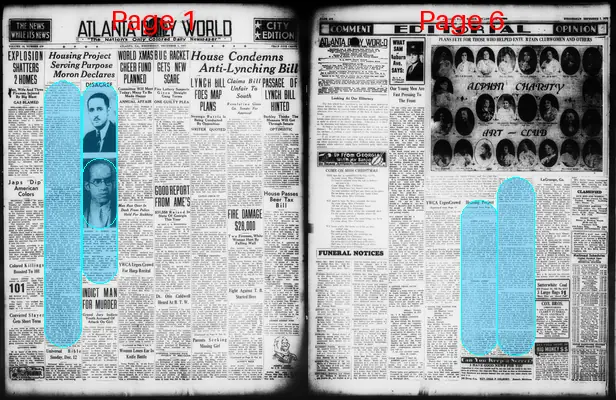
Atlanta Daily World
Atlanta, Fulton County, Georgia
What is this article about?
Alonzo G. Moron defends the Federal Housing Project, arguing it benefits low-income Negro families by providing decent housing and jobs, countering Prof. Forrester B. Washington's claims that it worsens their economic plight and fails to aid the lowest earners.
Merged-components note: Merged images and caption spatially adjacent and topically related to the housing debate editorial, along with its continuation on page 6; changed label of continuation from domestic_news to editorial as it is part of the opinion piece.
Clippings
1 of 2
OCR Quality
Full Text
"That anyone should hold up to ridicule the initiation of a program which in its earliest stage, has provided throughout the country decent, safe, and sanitary housing for over 7,000 Negro low-income families, who, in most cases, could not afford such housing accommodations at any price, makes us pause to wonder if those of us who are really interested in improving the lot of our fellow man should not wait until the millennium when by some kind of alchemy or transfiguration all things bad will be changed immediately into a condition which satisfies even the most carping critic.
Mr. Forrester B. Washington was asked by the Forum Committee of Morehouse College to discuss whether or not the United States Housing Program has benefited the Negro. In his discussion of this question which achieved unfortunate headlines in this paper yesterday, Mr. Washington based his answers on several fallacies that should be current among the man in the street but certainly should not be expounded as facts by a man who has given years of his life to working among the underprivileged and who has achieved national prominence in his ability to contribute to the solution of some of their problems.
DISCUSSES LOW PAY
"The first fallacy expounded as fact by Mr. Washington was that the beginnings of a Federal Housing Program did not benefit low-income Negroes. To support his contention he argues that all of the projects occupied to date are peopled for the most part, by preachers, teachers, doctors, lawyers and minor executives in insurance. Certainly the speaker should know that even if his contention were true enough to be representative of the tenantry of the few projects that are occupied, the members of the professions mentioned are not by any means in the high income group. Certainly he must know that one of the bitterest battles the local chapter of the National Association for the Advancement of Colored People advertises itself as being ready to fight is the granting of increases in teachers' salaries that will give them a living wage.
"Perhaps he doesn't know that under the terms of the George Healey Bill which enables the Government to operate these projects tenancy is limited to those families whose incomes do not exceed five times the rent which they have to pay in University Homes or in any other Federal housing project. In ascertaining these incomes every effort is made to check the income at the source rather than rely solely on the word of the applicants.
AVERAGE INCOME $11
"A study made of the incomes of families now living in University Homes shows that the average income of all wage earners living in this project is $11 per week. This average represents a range from $6 a week to $34 a week. That the average is close to the minimum answers the question as to whether or not University Homes is tenanted by people of other than low-income groups.
"The second fallacy upon which Mr. Washington asserted his contention is that slum dwellers are people of low incomes. Following Mr. Washington's example of brushing aside lightly a definition of a slum, let us look at a study made in 1934 by Dr. W. E. B. DuBois of Atlanta University of the families who lived at that time in the area now occupied by University Homes. This study showed that the families who had any incomes at all, had incomes ranging from less than $2 per week to as high as $50 per week. The average income for all families reporting incomes was $10.04 per week. Were these the lowest income groups in the City of Atlanta who had an average income of $10.04 a week in our worst depression year? Perhaps this is an exceptional case, but select any slum
(Continued on Page 6: Col. 5)
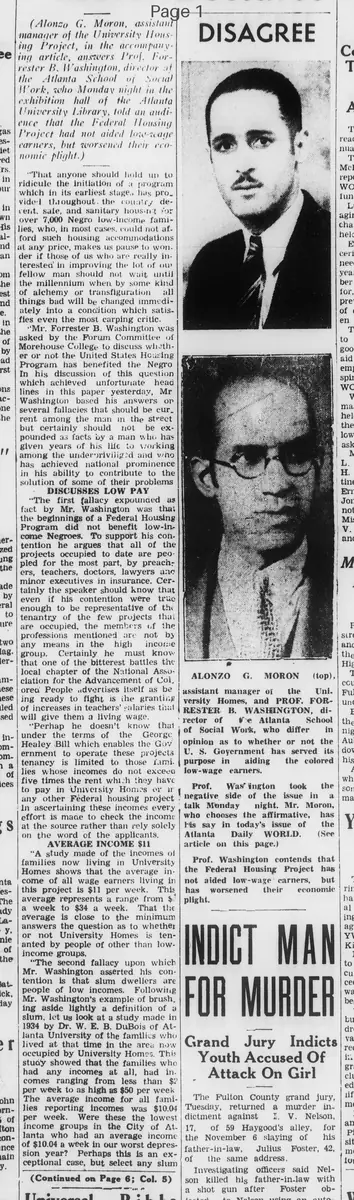
DISAGREE
ALONZO
G.
MORON
(top),
assistant manager of the
University Homes. and PROF.
FORRESTER B. WASHINGTON. director of the Atlanta School of Social Work, who differ in opinion as to whether or not the U. S. Government has served its purpose in aiding the colored low-wage earners.
Prof. Washington took the negative side of the issue in a talk Monday night. Mr. Moron, who chooses the affirmative, has his say in today's issue of the Atlanta Daily WORLD.
(See article on this page.)
Prof. Washington contends that the Federal Housing Project has not aided low-wage earners, but has worsened their economic plight.
Housing Project (Continued from Page 1)
area of equal size and see for yourself if all the people residing in this area are on the same social or economic level.
THIRD FALLACY
The third fallacy mentioned by Mr. Washington, and the one on which he based most of his contention, was that housing has not helped the Negro and that the erection of 7,000 additional new homes for Negroes has increased rents. In other words he would have us believe that in housing alone, an increase in the supply increases the price. Any watermelon eater knows that he has to pay much less for watermelons when the crop is plentiful. The sad thing about using this fallacy in public is that it adds further confusion to a subject which, when stripped to its elementals, is sufficiently complicated. In declaring that these projects per se have increased rents Mr. Washington forgets that there has been a general upturn in business during the last three years, that not only rents have gone up but that corn flakes and pork chops also cost more. We do not pay more for pork chops because more pigs have been raised.
"ERRORS CITED"
"In addition to these fallacies there were certain errors of fact which, for the information of the readers of this paper, should be corrected. Mr. Washington recommended that the Government Housing Program would be more successful in reaching the lowest income group if the profit motive were eliminated. The implication is that the Government is making money out of these housing projects. It is a matter of public record that housing built by the Public Works Administration received a grant of forty-five per cent of the cost, an outright gift by the Government to foster low-rent housing. The rents, therefore, contrary to the usual practice, are based on fifty-five per cent of the cost of the projects and not on one hundred per cent of the cost.
"Another error of fact was that the projects built by the Public Works Administration were built from an appropriation of $139,000,000 and not $434,000,000. With this $139,000,000 high standard housing in fifty-one projects will be provided for 21,439 families of whom over 7,000 or more than one-third will be Negro families.
"The question posed should not have been answered by Mr. Washington, it should not be answered by the writer. It should be answered by the 650 families in this city who are actually living in the project. It could also be answered by the hundreds of skilled and unskilled Negro workers who helped to build these projects at a time when private industry could not give them employment enough to take care of their families. It could also be answered by the holders of about two hundred white collar jobs and by five or six hundred skilled and unskilled jobs that these projects will create for Negroes at a time when new fields of employment are needed to absorb our college graduates, our mechanics, and our unemployed laborers. Perhaps the best answer to this question, however, could be given by the children who at long last, have places in which to play without fear of accidents and under capable supervision, who have warm comfortable houses in which to sleep and study and prepare themselves physically and mentally to take their places in a world which continues to demand more and more of those who would survive.
"It is important that this question be answered affirmatively at this time for with the completion of this first stage of a housing program the country will go into a permanent program in which the local communities will be the agencies responsible for providing new housing. Whether or not other projects like University Homes will be built for Negroes under the new program will depend, to a large measure, upon the participation by Negroes in building up much needed local sentiment for better housing for low-income groups. In order to be able to do this, Negroes must have correct information on what has been done in the past and a vision of what can be done in the future.
Negroes have benefited from the first stage of the housing program out of all proportion to their size in the population as a whole, to the amount they have contributed and certainly to the interest which they have taken in the present program or future plans for housing for low-income groups. It is only in relation to the need all Negroes have for better housing that we can criticize what has been done, and there our criticism must be tempered by the fact that the tax-paying public has not been educated to the need of Government subsidy for housing of any group, black or white, regardless of income or lack of it.
"In England and other European countries, housing did not get very far until the people themselves who needed better housing took an active part in securing necessary legislation and kept on the job to see that the laws were properly administered. To them housing was the principal issue. They were successful because they did not confuse it with other socio-psychological or economic problems."
What sub-type of article is it?
What keywords are associated?
What entities or persons were involved?
Editorial Details
Primary Topic
Defense Of Federal Housing Program's Benefits For Low Income Negroes
Stance / Tone
Strongly Supportive Of Housing Program, Critical Of Washington's Fallacies
Key Figures
Key Arguments