Thank you for visiting SNEWPapers!
Sign up free
The National Intelligencer And Washington Advertiser
Washington, District Of Columbia
What is this article about?
In a U.S. Senate speech on April 9, 1807, Mr. Giles defends John Smith against treason charges linked to Aaron Burr's conspiracy. He argues Smith's expressions and actions show no criminal intent, analyzing conversations, letters, and testimonies from Peter Taylor and others in Cincinnati and Kentucky.
Merged-components note: Continuation of Mr. Giles's speech in the Senate on the case of John Smith, spanning across pages 1 and 2.
Clippings
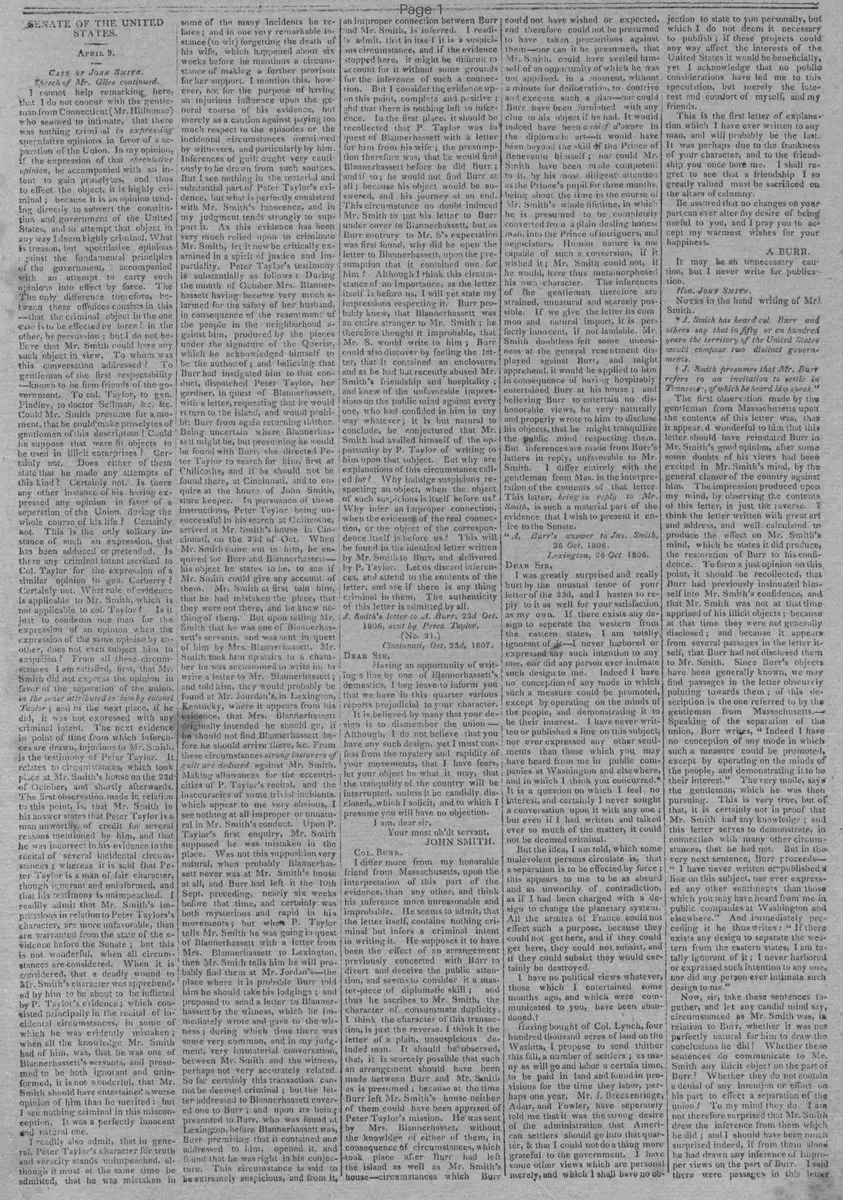
1 of 2
OCR Quality
Full Text
APRIL 9.
CASE OF JOHN SMITH.
Speech of Mr. Giles continued.
I cannot help remarking here, that I do not concur with the gentleman from Connecticut (Mr. Hillhouse) who seemed to intimate, that there was nothing criminal in expressing speculative opinions in favor of a separation of the Union. In my opinion, if the expression of that speculative opinion, be accompanied with an intent to gain proselytes, and thus to effect the object, it is highly criminal; because it is an opinion tending directly to subvert the constitution and government of the United States, and to attempt that object in any way I deem highly criminal. What is treason, but speculative opinions against the fundamental principles of the government, accompanied with an attempt to carry such opinions into effect by force. The only difference therefore, between these offences consists in this --that the criminal object in the one case is to be effected by force? in the other, by persuasion; but I do not believe that Mr. Smith could have any such object in view. To whom was this conversation addressed? To gentleman of the first respectability -known to be firm friends of the government. To col. Taylor, to gen. Findley, to doctor Sellman, &c. &c. Could Mr. Smith presume for a moment, that he could make proselytes of gentlemen of this description? Could he suppose that were fit objects to be used in illicit enterprises? Certainly not. Does either of them state that he made any attempts of this kind? Certainly not. Is there any other instance of his having expressed any opinion in favor of a separation of the Union, during the whole course of his life? Certainly not. This is the only solitary instance of such an expression, that has been adduced or pretended. Is there any criminal intent ascribed to Col. Taylor for the expression of a similar opinion to gen. Carberry? Certainly not. What rule of evidence is applicable to Mr. Smith, which is not applicable to col. Taylor? Is it just to condemn one man for the expression of an opinion when the expression of the same opinion by another, does not even subject him to suspicion? From all these circumstances I am satisfied, first, that Mr. Smith did not express the opinion in favor of the separation of the union, in the sense attributed to him by colonel Taylor; and in the next place, if he did, it was not expressed with any criminal intent. The next evidence in point of time from which inferences are drawn, injurious to Mr. Smith, is the testimony of Peter Taylor. It relates to circumstances, which took place at Mr. Smith's house on the 23d of October, and shortly afterwards. The first observation made in relation to this point, is, that Mr. Smith in his answer states that Peter Taylor is a man unworthy of credit for several reasons mentioned by him, and that he was incorrect in his evidence in the recital of several incidental circumstances; whereas it is said that Peter Taylor is a man of fair character, though ignorant and uninformed, and that his testimony is unimpeached. I readily admit that Mr. Smith's impressions in relation to Peter Taylor's character, are more unfavorable, than are warranted from the state of the evidence before the Senate: but this is not wonderful, when all circumstances are considered. When it is considered, that a deadly wound to Mr. Smith's character was apprehended by him to be about to be inflicted by P. Taylor's evidence; which consisted principally in the recital of incidental circumstances, in some of which he was evidently mistaken; when all the knowledge Mr. Smith had of him, was, that he was one of Blannerhassett's servants, and presumed to be both ignorant and uninformed, it is not wonderful, that Mr. Smith should have entertained a worse opinion of him than he merited: but I see nothing criminal in this misconception. It was a perfectly innocent and natural one. I readily also admit, that in general, Peter Taylor's character for truth and veracity stands unimpeached, although it must at the same time be admitted, that he was mistaken in some of the many incidents he relates; and in one very remarkable instance (to wit) forgetting the death of his wife, which happened about six weeks before he mentions a circumstance of making a further provision for her support. I mention this, however, not for the purpose of having an injurious influence upon the general course of his evidence, but merely as a caution against paying too much respect to the episodes or the incidental circumstances mentioned by witnesses, and particularly by him. Inferences of guilt ought very cautiously to be drawn from such sources. But I see nothing in the material and substantial part of Peter Taylor's evidence, but what is perfectly consistent with Mr. Smith's innocence, and in my judgment tends strongly to support it. As this evidence has been very much relied upon to criminate Mr. Smith, let it now be critically examined in a spirit of justice and impartiality. Peter Taylor's testimony is substantially as follows: During the month of October Mrs. Blannerhassett having become very much alarmed for the safety of her husband, in consequence of the resentment of the people in the neighborhood against him, produced by the pieces under the signature of the Querist, which he acknowledged himself to be the author of: and believing that Burr had instigated him to that conduct, dispatched Peter Taylor, her gardener, in quest of Blannerhassett, with a letter, requesting that he would return to the island, and would prohibit Burr from again returning thither. Being uncertain where Blannerhassett might be, but presuming he would be found with Burr, she directed Peter Taylor to search for him, first at Chilicothe, and if he should not be found there, at Cincinnati, and to enquire at the house of John Smith, store keeper. In pursuance of these instructions, Peter Taylor being unsuccessful in his search at Chilicothe, arrived at Mr. Smith's house in Cincinnati, on the 23d of Oct. When Mr. Smith came out to him, he enquired for Burr and Blannerhassett- his object he states to be, to see if Mr. Smith could give any account of them. Mr. Smith at first told him, that he had mistaken the place, that they were not there, and he knew nothing of them. But upon telling Mr. Smith that he was one of Blannerhassett's servants, and was sent in quest of him by Mrs. Blannerhassett, Mr. Smith took him up stairs to a chamber he was accustomed to write in, to write a letter to Mr. Blannerhassett: and told him, they would probably be found at Mr. Jourdan's, in Lexington, Kentucky, where it appears from his evidence, that Mrs. Blannerhassett originally intended he should go, if he should not find Blannerhassett before he should arrive there, &c. From these circumstances strong instances of guilt are deduced against Mr. Smith. Making allowances for the eccentricities of P. Taylor's recital, and the inaccuracies of some trivial incidents, which appear to me very obvious, I see nothing at all improper or unnatural in Mr. Smith's conduct. Upon P. Taylor's first enquiry, Mr. Smith supposed he was mistaken in the place. Was not this supposition very natural, when probably Blannerhassett never was at Mr. Smith's house at all, and Burr had left it the 10th Sept. preceding, nearly six weeks before that time, and certainly was both mysterious and rapid in his movements: but when P. Taylor tells Mr. Smith he was going in quest of Blannerhassett with a letter from Mrs. Blannerhassett to Lexington, then Mr. Smith tells him he will probably find them at Mr. Jordan's-the place where it is probable Burr told him he should take his lodgings; and proposed to send a letter to Blannerhassett by the witness, which he immediately wrote and gave to the witness; during which time there was some very common, and in my judgment, very immaterial conversation, between Mr. Smith and the witness, perhaps not very accurately related. So far certainly this transaction cannot be deemed criminal: but the letter addressed to Blannerhassett covered one to Burr; and upon its being presented to Burr, who was found at Lexington, before Blannerhassett was, Burr premising that it contained one addressed to him, opened it, and found that he was right in his conjecture. This circumstance is said to be extremely suspicious, and from it, an improper connection between Burr and Mr. Smith, is inferred. I readily admit, that in itself it is suspicious circumstance, and if the evidence stopped here, it might be difficult to account for it without some grounds for the inference of such a connection. But I consider the evidence upon this point, complete and positive; and that there is nothing left to inference. In the first place, it should be recollected that P. Taylor was in quest of Blannerhassett with a letter for him from his wife: the presumption therefore was, that he would find Blannerhassett before he did Burr; and if so; he would not find Burr at all; because his object would be answered, and his journey at an end. This circumstance no doubt induced Mr. Smith to put his letter to Burr under cover to Blannerhassett, but as Burr contrary to Mr. S's expectation was first found, why did he open the letter to Blannerhassett upon the presumption that it contained one for him? Although I think this circumstance of no importance, as the letter itself is before us, I will yet state my impressions respecting it. Burr probably knew, that Blannerhassett was an entire stranger to Mr. Smith: he therefore thought it improbable, that Mr. S. would write to him: Burr could also discover by feeling the letter, that it contained an enclosure, and as he had but recently abused Mr. Smith's friendship and hospitality; and knew of the unfavorable impressions on the public mind against every one, who had confided in him in any way whatever; it is but natural to conclude, he conjectured that Mr. Smith had availed himself of the opportunity by P. Taylor of writing to him upon that subject. But why are explanations of this circumstance called for? Why indulge suspicions respecting an object, when the object of such suspicions is itself before us? Why infer an improper connection, when the evidence of the real connection, or the object of the correspondence itself is before us? This will be found in the identical letter written by Mr. Smith to Burr, and delivered by P. Taylor. Let us discard inferences, and attend to the contents of the letter, and see if there is any thing criminal in them. The authenticity of this letter is admitted by all.
J. Smith's letter to A. Burr, 23d Oct. 1806, sent by Peter Taylor.
(No. 21.)
Cincinnati, Oct. 23d, 1807.
DEAR SIR,
Having an opportunity of writing a line by one of Blannerhassett's domestics, I beg leave to inform you that we have in this quarter various reports prejudicial to your character. It is believed by many that your design is to dismember the union - Although, I do not believe that you have any such design, yet I must confess from the mystery and rapidity of your movements, that I have fears, let your object be what it may, that the tranquility of the country will be interrupted, unless it be candidly disclosed, which I solicit, and to which I presume you will have no objection.
I am, dear sir,
Your most ob'dt servant,
JOHN SMITH.
COL. BURR.
I differ more from my honorable friend from Massachusetts, upon the interpretation of this part of the evidence, than any other, and think his inference more unreasonable and improbable. He seems to admit, that the letter itself, contains nothing criminal but infers a criminal intent in writing it. He supposes it to have been the effect of an arrangement previously concerted with Burr to divert and deceive the public attention, and seems to consider it a master-piece of diplomatic skill; and thus he ascribes to Mr. Smith, the character of consummate duplicity. I think the character of this transaction, is just the reverse. I think it the letter of a plain, unsuspicious deluded man. It should be observed, that, it is scarcely possible that such an arrangement should have been made between Burr and Mr. Smith as is presumed; because at the time Burr left Mr. Smith's house neither of them could have been apprised of Peter Taylor's mission. He was sent by Mrs. Blannerhassett, without the knowledge of either of them, in consequence of circumstances, which took place after Burr had left the island as well as Mr. Smith's house-circumstances which Burr could not have wished or expected, and therefore could not be presumed to have taken precautions against thein-nor can it be presumed, that Mr. Smith, could have availed himself of an opportunity of which he was not apprised, in a moment, without a minute for deliberation, to contrive and execute such a plan-nor could Burr have been furnished with any clue to his object if he had. It would indeed have been a chef d'oeuvre in the diplomatic art it would have been beyond the skill of the Prince of Benevento himself; nor could Mr. Smith have been made competent to it, by his most diligent attention as the Prince's pupil for three months, being about the time in the course of Mr. Smith's whole lifetime, in which he is presumed to be completely converted from a plain dealing honest man, into the Prince of intriguers, and negociators. Human nature is not capable of such a conversion, if it wished it: Mr. Smith could not, if he would, have thus metamorphosed his own character. The inferences of the gentleman therefore are strained, unnatural and scarcely possible. If we give the letter its common and natural import, it is perfectly innocent, if not laudable. Mr. Smith doubtless felt some uneasiness at the general resentment displayed against Burr, and might apprehend, it would be applied to him in consequence of having hospitably entertained Burr at his house; and believing Burr to entertain no dishonorable views, he very naturally and properly wrote to him to disclose his objects, that he might tranquilize the public mind respecting them. But inferences are made from Burr's letters in reply, unfavorable to Mr. Smith. I differ entirely with the gentleman from Mass. in the interpretation of the contents of that letter. This letter, being in reply to Mr. Smith, is such a material part of the evidence that I wish to present it entire to the Senate.
A. Burr's answer to Jno. Smith 26 Oct. 1806.
Lexington, 26 Oct 1806.
DEAR SIR,
I was greatly surprised and really hurt by the unusual tenor of your letter of the 23d, and I hasten to reply to it as well for your satisfaction as my own. If there exists any design to separate the western from the eastern states, I am totally ignorant of it-I never harbored or expressed any such intention to any one, nor did any person ever intimate such design to me. Indeed I have no conception of any mode in which such a measure could be promoted, except by operating on the minds of the people, and demonstrating it to be their interest. I have never written or published a line on this subject, nor ever expressed any other sentiments than those which you may have heard from me in public companies at Washington and elsewhere, and in which I think you concurred.* It is a question on which I feel no interest, and certainly I never sought a conversation upon it with any one; but even if I had written and talked ever so much of the matter, it could not be deemed criminal. But the idea, I am told, which some malevolent persons circulate is, that a separation is to be effected by force; this appears to me to be as absurd and as unworthy of contradiction, as if I had been charged with a design to change the planetary system. All the armies of France could not effect such a purpose, because they could not get here, and if they could get here, they could not subsist, and if they could subsist they would certainly be destroyed. I have no political views whatever, those which I entertained some months ago, and which were communicated to you, have been abandoned.t Having bought of Col. Lynch, four hundred thousand acres of land on the Washita, I propose to send thither this fall, a number of settlers; as many as will go and labor a certain time, to be paid in land and found in provisions for the time they labor, perhaps one year. Mr. J. Breckenridge, Adair, and Fowler, have separately told me that it was the strong desire of the administration that American settlers should go into that quarter, & that I could not do a thing more grateful to the government. I have some other views which are personal merely, and which I shall have no objection to state to you personally, but which I do not deem it necessary to publish; if these projects could any way affect the interests of the United States it would be beneficially, yet I acknowledge that no public considerations have led me to this speculation, but merely the interest and comfort of myself, and my friends. This is the first letter of explanation which I have ever written to any man, and will probably be the last. It was perhaps due to the rankness of your character, and to the friendship you once bore me. I shall regret to see that a friendship I so greatly valued must be sacrificed on the altars of calumny. Be assured that no changes on your part can ever alter my desire of being useful to you, and I pray you to accept my warmest wishes for your happiness.
A. BURR.
It may be an unnecessary caution, but I never write for publication.
Hon. JOHN SMITH.
Notes in the hand writing of Mr. Smith.
* J. Smith has heard col. Burr and others say that in fifty or a hundred years the territory of the United States would compose two distinct governments.
J. Smith presumes that Mr. Burr refers to an invitation to settle in Tennessee, of which he heard him speak.
The first observation made by the gentleman from Massachusetts upon the contents of this letter was, that it appeared wonderful to him that this letter should have reinstated Burr in Mr. Smith's good opinion, after some doubts of his views had been excited in Mr. Smith's mind, by the general clamor of the country against him. The impression produced upon my mind, by observing the contents of this letter, is just the reverse. I think the letter written with great art and address, and well calculated to produce the effect on Mr. Smith's mind, which he states it did produce, the restoration of Burr to his confidence. To form a just opinion on this point, it should be recollected, that Burr had previously insinuated himself into Mr. Smith's confidence, and that Mr. Smith was not at that time apprised of his illicit objects; because at that time they were not generally disclosed; and because it appears from several passages in the letter itself, that Burr had not disclosed them to Mr. Smith. Since Burr's objects have been generally known, we may find passages in the letter obscurely pointing towards them; of this description is the one referred to by the gentleman from Massachusetts.-- Speaking of the separation of the union, Burr writes, "Indeed I have no conception of any mode in which such a measure could be promoted, except by operating on the minds of the people, and demonstrating it to be their interest." The very mode, says the gentleman, which he was then pursuing. This is very true, but of that, it is certainly not in proof that Mr. Smith had any knowledge; and this letter serves to demonstrate, in connection with many other circumstances, that he had not. But in the very next sentence, Burr proceeds-- "I have never written or published a line on this subject, nor ever expressed any other sentiments than those which you may have heard from me in public companies at Washington and elsewhere." And immediately preceding it he thus writes: "If there exists any design to separate the western from the eastern states, I am totally ignorant of it; I never harbored or expressed such intention to any one, nor did any person ever intimate such design to me." Now, sir, take these sentences together, and let any candid mind say, circumstanced as Mr. Smith was, in relation to Burr, whether it was not perfectly natural for him to draw the conclusions he did? Whether these sentences do communicate to Mr. Smith any illicit object on the part of Burr? Whether they do not contain a denial of any intention or effort on his part to effect a separation of the union? To my mind they do. I am not therefore surprised that Mr. Smith drew the inference from them which he did; and I should have been much surprised indeed, if from them alone he had drawn any inference of improper views on the part of Burr. I said there were passages in this letter
which furnished the strongest presumption, that Mr. Burr had not communicated his illicit objects to Mr. Smith. Let me now call the attention of the Senate to some of them. One has been already mentioned. After speaking of his intention to settle the Washita lands, Burr writes thus :
"I have some other views which are personal merely, and which I shall have no objection to state to you personally; but which I do not deem it necessary to publish; if these objects could any way affect the United States, it would be beneficially, &c. &c." If Burr had already communicated his views to Mr. Smith, why should he say in this letter, "I shall have no objection to state to you personally;" certainly if he had already stated them, this profession would not only have been unnecessary, but foolish. Burr again writes—"This is the first letter of explanation which I have ever written to any man, and will probably be the last. It was perhaps due to the frankness of your character, and to the friendship you once bore me. I shall regret to see that friendship I so greatly valued, must be sacrificed on the altars of calumny. Be assured that no changes on your part can ever alter my desire of being useful to you, and I pray you to accept my warmest wishes for your happiness." Here follows this postscript.—"It may be an unnecessary caution, but I never write or [for] publication." From the whole tenor of this letter the real connection between Mr. Smith and Burr, may be easily discerned; but it is particularly demonstrated by these last sentences. In them the real state of Burr's mind may be clearly seen. They discover a man, conscious of having abused the unguarded confidence and misplaced friendship of another, which he was about to lose by the public exposure of his views. They display despondency and regret at the circumstance, and attempt to make a miserable atonement by a renewal of professions. They demonstrate too, that there was no participation in the conspiracy. In further corroboration of these conclusions, it ought not to escape notice, that on Burr's next visit to Cincinnati, he took lodgings at a tavern, and avoided Mr. Smith's hospitality, which would doubtless have been still open to him; he having been more successful in regaining Mr. Smith's confidence by the artful letter written by him than he had expected. This I believe to be the plain, obvious and natural import of this letter. To suppose that it was the effect of a preconcerted arrangement between Burr and Mr. Smith, and intended to disguise the real connection between them, would be a strained, improbable, unnatural supposition, and therefore in my judgment, ought not to be relied upon in any case; but especially not upon a question of guilt or innocence. The postscript of the letter itself furnishes another strong presumption against this conclusion. The next circumstance in point of time from which inferences injurious to Mr. Smith are drawn, happened on the 2d or 3d of December, at Frankfort, in Kentucky. At this time and place, Burr was attending on the court upon his second trial. Mr. Smith was drawn thither by business, when a short interview took place between himself and Burr, very immaterial in its objects or consequences. The ground of crimination deduced from this circumstance is, that Mr. Smith did not voluntarily attend the court as a witness against Burr, and testify to the disclosures which Burr had made to him upon his last visit to Cincinnati. Mr. Smith stated at the time his willingness to attend, but believed he knew nothing relevant to the ground of charge against Burr.
The gentleman from Massachusetts differs from Mr. Smith in opinion on this point, and conceives that if Mr. Smith had attended that court, and disclosed what he has since disclosed in relation to Burr's last communications to him, it would have been sufficient for Burr's conviction. I differ entirely from the gentleman on this point. All that we know relative to Burr's disclosure of his views at that time, is furnished by Mr. Smith himself. What was disclosed, it would probably be best to take it from Mr. Smith's own words :
"The candor discovered in the above recited letter (of October 26, 1806,) inspired my confidence, and when he made his second visit to Cincinnati, in November last, he disclosed his plan fully to my view, as I thought, which added strength to my confidence. He being about to take his leave of me, observed—Mr. Smith, my object in a few months will be disclosed; you will not find it dishonorable or inimical to this government. I feel superior to the mean artifices which are ascribed to me; calumnies I do not notice, for as fast as you put one down, another will rise up. This much I will venture to tell you,
if there should be war between the United States and Spain, I shall head a corps of volunteers, and be the first to march into the Mexican provinces; if peace should be preserved, which I do not expect, I shall settle my Washita lands, and make society as pleasant about me as possible. In this government I have been persecuted, shamefully persecuted, and I am sorry to say, that in it all private confidence between man and man, seems to be nearly destroyed. He shewed me a deed for a large tract of land on Red river, and said if I would consent to let my sons go thither, he would provide well for them, to which I gave consent, though I never communicated it to my eldest son till last Saturday, the day on which he returned from Marietta, and not till he expressed a disinclination to co-operate with Col. Burr's object till he knew whether it was hostile to the government of the United States or not. Col. Burr told me further, that very many of his friends in different parts of the United States would remove and settle with him, and that he would be the best neighbour this country ever had, and repeated that his object was not hostile to the people of the United States, or dishonorable to himself, and further, that in a few months many of his enemies would be proud to call him their friend."
(Mr. Giles's speech to be continued.)
What sub-type of article is it?
What themes does it cover?
What keywords are associated?
What entities or persons were involved?
Where did it happen?
Story Details
Key Persons
Location
United States Senate, Cincinnati, Lexington, Kentucky
Event Date
April 9, 1807
Story Details
Mr. Giles defends John Smith in Senate against treason accusations tied to Burr's conspiracy, arguing no criminal intent in Smith's opinions on Union separation, interactions with Peter Taylor, and letters to Burr expressing concerns and receiving reassurances.