Thank you for visiting SNEWPapers!
Sign up free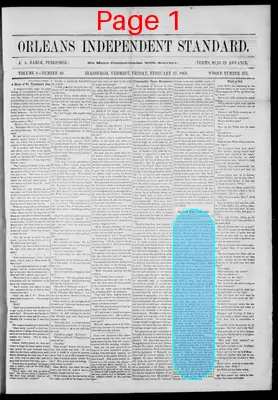
Editorial
February 27, 1863
Orleans Independent Standard
Irasburg, Barton, Orleans County, Vermont
What is this article about?
Extract from Beecher's sermon on liberty, portraying voluntary 'slavery' through love, especially a mother's selfless devotion to her child, as the highest form of service, contrasting it with compelled slavery.
Clipping
OCR Quality
95%
Excellent
Full Text
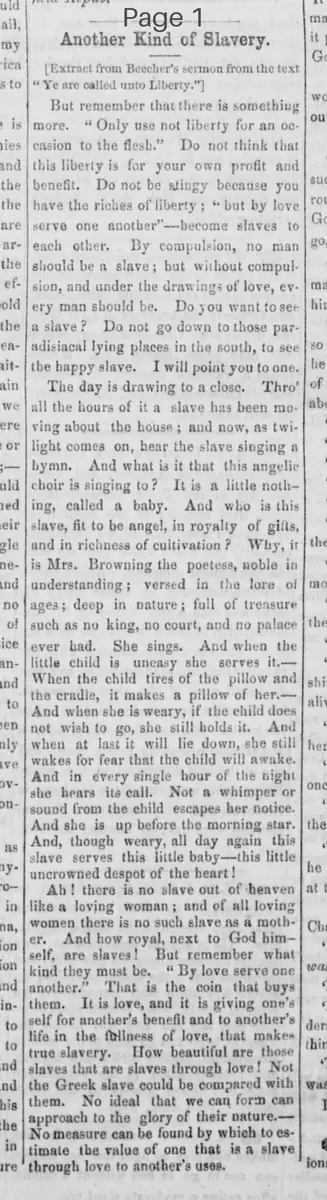
Another Kind of Slavery.
[Extract from Beecher's sermon from the text "Ye are called unto Liberty."]
But remember that there is something more. "Only use not liberty for an occasion to the flesh." Do not think that this liberty is for your own profit and benefit. Do not be stingy because you have the riches of liberty; "but by love serve one another"—become slaves to each other. By compulsion, no man should be a slave; but without compulsion, and under the drawings of love, every man should be. Do you want to see a slave? Do not go down to those paradisaical lying places in the south, to see the happy slave. I will point you to one. The day is drawing to a close. Thro' all the hours of it a slave has been moving about the house; and now, as twilight comes on, hear the slave singing a hymn. And what is it that this angelic choir is singing to? It is a little nothing, called a baby. And who is this slave, fit to be angel, in royalty of gifts, and in richness of cultivation? Why, it is Mrs. Browning the poetess, noble in understanding; versed in the lore of ages; deep in nature; full of treasure such as no king, no court, and no palace ever had. She sings. And when the little child is uneasy she serves it. When the child tires of the pillow and the cradle, it makes a pillow of her. And when she is weary, if the child does not wish to go, she still holds it. And when at last it will lie down, she still wakes for fear that the child will awake. And in every single hour of the night she hears its call. Not a whimper or sound from the child escapes her notice. And she is up before the morning star. And, though weary, all day again this slave serves this little baby—this little uncrowned despot of the heart!
Ah! there is no slave out of heaven like a loving woman; and of all loving women there is no such slave as a mother. And how royal, next to God himself, are slaves! But remember what kind they must be. "By love serve one another." That is the coin that buys them. It is love, and it is giving one's self for another's benefit and to another's life in the fullness of love, that makes true slavery. How beautiful are those slaves that are slaves through love! Not the Greek slave could be compared with them. No ideal that we can form can approach to the glory of their nature. No measure can be found by which to estimate the value of one that is a slave through love to another's uses.
[Extract from Beecher's sermon from the text "Ye are called unto Liberty."]
But remember that there is something more. "Only use not liberty for an occasion to the flesh." Do not think that this liberty is for your own profit and benefit. Do not be stingy because you have the riches of liberty; "but by love serve one another"—become slaves to each other. By compulsion, no man should be a slave; but without compulsion, and under the drawings of love, every man should be. Do you want to see a slave? Do not go down to those paradisaical lying places in the south, to see the happy slave. I will point you to one. The day is drawing to a close. Thro' all the hours of it a slave has been moving about the house; and now, as twilight comes on, hear the slave singing a hymn. And what is it that this angelic choir is singing to? It is a little nothing, called a baby. And who is this slave, fit to be angel, in royalty of gifts, and in richness of cultivation? Why, it is Mrs. Browning the poetess, noble in understanding; versed in the lore of ages; deep in nature; full of treasure such as no king, no court, and no palace ever had. She sings. And when the little child is uneasy she serves it. When the child tires of the pillow and the cradle, it makes a pillow of her. And when she is weary, if the child does not wish to go, she still holds it. And when at last it will lie down, she still wakes for fear that the child will awake. And in every single hour of the night she hears its call. Not a whimper or sound from the child escapes her notice. And she is up before the morning star. And, though weary, all day again this slave serves this little baby—this little uncrowned despot of the heart!
Ah! there is no slave out of heaven like a loving woman; and of all loving women there is no such slave as a mother. And how royal, next to God himself, are slaves! But remember what kind they must be. "By love serve one another." That is the coin that buys them. It is love, and it is giving one's self for another's benefit and to another's life in the fullness of love, that makes true slavery. How beautiful are those slaves that are slaves through love! Not the Greek slave could be compared with them. No ideal that we can form can approach to the glory of their nature. No measure can be found by which to estimate the value of one that is a slave through love to another's uses.
What sub-type of article is it?
Moral Or Religious
Slavery Abolition
What keywords are associated?
Liberty Through Love
Maternal Slavery
Voluntary Service
Beecher Sermon
Motherhood Devotion
What entities or persons were involved?
Beecher
Mrs. Browning
Mother
Editorial Details
Primary Topic
Voluntary Slavery Through Love And Motherhood
Stance / Tone
Exhortative Praise Of Selfless Maternal Service
Key Figures
Beecher
Mrs. Browning
Mother
Key Arguments
Liberty Should Not Be Used For Selfish Gain But For Serving Others Through Love
True Slavery Is Voluntary And Compelled By Love, Not Force
Mothers Exemplify The Highest Form Of Loving Servitude To Their Children
Such Slaves Are More Noble Than Any Compelled Or Ideal Forms