Thank you for visiting SNEWPapers!
Sign up free
Tabor City Tribune
Tabor City, Columbus County, North Carolina
What is this article about?
20-year-old Tabor City airman Charles Fipps died April 30 from a bullet wound during a 120 mph police chase in Horry County. Inquest attributes death to gunshot; officers Fowler and Gause held for investigation after roadblock evasion and shooting.
Merged-components note: Merging the main article on page 1 with its explicit continuation on page 6, including all sequential components detailing the inquest into the death of Charles James Fipps. Label changed from 'domestic_news' for page 6 parts to 'story' as it is a focused narrative article.
Clippings
1 of 2
OCR Quality
Full Text
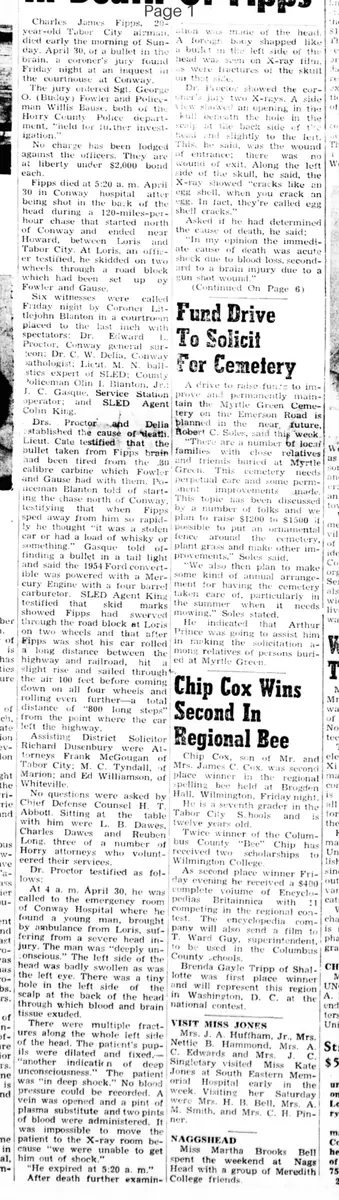
Charles James Fipps, 20-year-old Tabor City airman, died early the morning of Sunday, April 30, of a bullet in the brain, a coroner's jury found Friday night at an inquest in the courthouse at Conway.
The jury ordered Sgt. George O. (Buddy) Fowler and Policeman Willis Gause, both of the Horry County Police department, "held for further investigation."
No charge has been lodged against the officers. They are at liberty under $2,000 bond each.
Fipps died at 5:20 a.m. April 30 in Conway hospital after being shot in the back of the head during a 120-miles-per-hour chase that started north of Conway and ended near Howard, between Loris and Tabor City. At Loris, an officer testified, he skidded on two wheels through a road block which had been set up by Fowler and Gause.
Six witnesses were called Friday night by Coroner Littlejohn Blanton in a courtroom packed to the last inch with spectators: Dr. Edward I. Proctor, Conway general surgeon; Dr. C. W. Della, Conway pathologist; Lieut. M. N. Cate, ballistics expert of SLED; County Policeman Olin I. Blanton, Jr.; J. C. Gasque, Service Station operator; and SLED Agent Colin King.
Drs. Proctor and Della established the cause of death.
Lieut. Cate testified that the bullet taken from Fipps brain had been fired from the .30 calibre carbine which Fowler and Gause had with them. Policeman Blanton told of starting the chase north of Conway, testifying that when Fipps sped away from him so rapidly he thought "it was a stolen car or had a load of whisky or something." Gasque told of finding a bullet in a tail light and said the 1954 Ford convertible was powered with a Mercury Engine with a four barrel carburetor. SLED Agent King testified that skid marks showed Fipps had swerved through the road block at Loris on two wheels and that after Fipps was shot his car rolled a long distance between the highway and railroad, hit a slight rise and sailed through the air 100 feet before coming down on all four wheels and rolling even further—a total distance of "800 long steps" from the point where the car left the highway.
Assisting District Solicitor Richard Dusenbury were Attorneys Frank McGougan of Tabor City; M. C. Tyndall, of Marion; and Ed Williamson, of Whiteville.
No questions were asked by Chief Defense Counsel H. T. Abbott. Sitting at the table with him were L. B. Dawes, Charles Dawes and Reuben Long, three of a number of Horry attorneys who volunteered their services.
Dr. Proctor testified as follows:
At 4 a.m. April 30, he was called to the emergency room of Conway Hospital where he found a young man, brought by ambulance from Loris, suffering from a severe head injury. The man was "deeply unconscious." The left side of the head was badly swollen as was the left eye. There was a tiny hole in the left side of the scalp at the back of the head through which blood and brain tissue exuded.
There were multiple fractures along the whole left side of the head. The patient's pupils were dilated and fixed—"another indication of deep unconsciousness." The patient was "in deep shock." No blood pressure could be recorded. A vein was opened and a pint of plasma substitute and two pints of blood were administered. It was impossible to move the patient to the X-ray room because "we were unable to get him out of shock."
"He expired at 5:20 a.m."
After death further examination was made of the head. A foreign body shaped like a bullet in the left side of the head was seen on X-ray film, as were fractures of the skull on that side.
Dr. Proctor showed the coroner's jury two X-rays. A side view showed an opening in the skull beneath the hole in the scalp at the back side of the head and slightly to the left. This, he said, was the wound of entrance: there was no wound of exit. Along the left side of the skull, he said, the X-ray showed "cracks like an egg shell, when you crack an egg. In fact, they're called egg shell cracks."
Asked if he had determined the cause of death, he said: "In my opinion the immediate cause of death was acute shock due to blood loss, secondary to a brain injury due to a gun shot wound."
(Continued On Page 6)
(Continued From Page 1)
of violence except on the face,
Under questioning he said which showed one black eye, a
that the first time he knew
superficial scrape above the
there was a bullet wound was
left eye (not associated with
the bullet and an abrasion
when he saw the bullet on the
X-ray.
high on the left cheek.
He said there were no abra-
'The remainder of his testi-
sions or contusions to indicate
mony showed:
any
blow had caused death.
There was a single small
Dr. Della told of performing
hole in the left rear portion of
an autopsy on the body and
the scalp, devoid of powder
showed
the coroner's jury a
burns. There were many fract-
number of photos.
ures of the bones of the left
He said there were no marks inside of the skull from the very
back: and left side to the front.
The skin at the front of the
head was intact. He said the
bullet travelled from the back
of the head all the way to the
front and was later found at
about the midway point be-
cause it "fell back through the
tunnel, I think." He said he
didn't think that at first but
he did think so now but did
not indicate what has caused
him to change his thinking.
He identified the bullet he
said was received from the
head.
He said the fractures of the
head. except for that part o
the skull immediately in front
of the bullet. where caused not
directly by the bullet. but bv
the force of the "semi-fluid
brain" against the "rigid box"
of the skull when the bran
was pushed hard and suddenly
by the force of the bullet He
said these were "indirectly due
but not directly to the bullet."
He said that in his opinion
death was due to a gunshot
wound. with many multiple
fractures on the left side of
the skull, intravernal homor-
rhage and major contusions oi
the brain
Under questioning he added
that the "damage inflicted bv
the bullet to the head and
brain. were sufficient to ac-
count for death."
Lieut. Cate, who identified
himself as identification tech-
nician of the State Law En-
forcement Division's ballistics
department. told of receiving
from SLED Agent Colin King
on May 4 a bullet and a ".30
calibre M-1 carbine." he said
he fired a test bullet from the
carbine and that the same
weapon fired both that bullet
and the bullet turned over to
him by King.
Other testimony given by
him was to the effect that:
He had examined Fipps' car
and found several holes in the
back, some of which were
bullet holes but some of which
he could not say were bullet
holes.
One hole at the top left side
of the car was a bullet hole
and the bullet. after entering
the cloth top of the converti-
ble, had hit a zipper. covered
with black cloth. with white
canvas on either side of the
black cloth.
A photograph of the nose of
the bullet handed him by King
showed that it had hit some-
thing hard and that it bore a
black substance (not powder
burns) similar to the black
cloth between the two layers o
canvas on the zipper.
County Policeman
Olin I.
Blanton. Jr. was next on the
stand. His testimony tended to
show that:
He began pursuing a 1954
Ford convertible on Hwys. 410-
701 north of Conway about
3:30 a.m. April 30. after the
car sped away from him rapid-
ly as he approached it. Un-
able to catch the fleeing car.
he radioed County Police
Headquarters and learned that
Fowler and Gause were at the
Loris jail.
"I told the officer (at the
headquarters radio) to have
them stop this car as it was
coming through Loris, that
there was a chase underway."
The fleeing car "gained speed
on me all the time practically
When we got to Loris I saw
the boys had a road block . .
and could see that the car went
through the road block."
Gause and Fowler took off
behind the fleeing car. A mile
or so beyond Loris, Blanton's
police car "burned up."
Under questioning he testi-
fied further that:
For a few moments at the
start of the chase he was with-
in a few feet of the fleeing car.
He had not signalled the car
to pull over. it "just sped a-
way" He didn't have time to
turn on his siren but did turn
on his blinking red light as
the fleeing car sped away.
Twenty to 30 minutes after
his car burned up. Gause pick-
ed him up.
During most of the chase ov-
er 15 miles before reaching
Loris. Blanton raced along at
110 to 120 miles per hour
"most of the time doing close
to 120." At that speed he was
able to keep within a mile and
a half of the fleeing car.
When he was picked up. was
there any statement made a-
bout the fleeing car?
He had asked why the car
wrecked and was told it must
have blown a tire. He was also
told that the car in which
Fowler and Gause were pur-
suing the fleeing car. had also
had a flat tire.
What type of road block was
set up at Loris?
"All I could see was the red
light on the (police) car. As
we approached I saw he was
going through . . . I told the
boys. 'It hit him yet away.'"
Prior to the chase the Ford
convertible was doing about 70
north of Conway It changed
speed before Blanton could cut
on his flashing red light.
Why did he begin to chase
the car?
"I thought it was a stolen
car or had a load of whisky or
something."
He did not recognize the car
nor the driver at that time.
when he saw that he would
not be able to catch the fleeing
car, "I radioed the office and
asked them to locate Gause
and Fowler. I told my office to
have them give me assistance.
to set up a road block. and to
stop him at Loris."
J. C. Gasque. Tabor City ser-
vice station operator. said that
Fipps' car was stored at his
place from Sunday through
Friday. In examining the car.
he said. he found a hunk of
metal inside the tail light that
was built out over the tail
light." caught in the rim of
the old tail light inside."
He testified that Fipps' car
was a 1954 Ford. with a Mer-
cury engine.
The engine was not the en-
ggine originally in the car. he
said.
Asked if it was "a special
souped-up type motor." he re-
plied that it had a four-barrel
carburetor that is standard in
a Mercury engine.
SLED Agent Colin King told
of his investigation, of talking
with Fowler. Gause and Blan-
ton. of learning of the start of
the chase. of the "hot pursuit."
Two miles after it began, he
said he was told, Blanton's car
began to give trouble and Blan-
ton. "Realizing he was not go-
ing to be able to apprehend
him. radioed the boys at Loris
to help him."
"I asked Blanton his reason
for checking the car and he
said that after the car dashed
off at such a high rate of speed
he had reason to believe it was
either a hot automobile or load-
ed with liquor.
He said Fowler and Gause
told him that when they re-
ceived the message to help
Blanton they went a short dist-
ance out of Loris and set up a
road block. putting their police
car in the middle of the road
What sub-type of article is it?
What themes does it cover?
What keywords are associated?
What entities or persons were involved?
Where did it happen?
Story Details
Key Persons
Location
Conway, Horry County, Loris, Tabor City
Event Date
April 30
Story Details
20-year-old airman Charles James Fipps died from a gunshot wound to the head during a high-speed police chase initiated north of Conway. Officers Fowler and Gause set up a roadblock at Loris, which Fipps evaded. He was shot in the back of the head, causing his car to crash. Inquest finds cause of death as brain injury from gunshot; officers held for further investigation.