Thank you for visiting SNEWPapers!
Sign up free
Martinsburg Gazette And Public Advertiser
Martinsburg, Berkeley County, West Virginia
What is this article about?
A letter to the Martinsburg Gazette opposing Andrew Jackson's presidential candidacy, criticizing his supporters' hostility to protective tariffs, national improvements, and American manufacturing. It advocates for John Quincy Adams' re-election to foster peace, industry, and internal trade, warning of economic ruin under Jackson.
Clipping
OCR Quality
Full Text
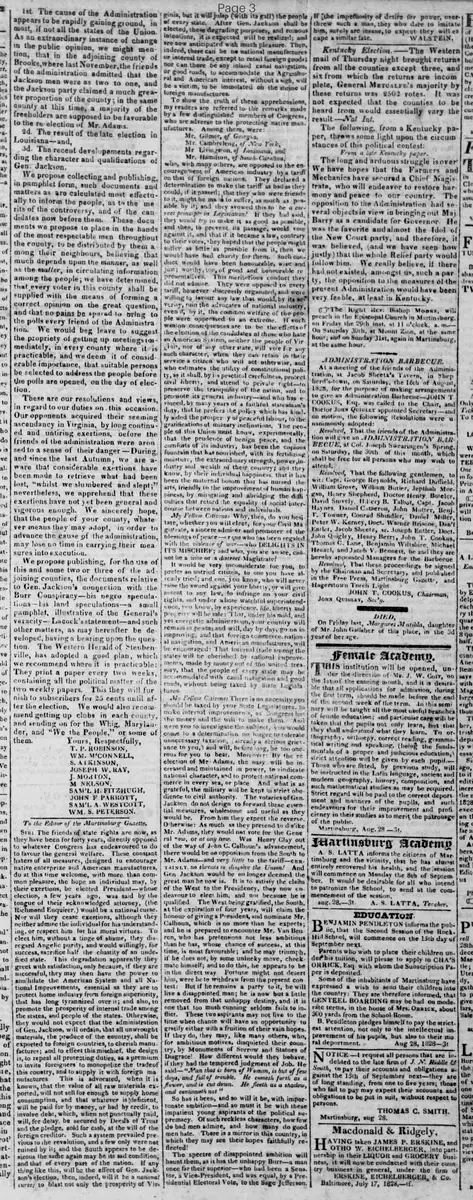
Sir: The friends of state rights are now, as they have been for forty years, directly opposed to whatever Congress has endeavoured to do to favour the general welfare. These constant haters of all measures, designed to encourage native enterprise and American manufactures do at this time welcome, with more than common pleasure, the hope an individual may, by their exertions, be elected President--whose election, a few years ago, was said by the tongue of their acknowledged attorney, (the Richmond Enquirer.) would be a national curse. Nor will they cease exertions, although they neither admire the individual for his understanding, or respect him for his moral virtues. To elect him, without a tinge of shame, they disregard angelic purity, and would willingly, for success, sacrifice half the chastity of an undefiled state. This degradation apparently they greet with satisfaction, only because, if they are successful, they may then have the power to annihilate the American System and all National Improvements, essential as they are to protect home industry from foreign superiority, that has long tyrannized over it; and also, to promote the prosperity of internal trade among the states, and people of the states. Otherwise, they would not expect that the administration of Gen. Jackson, will ordain, that all unwrought materials, the produce of the country, shall be exported to foreign Countries, to cherish manufactures; and to effect this mischief, the design is, to repeal all protecting duties, as a premium to invite foreigners to monopolize the trade of this country, and to supply it with foreign manufactures. This is advocated, when it is known, that the value of all raw materials exported, will not sell for enough to supply home consumption, and that whatever is deficient, will be paid for by money, or had by credit, to involve debt, which, when not punctually paid, will, for delay, be secured by Deeds of Trust and the pledge, sold for cash, at the will of the foreign creditor. Such a system prevailed previous to the revolution, and a few only were not ruined by it; and the South appears to be desirous the same again may be its sad condition, and that of every part of the nation. If any thing like this, will be the effect of Gen. Jackson's election, then, indeed, will it be a national curse; to blast not only the prosperity of Virginia, but it will imbue (with its gall) the people of every state. After Gen. Jackson shall be elected, these degrading purposes, and ruinous intentions, it is expected will be realized; and are now anticipated with much pleasure. Then, indeed, there can be no national manufactures or internal trade, except to retail foreign goods; nor can there be any inland canal navigation, or good roads, to accommodate the Agricultural and American interest, without a sigh, will be a victim, to be immolated on the shrine of foreign manufactures.
To show the truth of these apprehensions, my readers are referred to the remarks made by a few distinguished members of Congress, who are adverse to the protecting native manufactures. Among them, were:
Mr. Gilmer, of Georgia,
Mr. Cambreleng, of New York,
Mr. Livingston, of Louisiana, and
Mr. Hamilton, of South-Carolina,
who, with many others, are opposed to the encouragement of American industry by a tariff on that of foreign nations. They declared a determination to make the tariff as bad as they could, if it passed; that they who were friends to it, might be made to suffer, as much as possible, by it; and they avowed this to be a correct principle in Legislation! If they had sense, they would try to make it as good as possible, and then, to prevent its passage, would vote against it, and that if it became a law, contrary to their votes, they hoped that the people might suffer as little as possible from it, then we would have had charity for them. Such conduct would have been honourable, wise and just; worthy, too, of good and honourable representatives. This meritorious conduct they did not admire. They were opposed to every tariff, however discreetly organized, and were willing to favour any law that would, by its severity, ruin the advocates of national industry, even if, by it, the common welfare of the people were oppressed to an extreme. If such wanton consequences are to be the effects of the election of the candidates of those who hate an American System, neither the people of Virginia, nor of any other state, will vote for any such character, when they can retain in their service a citizen who will act otherwise, and who estimates the utility of constitutional policy, as it shall, by its practical carefulness, protect civil liberty, and attend to private right--to preserve the tranquility of the nation, and to promote its general industry--and who has evinced, by many years of a faithful statesman's duty, that he prefers the policy which has kindly aided the prosperity of peaceful labour, to the gratifications of military inclinations. The people of this Union must know, experimentally, that the prudence of benign peace, and the comforts of its industry, has been the copious fountain that has nourished, with its fertilizing moisture, the extraordinary strength, power, industry and wealth of their country; and they know, by their individual happiness, that it has been the maternal bosom that has nursed the arts, friendly to the improvement of human happiness, by mitigating and abridging the difficulties that retard the equality of social intercourse between nations and individuals.
My Fellow Citizens: Why, then, do you hesitate, whether you will elect, for your Civil Magistrate, a sincere admirer and promoter of the blessings of peace - one who has been regaled with the violence of war--who DELIGHTS IN ITS MISCHIEF; and who, you are aware, cannot be a wise or a discreet Magistrate?
It would be very inconsiderate for you, to prefer an untried citizen, to one you have already tried; and one, you know, who will never raise the sword against your liberty, or will give assent to any law, to infringe on your civil rights, and under whose watchful superintendence, you know, by experience, life, liberty and property will be safe: That, under his mild, and yet energetic administration, your country will remain in peace; and will, day by day, go on in improving: and that foreign commerce, national navigation, and American manufactures, will be encouraged: That internal trade among the states will be cherished by national improvements, made by money out of the united treasury, that the people of every state may be accommodated with canal navigation and good roads, without being taxed by State Legislatures.
My Fellow Citizens: There is no necessity you should be taxed by your State Legislatures, to make internal improvements, as Congress has the money and the will to make them. And were you to investigate the subject, you would come to a determination no longer to tolerate unnecessary taxation, (already a serious grievance to you,) and will, before long, be too onerous for you to bear. Moreover: By the re-election of Mr. Adams, the navy will be increased and maintained in power, to vindicate national character, and to protect national commerce in every sea, or place. And what is as grateful, the military will be kept in strict obedience to civil authority. The votaries of Gen. Jackson do not design to forward these essential measures, wholesome and useful as they would be. From him they expect the reverse. Otherwise: As much as they pretend to dislike Mr. Adams, they would not vote for the General now, or at any time. Was Henry Clay out of the way of John C. Calhoun's advancement, there would be no opposition from the South to Mr. Adams--and very little to the tariff--certainly, no threats to dissolve the Union! And Gen. Jackson would be no longer deemed the great man he now is. It is to satisfy the claim of the West to the Presidency, they now endeavour to elect him, and not because he is qualified. The West being gratified, the South, at the expiration of four years, will claim the honour of giving a President, and nominate Mr. Calhoun, which is no more than he expects; and he is prepared to encounter Mr. Van Buren, who has pretensions not less ambitious than he has, whose chance of success, at this time, is most favourable; and he may triumph, if he does not, by some unlucky move, checkmate himself; and to do this, he appears to be in the direct way. Fortune might not desert him, were he to withdraw from the present contest: But if he remains a party to it, he will live a disappointed man; he is now but a little removed from that unhappy destiny, and it is one that too much cunning seldom fails to inflict. These two aspirants may not live to the time when chance will have an opportunity to gratify either with a fruition of their vain hopes. If they do, they may, like many others, who, for ambitious motives, disquieted their country, by Monuments of Sorrow and Statues of Disgrace! How different would they behave, if they had the tempered judgment of Job. He said --"Man that is born of Woman, is but of few days, and full of trouble. He cometh forth as a flower, and is cut down. He fleeth as a shadow, and continueth not." So has it been, and so will it be, with importunate ambition--and so must it be with these impatient young aspirants of the political supremacy. Of such reckless characters, how few do bad men admire, and how many do good men hate. There is a mirror in this country, in which they may see their hopes faithfully reflected!
The spectre of disappointed ambition will haunt them, as it has the unhappy Burr--a man once far their superior--who had been a Senator, a Vice-President, and was equal, by a Presidential Electoral Vote, to the Sage Jefferson.
If (the impetuosity of desire for power, overthrew such a man, they who dare to imitate him, surely are insane, to expect they will escape a similar fate.
WALSTEIN.
What sub-type of article is it?
What themes does it cover?
What keywords are associated?
What entities or persons were involved?
Letter to Editor Details
Author
Walstein.
Recipient
To The Editor Of The Martinsburg Gazette.
Main Argument
the election of andrew jackson would lead to the repeal of protective tariffs, destruction of american manufacturing and internal improvements, resulting in economic ruin and foreign dominance; instead, re-elect john quincy adams to protect industry, promote peace, and ensure national prosperity.
Notable Details