Thank you for visiting SNEWPapers!
Sign up free
Editorial
July 31, 1843
Wheeling Times And Advertiser
Wheeling, Ohio County, West Virginia
What is this article about?
Editorial from Boston Atlas criticizes British economic dominance over the US, likening it to colonial vassalage. It attacks pro-British American papers like the Boston Post and Locofoco leaders for perpetuating dependence, urging development of domestic manufactures for true independence.
Clipping
OCR Quality
92%
Excellent
Full Text
From the Boston Atlas.
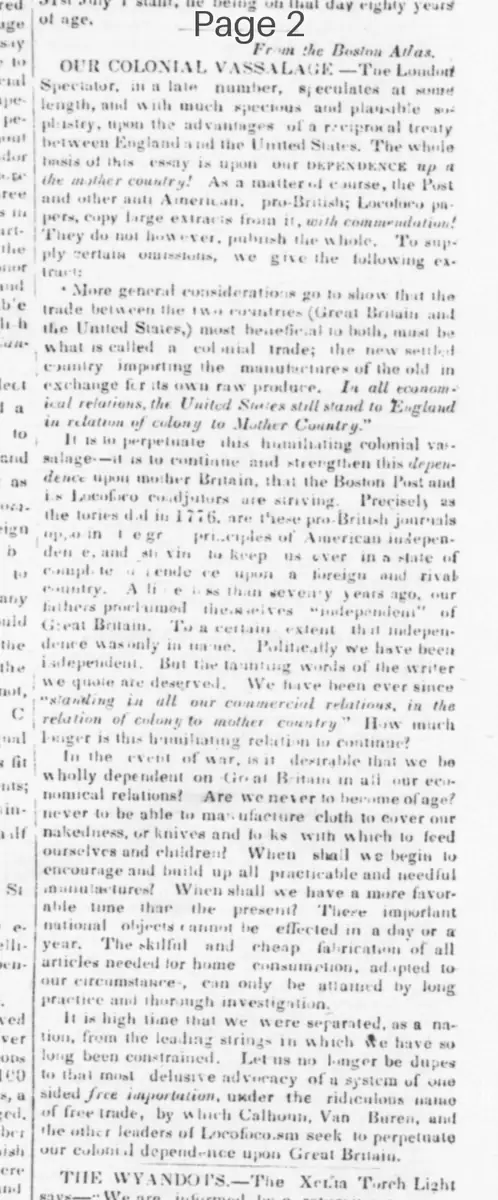
OUR COLONIAL VASSALAGE —The LONDON Spectator, in a late number, speculates at some length, and with much specious and plausible sophistry, upon the advantages of a reciprocal treaty between England and the United States. The whole basis of this essay is upon OUR DEPENDENCE upon the mother country! As a matter of course, the Post and other anti American, pro-British; Locofo co papers, copy large extracts from it, with commendation! They do not however, publish the whole. To supply certain omissions, we give the following extract:
"More general considerations go to show that the trade between the two countries (Great Britain and the United States,) most beneficial to both, must be what is called a colonial trade: the new settler country importing the manufactures of the old in exchange for its own raw produce. In all economical relations, the United States still stand to England in relation of colony to Mother Country."
It is to perpetuate this humiliating colonial vassalage—it is to continue and strengthen this dependence upon mother Britain, that the Boston Post and its Loco fico coadjutors are striving. Precisely as the tories did in 1776, are these pro British journals upon the old principles of American independence, and striving to keep us ever in a state of vassalage to an enemy and rival country. A little less than seventy years ago, our fathers proclaimed these senses "independence" of Great Britain. To a certain extent that independence was only in name. Politically we have been independent. But the taunting words of the writer we quote are deserved. We have been ever since "standing in all our commercial relations, in the relation of colony to mother country" How much longer is this humiliating relation to continue?
In the event of war, is it desirable that we be wholly dependent on Great Britain in all our commercial relations? Are we never to become of age? never to be able to manufacture cloth to cover our nakedness, or knives and forks with which to feed ourselves and children? When shall we begin to encourage and build up all practicable and needful manufactures When shall we have a more favorable time than the present? These important national objects cannot be effected in a day or a year. The skillful and cheap fabrication of all articles needed for home consumption, adapted to our circumstances, can only be attained by long practice and thorough investigation.
It is high time that we were separated, as a nation, from the leading strings in which we have so long been constrained. Let us no longer be dupes to that most delusive advocacy of a system of one sided free importation, under the ridiculous name of free trade, by which Calhoun, Van Buren, and the other leaders of Loco focoism seek to perpetuate our colonial dependence upon Great Britain.
OUR COLONIAL VASSALAGE —The LONDON Spectator, in a late number, speculates at some length, and with much specious and plausible sophistry, upon the advantages of a reciprocal treaty between England and the United States. The whole basis of this essay is upon OUR DEPENDENCE upon the mother country! As a matter of course, the Post and other anti American, pro-British; Locofo co papers, copy large extracts from it, with commendation! They do not however, publish the whole. To supply certain omissions, we give the following extract:
"More general considerations go to show that the trade between the two countries (Great Britain and the United States,) most beneficial to both, must be what is called a colonial trade: the new settler country importing the manufactures of the old in exchange for its own raw produce. In all economical relations, the United States still stand to England in relation of colony to Mother Country."
It is to perpetuate this humiliating colonial vassalage—it is to continue and strengthen this dependence upon mother Britain, that the Boston Post and its Loco fico coadjutors are striving. Precisely as the tories did in 1776, are these pro British journals upon the old principles of American independence, and striving to keep us ever in a state of vassalage to an enemy and rival country. A little less than seventy years ago, our fathers proclaimed these senses "independence" of Great Britain. To a certain extent that independence was only in name. Politically we have been independent. But the taunting words of the writer we quote are deserved. We have been ever since "standing in all our commercial relations, in the relation of colony to mother country" How much longer is this humiliating relation to continue?
In the event of war, is it desirable that we be wholly dependent on Great Britain in all our commercial relations? Are we never to become of age? never to be able to manufacture cloth to cover our nakedness, or knives and forks with which to feed ourselves and children? When shall we begin to encourage and build up all practicable and needful manufactures When shall we have a more favorable time than the present? These important national objects cannot be effected in a day or a year. The skillful and cheap fabrication of all articles needed for home consumption, adapted to our circumstances, can only be attained by long practice and thorough investigation.
It is high time that we were separated, as a nation, from the leading strings in which we have so long been constrained. Let us no longer be dupes to that most delusive advocacy of a system of one sided free importation, under the ridiculous name of free trade, by which Calhoun, Van Buren, and the other leaders of Loco focoism seek to perpetuate our colonial dependence upon Great Britain.
What sub-type of article is it?
Economic Policy
Foreign Affairs
Partisan Politics
What keywords are associated?
Colonial Vassalage
Economic Dependence
Domestic Manufactures
Free Trade Criticism
Locofoco Papers
British Influence
What entities or persons were involved?
London Spectator
Boston Post
Locofo Co Papers
Calhoun
Van Buren
Great Britain
Editorial Details
Primary Topic
Opposition To Economic Dependence On Great Britain
Stance / Tone
Strongly Anti Colonial Vassalage And Pro Domestic Manufacturing
Key Figures
London Spectator
Boston Post
Locofo Co Papers
Calhoun
Van Buren
Great Britain
Key Arguments
Us Remains Economically Dependent On Britain As A Colony
Pro British Papers Like Boston Post Perpetuate This Vassalage
True Independence Requires Developing Domestic Manufactures
Free Trade Advocacy By Locofocos Maintains Colonial Dependence
Political Independence Achieved In 1776, But Commercial Dependence Persists
Urgent Need To Separate From British Economic Leading Strings